Wildlife Removal in Port St. Lucie, FL
Scratching over the bedroom ceiling, droppings along the pool cage, a snake folded into the canal-side landscaping — in a city built this fast, wildlife moves into finished streets as quickly as people do. Tell us what you are hearing or seeing, and we will tell you plainly what animal it points to.
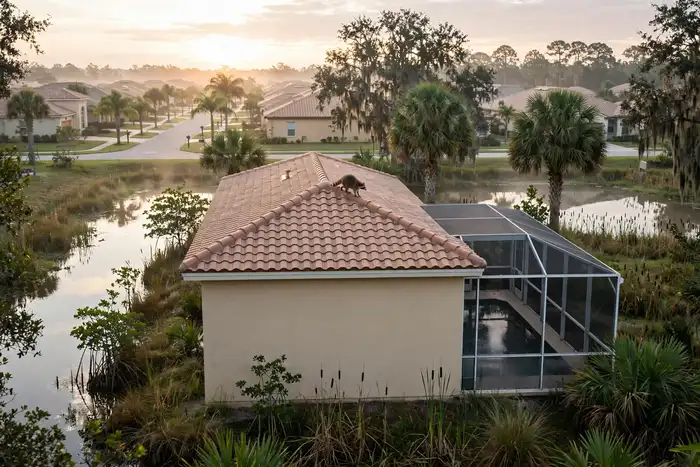
Why Port St. Lucie homes see the wildlife they do
Port St. Lucie holds roughly 268,000 people across about 120 square miles, and nearly all of it is single-family subdivisions. The west side stacks up the big master plans — St. Lucie West, Tradition, Riverland, Wylder and PGA Village — with their retention ponds, preserves and 55+ villages. East and south, in Torino and the older platted sections, thousands of scattered vacant lots sit between finished homes with no HOA at all, and builders are filling them street by street. Every cleared lot pushes its resident rats, raccoons and snakes into the houses already standing.
Threaded through all of it is water. A canal grid reaches into almost every neighborhood, the North Fork of the St. Lucie River bends along the east side, and the Savannas Preserve marsh presses against the city's eastern edge. Canals are highways for raccoons and water snakes, ponds in the new master plans draw Muscovy ducks and wading birds, and the flatwoods pockets left between subdivisions hold armadillos, opossums and — near the Savannas and the western natural areas — dusky pygmy rattlesnakes.
Our work here is licensed & insured, and removal is performed under FWC Rule 68A-9.010 with the property owner's authorisation. The method does not change from street to street: identify the animal correctly, get it out, close the building or the burrow so the next animal finds nothing open, and clean what was left behind. Port St. Lucie's split housing stock — maturing 1990s and 2000s homes in one direction, brand-new builds in the other — means the entries differ, but the discipline is the same.
A city still being built, one lot at a time
Most Florida cities were built out decades ago; Port St. Lucie is still mid-sentence. On a typical Torino or south-end street, a finished home stands beside a vacant lot, beside another finished home. The lots carry palmettos, pines and burrows, and when a crew finally clears one, everything living there relocates overnight — usually sideways, into the nearest attic, pool deck or garage. Calls often arrive in pairs from the same street within a month of a lot clearing, and the fix has to account for the pressure, not just the one animal caught.
Two generations of roofs, one set of weak points
The maturing stock — the 1990s and 2000s subdivisions — now has aging soffits, tired vent screens and roof-to-wall joints that have cycled through twenty summers of heat. The brand-new builds in Riverland and Wylder have crisp materials but construction gaps: an unsealed pipe penetration, a garage corner left open, a soffit return nobody caulked. Roof rats work both generations without preference. A March-to-May pass over the roofline, before hurricane season opens it further, is the highest-value visit a Port St. Lucie homeowner can schedule.
Canals, ponds and pool cages shape the calls
Backyard water is this city's defining wildlife feature. Canal banks give raccoons and armadillos a covered route from lot to lot, retention ponds in Tradition and Riverland concentrate ducks and attract the snakes that hunt frogs along their edges, and the screened pool cage — nearly universal here — creates its own call type: rats running the cage roofline, raccoons tearing screens to reach the water, snakes slipping through a door left ajar. Sealing work that ignores the cage and the canal side of the house misses half the map.
Hurricane season and the snowbird cycle
From June through November, storms displace wildlife and tear at rooflines; after a hard blow, animals that lost their trees and burrows try the nearest attic. Layered over that is the seasonal rhythm of a city with many part-year residents. Homes sit vacant through the summer with the water barely running, then owners return in October and November to smells, droppings and damage months old. We build pre-departure seals in spring and return inspections in the fall around exactly that pattern — it prevents more Port St. Lucie jobs than any trap.
Wildlife we remove in Port St. Lucie
From canal streets in St. Lucie West to new builds in Riverland and older lots in Torino, these are the ten calls Port St. Lucie homeowners make to us most often.
🐀 Rodents
Roof rats — fruit rats, palm rats, citrus rats, all one animal — run the palm skirts and pool-cage rooflines in every subdivision here, old and new. Night gnawing in the attic is the usual first report. Port St. Lucie rodent removal
🦝 Raccoons
Canal-fed raccoons den in maturing attics in St. Lucie West, tear pool-cage screens, and raise litters within earshot of the water they fish at night. Strong, dexterous and a rabies-vector species — not a do-it-yourself problem. Port St. Lucie raccoon removal
🦇 Bats
Brazilian free-tailed and evening bats roost in tile-roof gaps and soffits from Tradition to Torino and feed over the canals at dusk. Exclusion is one-way devices only, inside the legal Aug 15 to Apr 15 window. Port St. Lucie bat removal
🐿️ Squirrels
Gray squirrels commute through the oak canopy left standing between subdivisions and drop onto roofs wherever lots were cleared around mature trees. Dawn and dusk attic noise, and chewed fascia, give them away. Port St. Lucie squirrel removal
🐾 Opossums
Night wanderers off the canal banks and vacant lots that settle under pool decks, in garages and beneath sheds. Mild-mannered and rarely a rabies concern, but a resident den fouls fast in Florida heat. Port St. Lucie opossum removal
🦔 Armadillos
Nine-banded armadillos root up new sod in Riverland, dig under pool decks and air-conditioning pads, and burrow along canal banks. They are nonnative in Florida, which shapes how a removal has to end. Port St. Lucie armadillo removal
🐍 Snakes
We lead with identification: racers and rat snakes in the lots, banded water snakes in the canals, and pygmy rattlesnakes near the Savannas. Most snakes here are harmless; knowing which is which is the service. Port St. Lucie snake removal
🕊️ Dead animals
A rat or opossum that dies in a wall void announces itself fast in this climate — and returning seasonal owners meet the smell at the front door. We locate it, remove it, sanitize and seal the entry. Port St. Lucie dead animal removal
🐦 Birds
Muscovy ducks own the retention ponds of Tradition and Riverland and the HOA complaints that follow them; pigeons and starlings work the vents and eaves behind them. Deterrence and exclusion, done legally. Port St. Lucie bird removal
🦎 Iguanas
Green iguanas are increasingly reported along St. Lucie canals and seawalls — seen more each year, though not established here the way they are farther south. A prohibited species Florida encourages removing. Port St. Lucie iguana removal
Animal-specific help in Port St. Lucie
Deep, local guides for the problems we get called about most — with our wildlife crew behind every one.
How to get help in Port St. Lucie
Tell us what you're hearing
Scratching in the attic, a snake by the porch, holes in the yard — call with your problem and your Port St. Lucie address.
We connect you locally
Call us and tell us about the job — we will confirm the local crew for your county before any work starts.
They solve it — for good
Inspection, humane removal, full exclusion and cleanup — handled by our wildlife crew, following Florida rules.
Common wildlife removal questions in Port St. Lucie
A lot next door was just cleared and now I hear animals. Is that connected?+
Do you charge for the first inspection visit in Port St. Lucie?+
Can you move an animal you catch to a preserve or empty land?+
We are leaving for the summer. What should happen before we go?+
I think I saw a skunk near the canal. Do you remove skunks?+
What does wildlife removal cost in Port St. Lucie?+
Serving all of St. Lucie County
Port St. Lucie is one part of St. Lucie County. See wildlife removal in St. Lucie County, FL for the county-wide picture — the animals we get called about most, and the other towns we cover.
One call to your Port St. Lucie wildlife crew
Whether it's squirrels in an older in-town attic or a raccoon in a new subdivision crawlspace, the fastest fix is our wildlife crew, who knows St. Lucie County wildlife. Call us and tell us about the job — we will confirm the local crew for your county before any work starts.
- Local to St. Lucie County. FWC-compliant handling — call to ask about licensing and insurance.
- One company, one call. Call us and tell us about the job.
- Done right. Removal, exclusion and cleanup.