Snake Removal in Port St. Lucie, FL
It crossed the pool deck, folded into the pond landscaping, or is holding still beside the canal path while the dog loses its mind. Do not approach it. Get a photo from a safe distance if you can, and call — naming the snake is where this service starts.
Snakes in your Port St. Lucie home
Port St. Lucie was flatwoods and marsh a generation ago, and its snakes never left — they redistributed into the landscaping. The harmless majority earns its keep: southern black racers hunting lizards through the vacant lots, corn snakes — the red rat snake — and eastern rat snakes working the oaks and attics after roof rats. In the canals, the heavy-bodied swimmer is usually the Florida banded water snake, a harmless fish-eater that is also this coast's great cottonmouth impersonator.
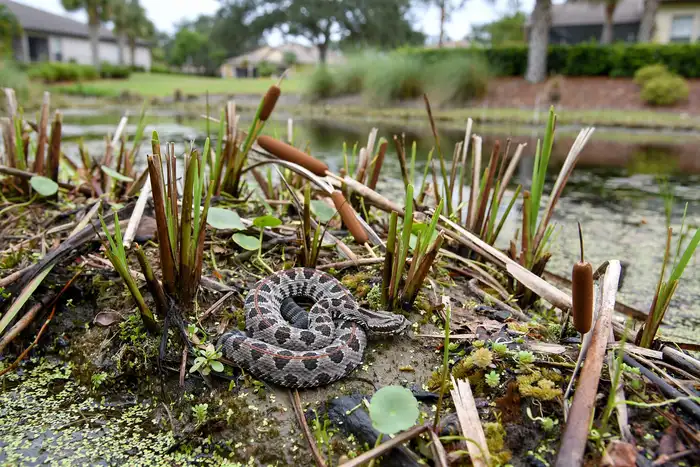
The venomous list here is short and specific: the cottonmouth at canal and pond edges, the eastern diamondback rattlesnake in dry western lots and scrub, the small dusky pygmy rattlesnake near the Savannas and other wet natural areas, and the slender, secretive eastern coral snake in leaf litter. A city laced with retention ponds and preserve edges will produce encounters with all four — which is exactly why identification comes before any hand is extended.
The banded water snake and the cottonmouth question
Most urgent canal calls resolve into this one comparison. The banded water snake is thick, banded, and quick to flatten its head and strike when cornered — a convincing performance. A cottonmouth is heavier still, with a blocky, angular head, a dark eye band, and a habit of holding its ground and gaping. From a dock or a mowed bank the two are genuinely confusable, and guessing wrong in either direction is a bad idea. Send the photo; we will name it and say whether it needs removing or merely room.
Pygmy rattlesnakes near the Savannas and preserve edges
The dusky pygmy is this area's most under-respected snake: barely a foot and a half long, gray with dark blotches and a reddish stripe down the back, with a rattle too small to hear past a few feet. It lives where subdivisions meet marsh — Savannas-side streets, preserve edges in the newer master plans, low wet lots in the east. Gardeners meet it at ground level, in mulch and at pond margins. Small size does not mean small consequence; a pygmy near a play area or a dog run is a removal, not a watch-and-wait.
Diamondbacks, coral snakes and the dry lots
Western Port St. Lucie still has dry, sandy, palmetto-dotted ground, and that is diamondback country — a heavy rattlesnake that wants nothing to do with people and announces itself honestly when approached. The coral snake is the opposite in temperament and looks: red, yellow and black bands, burrowing in leaf litter and loose soil, almost never seen unless a gardener uncovers it. Both are venomous; both are reasons to keep dogs on leash at lot edges and to call rather than rake first and look second.
Racers and rat snakes: the working snakes
A black racer in the yard is a fast, nervous, entirely harmless hunter that will be gone if you give it a minute. Rat snakes — corn snakes in their red-orange form around houses, eastern rat snakes in the oaks — climb superbly and follow roof rats into attics and pool cages. Finding one indoors usually certifies a rodent route into the house. For these snakes the prescription is identification, reassurance, and sealing the prey's entries rather than punishing the predator that reported them.
The protected snake we will not touch
The eastern indigo snake — large, glossy blue-black, docile — is a protected species in Florida. If you meet one, admire it from a distance and leave it entirely alone; we do not handle indigos and will point you to FWC instead. The same referral logic covers a gopher tortoise or its burrow, which is permit-only territory, and any alligator, which belongs to FWC's nuisance alligator program and its hotline rather than to any private removal service.
Making the yard less inviting
Snakes follow food and cover. Rodent control removes the food; trimming pond-edge landscaping back from paths, clearing leaf litter against the house, moving woodpiles off the ground at lot edges, and keeping pool-cage doors latched removes the cover and the access. On canal and preserve-edge lots you will never reach zero snakes — the goal is a yard where they pass through the far corner instead of sunning by the steps.
Common snake questions in Port St. Lucie
There is a snake by my pool right now. What should I do?+
How can I tell a cottonmouth from a water snake?+
Are pygmy rattlesnakes really in Port St. Lucie subdivisions?+
A rat snake is in my attic. Do I need it out?+
What does snake removal cost in Port St. Lucie?+
Other Port St. Lucie problems that come with snakes
Our wildlife crew handles these closely related problems — the ones that most often turn up with a snake issue.
Got more than snakes in Port St. Lucie?
Snakes are rarely the only thing using an attic or yard in Port St. Lucie. See everything we handle locally on the Port St. Lucie wildlife removal hub, or jump to Florida wildlife removal.
Serving all of St. Lucie County
Port St. Lucie is one part of St. Lucie County. See wildlife removal in St. Lucie County, FL for the county-wide picture — the animals we get called about most, and the other towns we cover.
One call to your Port St. Lucie snake crew
The longer snakes stay in the attic, the more they chew and the bigger the cleanup. Call us and tell us about the job — we will confirm the local crew for your county before any work starts.
- Local to St. Lucie County. FWC-compliant handling — call to ask about licensing and insurance.
- Humane exclusion. One-way doors and steel sealing, not poison.
- Done right. Removal, exclusion and cleanup.