Armadillo Removal in Port St. Lucie, FL
The lawn looked fine at dinner and looks plowed by morning — neat conical holes everywhere, sod peeled along the canal bank, a burrow mouth under the pool deck. That is armadillo work, and this city gives them endless soft ground. Show us the damage pattern and we will find the burrow.
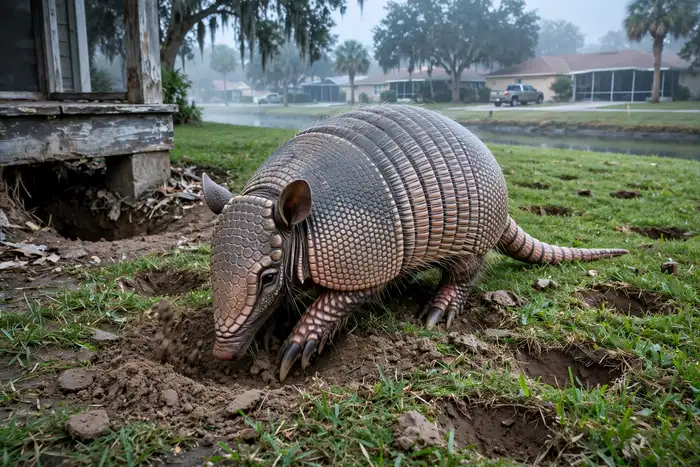
Armadillos in your Port St. Lucie home
The nine-banded armadillo is built for Port St. Lucie: sandy soil that digs easily, irrigated lawns full of grubs and worms, canal banks for burrows, and thousands of fresh-sod yards in the new sections where the ground is soft and the landscaping is young. Riverland and Wylder homeowners meet armadillos the month they move in; older neighborhoods meet them along the water. One animal works a lawn methodically, nose down, digging dozens of shallow holes in a single night's feeding.
One legal fact shapes every armadillo job and we state it upfront: armadillos are nonnative in Florida, so a captured armadillo may not be relocated or released — not to a preserve, not to a rural lot, not anywhere. Any service implying it will trap your armadillo and let it go out in the country is describing something Florida law does not allow. Our work is removal conducted lawfully under FWC Rule 68A-9.010 with the owner's authorisation, plus burrow closure so the next animal inherits nothing.
Feeding damage versus a home burrow
Two patterns get confused. Feeding damage is the scattered, shallow digging across open lawn — annoying, cosmetic, and the work of an animal that may live two streets away. A burrow is real estate: a round entrance, often under a pool deck, air-conditioning pad, sidewalk edge or canal bank, with excavated soil fanned outside. Feeding visits call for yard-level deterrence and sometimes removal; a burrow under a structure calls for both, plus closure, because the void is the problem that compounds.
New sod is an open buffet
Fresh subdivision sod arrives watered, fertilized and full of grubs — and it lifts like a rug while the roots knit. Armadillos peel it back in strips overnight, which is why builders' streets generate clusters of calls in the first season after move-in. Prompt removal matters more on new lawns than old ones: an established St. Augustine lawn survives feeding with scars, while a new one can be unmade in a week.
Burrows under pool decks and slabs
An armadillo burrow runs several feet and ends in a chamber, and it is frequently dug where the soil was supporting something — a deck edge, a pad, the backfill against a pool shell. Voids migrate as loose sand settles, showing up later as a cracked paver run or a deck corner out of level. Burrows also get inherited: an emptied armadillo system is ready housing for opossums and other diggers, so closure is part of the job, not an upsell.
Canal banks and the neighbor problem
On canal lots the burrow often sits in the bank, with the animal feeding across three or four yards nightly. Removing one animal from one lawn while the bank burrow stays open accomplishes a week of quiet at best. We map the bank burrows on your frontage, address the active system, and tell you honestly when the pressure is coming from a stretch of bank no single homeowner controls — canal streets do best when two or three neighbors act in the same month.
Fencing and deterrents, honestly graded
Armadillos push under light fencing and climb better than they look, so ornamental barriers disappoint. A low fence with a buried, outward-angled apron can defend a garden or a single lawn edge, and reducing grub food with sensible lawn care lowers the reward. Repellent granules, in our experience here, mostly perfume the digging. Removal of the resident animal plus burrow closure remains the arithmetic that adds up on a problem lot.
Timing the work in a build-out city
Armadillos breed through the warm months and are most visible at dusk and after rain, when the ground softens and grubs rise. Streets still under construction see waves of them as lots are cleared and rough ground is graded. If your street is mid-build, expect prospecting animals even after a successful removal — the closure work, not any single catch, is what holds the line until the neighborhood settles.
Common armadillo questions in Port St. Lucie
Can you trap the armadillo and release it somewhere wild?+
How do I know the digging is an armadillo and not something else?+
The burrow is under my pool deck. Is that urgent?+
Will treating my lawn for grubs solve it?+
What does armadillo removal cost in Port St. Lucie?+
Other Port St. Lucie problems that come with armadillos
Our wildlife crew handles these closely related problems — the ones that most often turn up with a armadillo issue.
Got more than armadillos in Port St. Lucie?
Armadillos are rarely the only thing using an attic or yard in Port St. Lucie. See everything we handle locally on the Port St. Lucie wildlife removal hub, or jump to Florida wildlife removal.
Serving all of St. Lucie County
Port St. Lucie is one part of St. Lucie County. See wildlife removal in St. Lucie County, FL for the county-wide picture — the animals we get called about most, and the other towns we cover.
One call to your Port St. Lucie armadillo crew
The longer armadillos stay in the attic, the more they chew and the bigger the cleanup. Call us and tell us about the job — we will confirm the local crew for your county before any work starts.
- Local to St. Lucie County. FWC-compliant handling — call to ask about licensing and insurance.
- Humane exclusion. One-way doors and steel sealing, not poison.
- Done right. Removal, exclusion and cleanup.