Raccoon Removal in Port St. Lucie, FL
Heavy steps overhead at midnight, a pool-cage screen peeled back, the trash cart rearranged by an expert. Raccoons commute this city's canals and den in its attics. Tell us where the sign is and we will find the den.
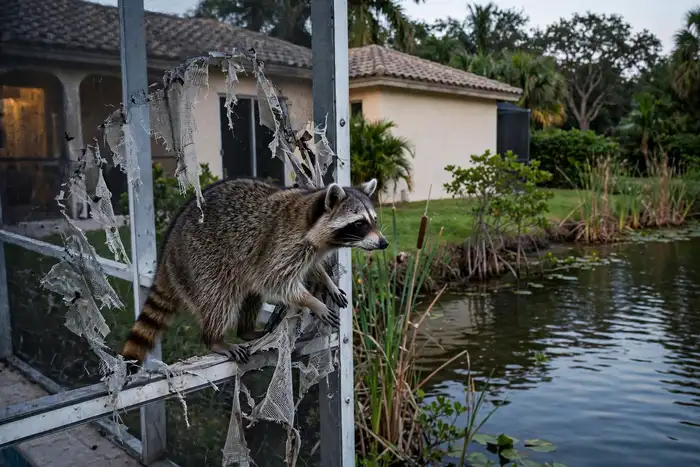
Raccoons in your Port St. Lucie home
Port St. Lucie's canal grid is a raccoon transit system. The banks are mowed, the water holds fish and frogs, and every canal street backs houses onto it — so a raccoon can fish at night, cross two fences, and be asleep in an attic by dawn without ever crossing open ground. St. Lucie West and the older canal sections east of US-1 produce steady calls; the master plans produce them too, wherever a retention pond meets a preserve edge.
A denning raccoon here is usually a mother. Spring and summer litters are raised in attics because attics are what this city offers instead of hollow trees, and pool cages attract year-round attention — raccoons swim, wash food, and will tear a screen panel to reach water. They are also a rabies-vector species in Florida, which settles the handling question: this is licensed work, done under FWC Rule 68A-9.010 at the property owner's authorisation, not a weekend project with a borrowed trap.
Reading raccoon sign in a subdivision attic
Raccoon traffic sounds deliberate — walking, pausing, the odd thud — quite unlike a rat's patter or a squirrel's gallop. In the attic we look for insulation trampled into paths, a latrine corner used repeatedly, and an entry scaled to the animal: a pushed-up soffit, a vent cover bent outward, shingles worried at a roof valley. On canal lots, muddy prints on the cage frame or the air-conditioning pad often mark the approach route before we ever climb.
Pool cages: screens, doors and swimmers
A torn cage screen in Port St. Lucie is a raccoon signature until proven otherwise. They enter to swim and to hunt frogs around the deck, and a mother may den in the hollow of a cage-adjacent soffit while visiting the pool nightly. Repairs here go beyond rescreening: the door latch gets attention, the gap at the cage-to-roof tie-in is closed, and any soffit the animal used is rebuilt so claws meet metal rather than vinyl.
Litters change the order of work
Kits cannot climb out, follow a one-way door, or manage on their own, so a spring attic job is sequenced around them. The litter is located first, the mother's exit is arranged so the family regroups outside, and sealing waits until the headcount is complete. A plan that starts by closing the entry strands the young inside and hands the mother a reason to tear a new one — she will, usually through a worse place in the roof.
What the law allows us to do with a caught raccoon
Homeowners picture a trap and a drive to the woods; Florida does not work that way. A native raccoon may be released where it was caught, or moved only inside St. Lucie County to a property of at least forty contiguous acres whose owner has given written permission, and the animal must be released or euthanized within a day of capture. Our exclusion-first approach — out through a controlled exit, then sealed out — keeps most jobs inside the simplest, most humane reading of those rules.
The latrine is a cleanup, not a detail
An attic raccoon picks one corner and uses it for weeks. The droppings can carry parasites whose eggs persist in insulation, so the fouled section comes out and the area is treated rather than covered up. We show you the corner, say plainly how much material is involved, and separate the removal scope from the cleanup scope in the written plan so each can be judged on its own.
Keeping canal streets unattractive afterward
No street on a canal will be raccoon-free, and we will not pretend otherwise. What changes is your house's ranking: entries armored, pet food indoors at night, trash carts latched, and fallen citrus picked up. A sealed house on a tidy lot slides down the den list, and in a city with this many attics, sliding down the list is what success looks like.
Common raccoon questions in Port St. Lucie
A raccoon keeps getting into our pool cage. What actually stops it?+
There are babies in the attic. Will they be harmed?+
Can the raccoon be taken out to the Savannas or a rural road?+
Is the raccoon in my attic dangerous?+
What does raccoon removal cost in Port St. Lucie?+
Other Port St. Lucie problems that come with raccoons
Our wildlife crew handles these closely related problems — the ones that most often turn up with a raccoon issue.
Got more than raccoons in Port St. Lucie?
Raccoons are rarely the only thing using an attic or yard in Port St. Lucie. See everything we handle locally on the Port St. Lucie wildlife removal hub, or jump to Florida wildlife removal.
Serving all of St. Lucie County
Port St. Lucie is one part of St. Lucie County. See wildlife removal in St. Lucie County, FL for the county-wide picture — the animals we get called about most, and the other towns we cover.
One call to your Port St. Lucie raccoon crew
The longer raccoons stay in the attic, the more they chew and the bigger the cleanup. Call us and tell us about the job — we will confirm the local crew for your county before any work starts.
- Local to St. Lucie County. FWC-compliant handling — call to ask about licensing and insurance.
- Humane exclusion. One-way doors and steel sealing, not poison.
- Done right. Removal, exclusion and cleanup.