Squirrel Removal in Port St. Lucie, FL
Galloping over the ceiling at sunrise, shredded insulation in the eaves, a fascia board chewed to lace. Gray squirrels treat Port St. Lucie attics as hollow trees with air conditioning. Tell us when the noise happens — the timing names the animal.
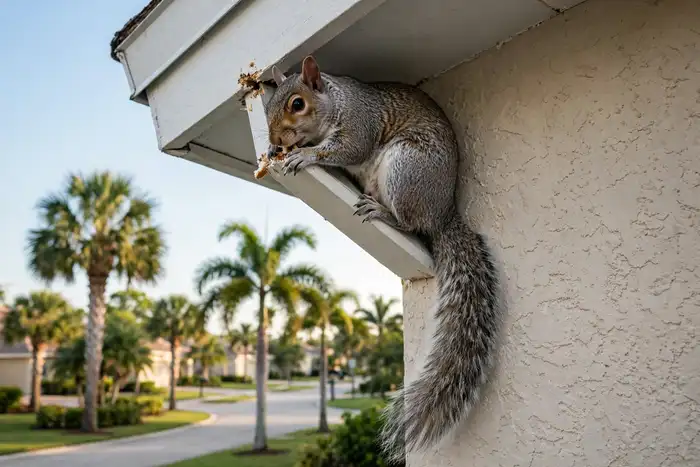
Squirrels in your Port St. Lucie home
The gray squirrel is the only squirrel with an attic habit in Port St. Lucie. Builders here cleared flatwoods lot by lot but left oaks standing as street and yard trees, and those oaks now form stepping-stones over whole subdivisions — a squirrel can cross a Torino street in the canopy and drop onto any roof along it. Where a new section is clearing around older trees, the displaced animals concentrate on the finished houses at the edge.
Two local relatives deserve a sentence each so they are not confused with the attic tenant. The fox squirrel is a protected species of special concern in Florida; it is a ground-and-pine animal we do not handle, and it is not the squirrel in your roof. Flying squirrels occur here too — small, nocturnal and quiet — and account for a share of mysterious night noises in wall voids near wooded preserves.
Dawn noise, dusk noise, and what each means
Gray squirrels keep daylight hours: out near sunrise, back before dark, with noisy midday nest work in between. Attic sound that starts after full dark points elsewhere — flying squirrels if it is soft and scratchy, roof rats if it is gnawing and pattering. Homeowners who note the hour save the inspection a step, and the distinction matters because each animal's exit route and sealing list differ.
Entry points on production-built homes
Port St. Lucie's production housing repeats a handful of details, and squirrels have learned all of them: the soffit return where two roof planes meet, the plastic vent a determined animal chews through in a week, the gap where the garage roof ties into the main house, and fascia softened by one wet season behind a clogged gutter. On street after street the same four openings account for most nests, which is why our inspection walks the full roofline — sealing the chewed hole while leaving its twin is an invitation addressed to the same squirrel.
Litters in a city with two breeding seasons
Florida's gray squirrels raise young in late winter and again in summer, so an attic nest holds helpless babies during much of the year. A mother shut out from her litter will attack the repair at its weakest point to get back in, and usually finds a worse one. We locate the nest before scheduling, and when young are present the timeline is set so the family leaves together and the sealing happens once, behind them.
Why an occupied attic should not wait
Squirrels gnaw constantly — trim, stored boxes, duct insulation and, most seriously, cable sheathing. Bared conductors in a dry, hot Florida attic are a fire risk that grows silently while the noise fades into routine. Nests also mat down insulation, so the rooms below run warmer and the cooling bill follows. The safety argument and the energy argument point the same way: a squirrel tenancy is cheapest in its first month.
Exclusion fitted to a climbing animal
We mount a one-way door at the entry in use, armor the remaining gaps in galvanized material, and return to confirm quiet before removing the door and closing the final opening. Trapping has a supporting role where a door cannot be fitted, conducted under the same Florida disposition rules — any native animal released is released on site, or within the county under the acreage and permission conditions the rule requires.
Trim, feeders and the next prospect
Cutting roof-touching limbs back buys a head start rather than immunity — a gray squirrel can jump a surprising gap and climb a wall besides. Feeders hung off the house itself subsidize the exact population testing your soffits, so they move to a pole during and after a job. What finishes the work is the seal: a squirrel that meets steel at every old doorway shops the next street instead.
Common squirrel questions in Port St. Lucie
How do squirrels get removed from a Port St. Lucie attic?+
Could the night noise be something else?+
The big squirrel with the orange tail in my yard — is that the problem?+
They came back last year after a handyman patched the hole. Why?+
What does squirrel removal cost in Port St. Lucie?+
Other Port St. Lucie problems that come with squirrels
Our wildlife crew handles these closely related problems — the ones that most often turn up with a squirrel issue.
Got more than squirrels in Port St. Lucie?
Squirrels are rarely the only thing using an attic or yard in Port St. Lucie. See everything we handle locally on the Port St. Lucie wildlife removal hub, or jump to Florida wildlife removal.
Serving all of St. Lucie County
Port St. Lucie is one part of St. Lucie County. See wildlife removal in St. Lucie County, FL for the county-wide picture — the animals we get called about most, and the other towns we cover.
One call to your Port St. Lucie squirrel crew
The longer squirrels stay in the attic, the more they chew and the bigger the cleanup. Call us and tell us about the job — we will confirm the local crew for your county before any work starts.
- Local to St. Lucie County. FWC-compliant handling — call to ask about licensing and insurance.
- Humane exclusion. One-way doors and steel sealing, not poison.
- Done right. Removal, exclusion and cleanup.