Bat Removal in Port St. Lucie, FL
Droppings beneath a gable, a dry fluttering in the wall at dusk, bats pouring from one roof corner at sunset. Timing decides everything with bats in Florida — tell us what you have seen and when, and we will place your job on the right side of the calendar.
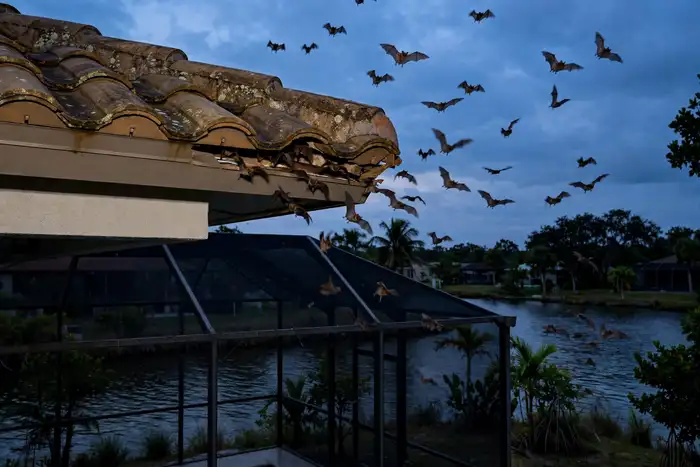
Bats in your Port St. Lucie home
Two bats do nearly all of Port St. Lucie's house-roosting. The Brazilian free-tailed bat, Florida's most common species, colonies in warm roof spaces and slips out at dusk to hunt over the canals. The evening bat roosts smaller and quieter, often behind soffits and in attic corners of the older subdivisions. Both are easy to live beside unknowingly for years — the sign is modest: a scatter of droppings under one eave, a faint musk on still evenings, a seam of the roof that empties at sunset.
Florida law shapes this service more than any other. Bats may never be harmed or killed here, and exclusion — fitting one-way devices that let bats leave and not return — is lawful only from August 15 through April 15. From mid-April to mid-August, maternity season, colonies are raising pups that cannot fly, and no exclusion may happen at all. That blackout sits inside hurricane season, which makes late-summer planning a local art form.
A summer bat call means inspect now, exclude in August
If you find bats in June or July, the honest answer is a two-step one. We inspect immediately — identify the species, count the exits at dusk, map every gap in the tile and soffit line — and we do the sealing preparation that does not trap anyone. The devices themselves go on after August 15, when the pups are flying. Booking the inspection during the blackout puts your house near the front of the busiest fortnight of the bat year.
Where bats enter Port St. Lucie roofs
Tile roofs offer the classic entry: a lifted tile edge or an open ridge gap with a slot behind it just wide enough for a free-tailed bat. Shingle roofs give up gaps at gable ends and where the fascia has shrunk. Newer homes add construction seams at soffit returns; older ones add vents screened in material long since rusted. A bat needs a crack, not a hole, which is why the dusk watch — watching where they actually exit — decides the plan rather than guesswork from the ground.
Exclusion is the whole method, by law and by design
There is no trapping, poisoning or relocating a Florida bat colony. The device work does everything: exits in active use receive one-way fittings, every other slot on the structure is sealed, and over several nights the colony leaves to feed and finds the door swings one way. After exit counts confirm an empty roost, fittings come off and those last openings are closed like the rest. The bats resume hunting the canal behind your house; they simply sleep elsewhere.
Hurricane season collides with the calendar
The exclusion window opens in mid-August, in the teeth of storm season. A hurricane can tear fresh gaps in a roof the week after a careful sealing, and storm-displaced colonies prospect for new roosts all fall. Practical consequence: Port St. Lucie bat work pairs exclusion with a roofline built to hold — sound tiles reset, soffits repaired — and homeowners who suspect a colony do best to be inspected before the season, not after a storm names the weekend.
Guano and the attic question
A long-used roost leaves guano concentrated under the entry seam, staining insulation and carrying a musty odor down through ceiling fixtures. Cleanup is handled with protective equipment and without blowing material through living space, and its scope follows the roost's size and age — a one-season evening bat corner is a modest job beside a free-tailed colony of several years. We measure before we quote it.
A single bat indoors is a different call
One bat circling a bedroom usually entered through an open door or an attic hatch, not a colony breach. Keep the room closed, keep people and pets out of it, and do not handle the animal with bare hands. If anyone slept in the room, mention it when you call — the health guidance differs, and we will walk you through who else should hear about it.
Common bat questions in Port St. Lucie
When can bats legally be removed from my Port St. Lucie home?+
Will the bats be killed or trapped?+
How do I know whether I have a colony or one lost bat?+
We found bats in July. Is there anything useful to do now?+
What does bat exclusion cost in Port St. Lucie?+
Other Port St. Lucie problems that come with bats
Our wildlife crew handles these closely related problems — the ones that most often turn up with a bat issue.
Got more than bats in Port St. Lucie?
Bats are rarely the only thing using an attic or yard in Port St. Lucie. See everything we handle locally on the Port St. Lucie wildlife removal hub, or jump to Florida wildlife removal.
Serving all of St. Lucie County
Port St. Lucie is one part of St. Lucie County. See wildlife removal in St. Lucie County, FL for the county-wide picture — the animals we get called about most, and the other towns we cover.
One call to your Port St. Lucie bat crew
The longer bats stay in the attic, the more they chew and the bigger the cleanup. Call us and tell us about the job — we will confirm the local crew for your county before any work starts.
- Local to St. Lucie County. FWC-compliant handling — call to ask about licensing and insurance.
- Humane exclusion. One-way doors and steel sealing, not poison.
- Done right. Removal, exclusion and cleanup.