Dead Animal Removal in Port St. Lucie, FL
Nothing in sight — just a smell that owns one bedroom, or a whole house that greeted you at the door after three months away. In Florida heat, something dead inside a wall does not wait politely. Call and describe where the odor is strongest; that detail starts the search.
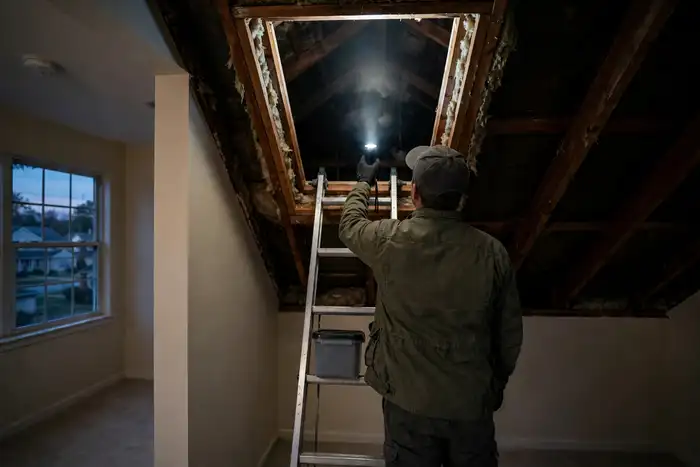
Dead Animals in your Port St. Lucie home
Dead-animal calls are a high-volume suburb call in Port St. Lucie for structural reasons. Tens of thousands of similar houses means tens of thousands of wall voids, attic corners and soffit runs where a roof rat, opossum or squirrel can die concealed — and Florida's heat and humidity accelerate everything that follows. A carcass that would whisper for weeks in a northern winter announces itself here in days, and the smell strengthens until the source is out.
The local signature case is the return discovery. A seasonal home sits closed through the summer; an animal that got in during a June storm dies in a wall in July; the owners unlock the door in October to a house full of odor and staining. Our service is built as a sequence for exactly this: locate the source precisely, remove it, sanitize what it touched, and seal the entry — because a retrieval that skips the last step is a subscription.
Locate: odor is evidence, not ambience
Smell concentrates near its source, travels duct runs, and blooms with heat — so we grade it room by room, note which walls and ceiling lines read strongest, and correlate that map with the framing, the attic layout and the plumbing chases. In a subdivision of repeated floor plans, experience with the model helps: the same void hides the same problem on street after street. The aim is a specific cavity identified before any opening is made.
Wall voids: the Port St. Lucie classic
Roof rats fall into wall cavities from attics and cannot climb the smooth interior back out; others die where they nested, over a bedroom ceiling. Retrieval works from the attic or an existing access where possible. When the mapped location can only be reached directly, the remedy is a small opening cut exactly at the evidence — sized to the job, discussed with you first, and placed so the finish repair afterward is simple.
Remove and sanitize: what treatment actually means
Removing the animal removes the source, but fluids migrate into insulation, drywall and framing, and untreated material keeps the smell alive at low volume for weeks. Fouled insulation around the site comes out, the surfaces of the void are treated with sanitizing agents, and the space is ventilated. We tell you how much material is involved and why before it comes out — in a one-rat wall void it is a modest radius; in a summer-long vacant-house case it can be considerably more.
The snowbird return, step by step
Returning owners should resist two urges: running the air conditioning hard, which distributes odor through every duct, and masking with scent, which only layers it. Open the house, note the strongest rooms, and call. Our return-home work triages the source first, then checks the whole house — because a home that admitted one animal through a dried drain trap or a storm-lifted soffit often has a second story to tell in the attic.
Attics, soffits and pool-cage rooflines
Not every source is in a wall. Squirrels expire in attic nests, opossums die in soffit runs and under pool decks, and a rat in the cage roofline can scent a lanai for a week. Each location has its own access logic, and the odor map usually distinguishes them — ceiling-centered smell points up, low and exterior-weighted smell points to decks and soffits. The inspection follows the evidence rather than a script.
Seal: the step that ends the story
Every one of these calls began with a living animal choosing the structure — through a chewed soffit, a vent screen, a dried-out drain in a vacant house, a gap the last storm opened. We find that route and close it as part of the same job. In a city adding houses and clearing lots weekly, another animal is always prospecting; a sealed structure is the only version of this story that does not get a sequel.
Common dead animal questions in Port St. Lucie
We just returned after months away and the house smells terrible. Where do we start?+
How long would the smell last if we just waited?+
Will you have to cut my wall?+
Could the smell be coming from the drains instead?+
What does dead animal removal cost in Port St. Lucie?+
Other Port St. Lucie problems that come with dead animals
Our wildlife crew handles these closely related problems — the ones that most often turn up with a dead animal issue.
Got more than dead animals in Port St. Lucie?
Dead Animals are rarely the only thing using an attic or yard in Port St. Lucie. See everything we handle locally on the Port St. Lucie wildlife removal hub, or jump to Florida wildlife removal.
Serving all of St. Lucie County
Port St. Lucie is one part of St. Lucie County. See wildlife removal in St. Lucie County, FL for the county-wide picture — the animals we get called about most, and the other towns we cover.
One call to your Port St. Lucie dead animal crew
The longer dead animals stay in the attic, the more they chew and the bigger the cleanup. Call us and tell us about the job — we will confirm the local crew for your county before any work starts.
- Local to St. Lucie County. FWC-compliant handling — call to ask about licensing and insurance.
- Humane exclusion. One-way doors and steel sealing, not poison.
- Done right. Removal, exclusion and cleanup.