Iguana Removal in Port St. Lucie, FL
A four-foot green lizard is sunning on your seawall, and it was not there last year. That report is arriving more often from canal streets every season. Tell us where you are seeing them and how many — the honest picture here starts with an accurate count.
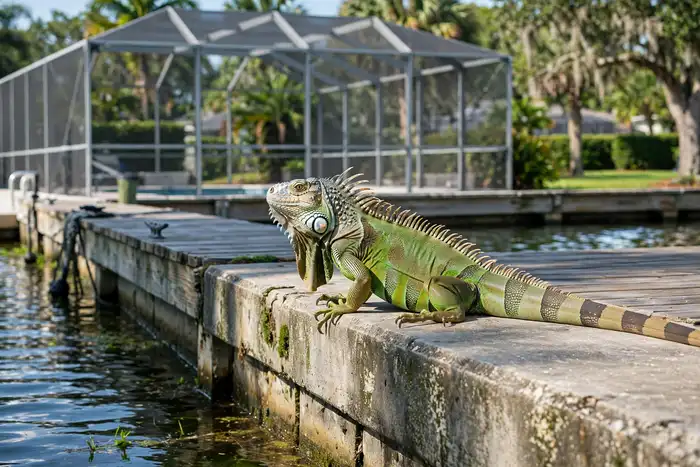
Iguanas in your Port St. Lucie home
We will describe the iguana situation the way the state data supports: green iguanas are increasingly reported in St. Lucie County — along canals, on seawalls, around docks and in waterside landscaping — but they are not established here the way they are in the counties farther south, where breeding populations have existed for decades. Port St. Lucie sits near the northern edge of where this tropical animal can persist, and winter cold is the reason: a hard snap still thins the local numbers in a way Miami never experiences.
The law, at least, is unambiguous. The green iguana is a prohibited species in Florida, and FWC encourages its removal from private property year-round with the landowner's permission. The counterpart rule is just as firm: a captured iguana may never be relocated or released anywhere in this state. Removal here means removal in the full sense, and we say so plainly before any work is agreed.
Where Port St. Lucie sightings concentrate
Reports cluster on the water infrastructure the city is laced with: canal banks and the seawalls along them, dock edges, riprap, and the sunny side of waterside pool cages. Iguanas dig burrows into soft canal banks, which can undermine a seawall's backfill over time, and they bask in the open — a wall, a dock, a bare bank — which is why a new animal on a street is noticed by the whole street within the week. Warm microclimates matter: south-facing walls and sheltered canal corners carry animals through winters that exposed lots do not.
What an iguana does to a canal lot
The damage list is modest beside a raccoon's, but real: burrowing at seawall bases and under dock edges, landscaping eaten down to preference — hibiscus and other ornamentals are favorites — and droppings on docks, seawalls and pool decks where the animals bask. In a master-planned street the aesthetic complaint travels fast; in practical terms the burrowing is the item worth acting on early, before a bank burrow system grows chambers.
Cold snaps: the local control nobody schedules
When temperatures fall below roughly fifty degrees, iguanas lose muscle control and go torpid — stunned animals drop from trees and lie motionless on lawns and sidewalks until the sun restores them. A cold morning after a snap is when Port St. Lucie sees the most iguanas at once. Two cautions follow: a torpid iguana is alive and will revive, sometimes abruptly, so it should not be picked up by hand or brought indoors to warm up; and our crew can collect reported animals during these windows far more efficiently than in July.
Removal, and the no-release rule explained
Work on your property proceeds with your permission, as Florida requires, using trapping and direct capture suited to canal-bank terrain. Because iguanas are prohibited and invasive, every captured animal is handled under the state's no-release framework — none is transported for release, and none is let go at a canal across town. Homeowners sometimes ask about humane relocation out of kindness; the honest answer is that Florida closed that door deliberately, because released iguanas are precisely how new populations start.
Common iguana questions in Port St. Lucie
Are iguanas really established in Port St. Lucie?+
I found one lying stiff in my yard after a cold night. Is it dead?+
Can you catch it and let it go at a canal away from houses?+
Will removing the one on my seawall end the problem?+
What does iguana removal cost in Port St. Lucie?+
Got more than iguanas in Port St. Lucie?
Iguanas are rarely the only thing using an attic or yard in Port St. Lucie. See everything we handle locally on the Port St. Lucie wildlife removal hub, or jump to Florida wildlife removal.
Serving all of St. Lucie County
Port St. Lucie is one part of St. Lucie County. See wildlife removal in St. Lucie County, FL for the county-wide picture — the animals we get called about most, and the other towns we cover.
One call to your Port St. Lucie iguana crew
The longer iguanas stay in the attic, the more they chew and the bigger the cleanup. Call us and tell us about the job — we will confirm the local crew for your county before any work starts.
- Local to St. Lucie County. FWC-compliant handling — call to ask about licensing and insurance.
- Humane exclusion. One-way doors and steel sealing, not poison.
- Done right. Removal, exclusion and cleanup.