Wildlife Removal in Cuyahoga Falls, OH
Cuyahoga Falls is a city built on a slope above a gorge. The river drops through town in a wooded ravine, parks and park edges thread between neighborhoods, and a lot of houses look straight into trees. Wildlife does not have to travel far to reach a roofline here — in many streets it is already living next door. Call us and tell us about the job — we will confirm the local crew for your county before any work starts.
Why Cuyahoga Falls homes see the wildlife they do
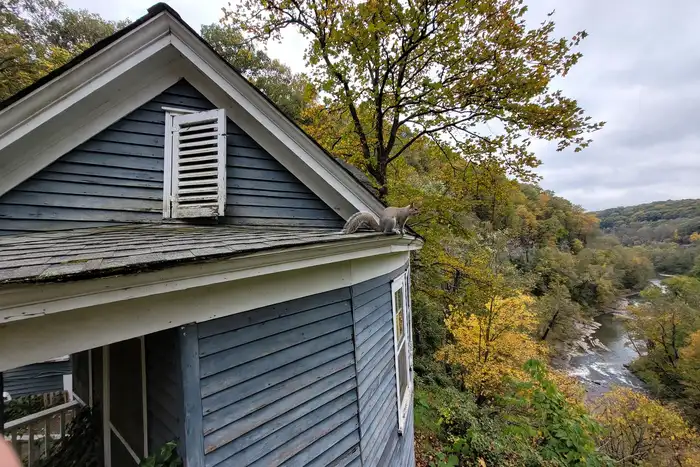
The defining fact of Cuyahoga Falls is vertical. The Cuyahoga River runs through a gorge in the middle of the city, and the neighborhoods climb away from it on both sides — streets of older homes on steep lots, retaining walls holding back wooded banks, and ravines and parkland slipping between one block and the next. That terrain is beautiful, and it is also a permanent wildlife corridor with houses built all along its rim. Deer country, raccoon country and bat country begin, in much of this city, at the back fence.
The homes along the river are frequently the city's oldest. The Front Street-era housing stock and the early neighborhoods around it carry the full catalogue of age: attics under roofs that have been patched and re-flashed through decades of Ohio weather, chimneys that have not seen a cap in years, porches and additions added in stages, each junction leaving a seam. Higher up and farther out, the housing gets newer and the lots flatter — but even there, the wooded slope or the park edge is rarely more than a street away, and groundhogs and chipmunks work the retaining walls that hold those lots together.
Our wildlife crew's job in Cuyahoga Falls is to close the distance between the woods and the house: identify the animal using your slope, your wall or your attic, remove it humanely and within Ohio law, seal the structure with metal, and address the terrain features — the wall, the deck, the bank — that will otherwise deliver the next animal to the same spot.
Living on the rim of the gorge
In most suburbs, wildlife arrives from a tree line at the edge of a development. In Cuyahoga Falls, the habitat is woven through the city itself. The gorge walls are wooded from the river up to the street, ravines carry that cover deep into residential blocks, and park edges add more. Raccoons commute up the slopes at night. Bats hunt the river and roost in the warm attics of the houses above it. Skunks and opossums work the quiet streets on the rim. A home near the gorge should expect steady, year-after-year wildlife pressure — not as a sign anything is wrong with the house, but as a fact of the address.
That expectation changes how a job should be done. Removing one animal from a gorge-side attic without sealing the whole roofline is a subscription, not a solution: the next raccoon on the slope will find the second gap the first one did not need. Our crew inspects rim-side homes as houses under permanent pressure and seals them accordingly.
Older river homes and their attics
The older homes near the river were built in stages and repaired in layers, and animals exploit exactly the places where those layers meet. Flashing where an addition roof dies into an original wall. A gable vent screened, once, with material that rusted out during some past decade. Eaves on a house that has settled a little on its slope, opening a gap along one side that no one can see from the yard. Chimneys tall enough for the hillside — and a female raccoon only needs one uncapped flue among them.
These same attics, warm and high above the river's insect hatches, are where Cuyahoga Falls' bat colonies live. More than one homeowner near the gorge has discovered that the faint squeaking in the peak and the droppings on the deck below mean a colony has summered in the roof for years. Older river homes deserve an attic-level inspection even when the complaint starts somewhere else — in this housing stock, openings travel in groups.
Steep lots, retaining walls and the digging animals
Hold a hillside lot together and you build a retaining wall — and a retaining wall, to a chipmunk or a groundhog, is a pre-dug burrow site with a roof. Chipmunks run the walls of Cuyahoga Falls like highways, denning behind them and popping out at the drainage holes. Groundhogs dig at the base of walls and under the decks and sheds that terrace the slopes, and their excavations can start a wall leaning by stealing the soil it stands in. Add the wooded bank above or below the lot, and a sloped property offers food, cover and digging ground in a single short commute.
Managing digging animals on a slope means thinking about the wall as well as the animal. Our crew maps burrows against the structures they threaten, removes the diggers, and proofs wall bases, deck edges and shed lines with buried steel mesh set to survive on a hillside — because a burrow reopened behind a retaining wall is a masonry bill, not just a wildlife call.
The Ohio calendar and the Ohio rulebook
Summit County wildlife keeps northern hours. Autumn brings the great push indoors — squirrels testing rooflines, mice finding foundation gaps, raccoons looking for a winter den as the gorge woods go bare. Winter silences the groundhogs entirely (they hibernate), slows skunks to the mildest nights, and finds big brown bats asleep in some of the attics they summered in. Spring wakes everything at once: groundhogs digging out, skunks mating and spraying, raccoons giving birth in chimneys and attics. Summer belongs to the bats raising young over the river — the season when Ohio law, not preference, sets the schedule for getting them out.
The law behind the work: our crew operates under Ohio's Commercial Nuisance Wild Animal Control Operator license from the ODNR Division of Wildlife (ORC §1531.40). And Ohio draws a hard line the homeowner should hear from us before anyone sets a trap — raccoons, skunks, opossums, beaver, coyotes and red fox cannot be relocated. Under OAC 1501:31-15-03(E)(3) they are released on site or euthanized. So the craft here is exclusion: one-way doors, timing and metal, getting animals out of structures and keeping them out, with hands-on handling done exactly as the rule prescribes. Raccoons, skunks, foxes and bats are also Ohio's principal rabies species — another reason the work belongs to a licensed crew, not a borrowed trap.
Wildlife we remove in Cuyahoga Falls
Gorge-side, wall-side or attic-deep, these are the animals Cuyahoga Falls homeowners ask our wildlife crew about most.
🦇 Bats
The signature animal of the river neighborhoods. Big brown bats hunt the gorge at dusk and colony-roost in the older attics above it — and hibernate in some of them all winter. Ohio allows exclusion only April 1–May 15 and August 1–October 15 without written ODNR permission, so the call needs to come before the window, not after. See our full Cuyahoga Falls bat guide →
🦝 Raccoons
They climb out of the gorge every night to work the rim streets, then look for a den — an uncapped chimney or a soft soffit on an older river home is ideal, kits and all in spring. A rabies-vector species Ohio forbids relocating; our crew excludes them and seals in heavy metal.
🐿️ Squirrels
Wooded slopes put squirrels on the roof without any help from a tree in your own yard. Grays run the older neighborhoods; flying squirrels — nocturnal and colonial — are common in the wooded streets. Fall is entry season, wiring is the risk, steel sealing is the answer.
🌰 Chipmunks
The retaining-wall specialists. On Cuyahoga Falls' steep lots, chipmunks den behind walls, under stoops and along foundations, and their burrows undermine the very structures holding the hillside up. Small holes, expensive masonry if ignored.
🕳️ Groundhogs
Woodchucks dig at wall bases, under slope-side decks and along the park edges, then vanish into hibernation from late fall to late winter. A burrow at the foot of a retaining wall is an engineering problem wearing a fur coat — spring emergence is removal season.
🦨 Skunks
Striped skunks den under the porches and low decks of the older river streets and patrol gorge-side lawns for grubs. Rabies-vector, and on Ohio's no-relocation list — the job is lawful removal plus buried screening that retires the den.
🐾 Opossums
Mostly night passersby along the ravines — until one settles into a garage, a crawlspace or the space under a porch and starts raising young there. Ohio law bars relocating them, so our crew clears the shelter lawfully and closes it.
🐀 Rodents
House mice invade at the first frost through foundation gaps in the older stock; Norway rats work low ground near the river and older housing; voles tunnel lawns under the snow and show their trails at melt. Exclusion first — bait alone leaves the doors open. See our Cuyahoga Falls rodent guide →
🐍 Snakes
Northern watersnakes along the river, garter snakes in every damp garden, rat snakes climbing after rodents, milk snakes near old foundations. Northeast Ohio's snakes are overwhelmingly nonvenomous — our work is sure identification and calm removal when one gets inside.
🏠 Dead animals
Winter is the season of the unexplained smell: an animal that denned in an attic, wall or chimney in the fall dies there, and a closed, heated house concentrates the odor. We locate it precisely, remove it, clean up, and seal the opening it came through.
Animal-specific help in Cuyahoga Falls
Deep, local guides for the problems we get called about most — with our wildlife crew behind every one.
How to get help in Cuyahoga Falls
Tell us what you're hearing
Scratching in the attic, a snake by the porch, holes in the yard — call with your problem and your Cuyahoga Falls address.
We connect you locally
Call us and tell us about the job — we will confirm the local crew for your county before any work starts.
They solve it — for good
Inspection, humane removal, full exclusion and cleanup — handled by our wildlife crew, following Ohio rules.
Common wildlife removal questions in Cuyahoga Falls
Who do I call for wildlife removal in Cuyahoga Falls?+
Why does my house near the gorge get wildlife every year?+
Can a raccoon or opossum be trapped and released in a park?+
I think bats summer in my attic by the river. When can they be excluded?+
Something is digging behind my retaining wall — how serious is that?+
How much does wildlife removal cost in Cuyahoga Falls?+
Serving all of Summit County
Cuyahoga Falls is one part of Summit County. See wildlife removal in Summit County, OH for the county-wide picture — the animals we get called about most, and the other towns we cover.
One call to your Cuyahoga Falls wildlife crew
Whether it's squirrels in an older in-town attic or a raccoon in a new subdivision crawlspace, the fastest fix is our wildlife crew, who knows Summit County wildlife. Call us and tell us about the job — we will confirm the local crew for your county before any work starts.
- Local to Summit County. ODNR-compliant handling — call to ask about licensing and insurance.
- One company, one call. Call us and tell us about the job.
- Done right. Removal, exclusion and cleanup.