Bat Removal & Exclusion in Cuyahoga Falls, OH
At dusk over the gorge the air fills with bats coming off the river — some of them, very likely, from the attics of the houses above it, possibly including yours. Call us and tell us about the job — we will confirm the local crew for your county before any work starts.
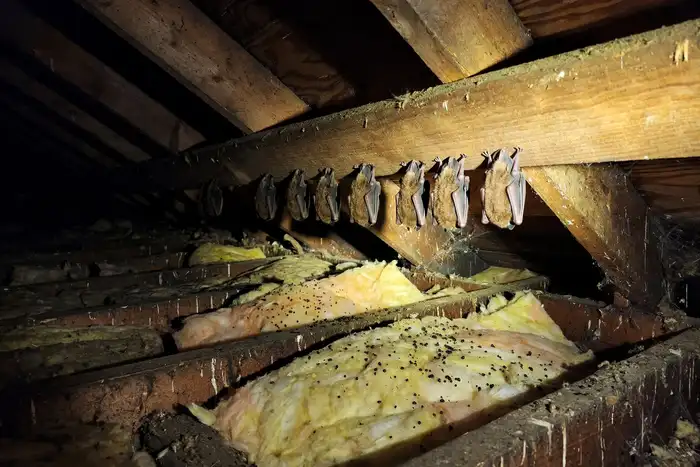
Bats in your Cuyahoga Falls home
If any Ohio city was built for bats, it is this one. The gorge pours insects into the evening air all summer — a feeding ground — and the streets above it are lined with older houses whose attics offer the warm, undisturbed peaks a maternity colony of big brown bats requires. Little brown bats, once common, have thinned drastically in Ohio since white-nose syndrome, so the colony in a Cuyahoga Falls roof today is big browns in nearly every case. They slip in through openings a finger wide: a lifted corner of chimney flashing, a gable vent whose screen is older than the mortgage, the seam where an addition joined the house.
Homeowners rarely meet their colony face to face. They meet the evidence — droppings speckling the deck or collecting on a ledge beneath a gap, a rustling and faint squeaking in the roof peak on warm evenings, a brown smudge framing an opening where bodies squeeze through nightly. And then they meet the complication that defines bat work in this state: in Ohio, when is a legal question with a strict answer, and much of the year the answer is 'not yet.'
The two blackouts, and the two windows between them
Ohio's bat rule, OAC 1501:31-15-03(H)(5), closes exclusion twice a year. From May 16 to July 31, no exclusion may be done when five or more bats are present — that is maternity season, and the pups in the colony cannot fly; a one-way valve would let the mothers out and starve the young in the attic. From October 15 to March 31, exclusion is closed for a different reason: hibernation. Big brown bats do not all leave for caves — many hibernate right inside Ohio attics, torpid in the cold peak, unable to exit through a valve at all. Either blackout yields only to prior written permission from the ODNR Division of Wildlife. What remains are the legal windows — April 1–May 15 and August 1–October 15 — and bat work in Cuyahoga Falls is planned backwards from them.
Reading a colony from the ground
Confirmation does not require entering the attic at the wrong season. Our crew reads the house from outside: droppings below a gap tell us the exit is active; staining around a crevice shows it has been used for seasons, not days; and a dusk watch, standing in the yard as the light fails, shows the colony leaving — the surest census there is, and the way we learn which of several gaps are actually live. Two watches within a short span is also the standard Ohio expects before any exclusion near the maternity window. An inspection like this can be booked in any month, including the blackouts, and it is what puts your house at the front of the schedule when a window opens.
Guano and the attic you cannot see
A colony that summers in a roof for years leaves a growing deposit beneath its roost, and in the warm, finished attics of the river homes that deposit is often directly over living space. Dried bat guano can carry the fungus that causes histoplasmosis, a lung infection — undisturbed in an attic it is a low-level issue; disturbed without protection during a renovation or a DIY cleanup, it becomes a real exposure. Our crew assesses the accumulation as part of the job and removes what needs removing with proper precautions. As with raccoon cleanup, proportion applies: a vent colony and a decade-old attic colony are different cleanups, and we will describe yours accurately.
A bat in the bedroom changes the script
One bat, loose in the living space, is not an exclusion problem — it is a health protocol. Bats account for the large majority of Ohio's confirmed animal rabies cases. A bat found in a room where a person slept, or anywhere a child, an impaired person or a pet may have touched it, should be contained without bare-hand contact and the county health department consulted about testing; simply shooing it out the window destroys information your doctor may need. Our crew can talk you through safe containment on the phone and handle pickup where appropriate. A colony sealed in the attic, by contrast, poses no such urgency — it waits for its window.
Exclusion day, when the window arrives
The work itself is quiet and precise. Every gap on the structure except the live exits is sealed — metal and sealant in the crevices of an old roofline, screens renewed behind the gable louvers. Over each live exit goes a bat valve, a one-way passage: the colony streams out at dusk to hunt the river and finds, returning, that it cannot re-enter. Over successive nights the bats take up natural roosts, the exits are watched until they run empty, and then the valves come down and those last gaps are sealed permanently. Only a licensed Commercial Nuisance Wild Animal Control Operator may perform bat exclusion for hire in Ohio — it is not handyman work under the law, and our crew operates under that ODNR license.
Mistakes that make a colony worse
The classic error is sealing the visible gap the day you find it. Done in summer, it traps pups; done in winter, it traps hibernating adults; done in a legal window without first excluding, it still traps whoever was home that day — and bats dying inside a roof peak create an odor and insect problem worse than droppings ever were. Ultrasonic gadgets, mothballs and bright lights do not disperse a colony; a maternity colony in particular will tolerate almost anything rather than abandon pups. The patience the law demands is, inconveniently, also the only thing that works.
Common bat questions in Cuyahoga Falls
It is June and bats are in my Cuyahoga Falls attic — what can actually be done?+
Why does Ohio ban bat exclusion in winter?+
How can I tell if bats are roosting in my roof?+
A bat was in the room where my child sleeps — what now?+
Do I need to replace my attic insulation after bats?+
How much does bat exclusion cost in Cuyahoga Falls?+
Other Cuyahoga Falls problems that come with bats
Our wildlife crew handles these closely related problems — the ones that most often turn up with a bat issue.
Got more than bats in Cuyahoga Falls?
A roofline old enough to host bats above the gorge has usually opened more than one door. See everything we handle locally on the Cuyahoga Falls wildlife removal hub, or jump to Ohio wildlife removal.
Serving all of Summit County
Cuyahoga Falls is one part of Summit County. See wildlife removal in Summit County, OH for the county-wide picture — the animals we get called about most, and the other towns we cover.
One call to your Cuyahoga Falls bat crew
A bat colony is removed on the law's calendar, not the homeowner's — but the inspection that makes a prompt, legal exclusion possible can happen this week, whatever the season. Call us and tell us about the job — we will confirm the local crew for your county before any work starts.
- Local to Summit County. ODNR-compliant handling — call to ask about licensing and insurance.
- Timed, one-way exclusion. Valves on the live exits during a legal window, every other crevice in the roofline sealed, and a confirmed-empty attic before the last gap closes.
- Done right. Removal, exclusion and cleanup.