Squirrel Removal in Cuyahoga Falls, OH
In a city where the woods stand at the end of half the streets, squirrels do not need an invitation — they need one loose soffit. If the running overhead has started, they have found it. Call us and tell us about the job — we will confirm the local crew for your county before any work starts.
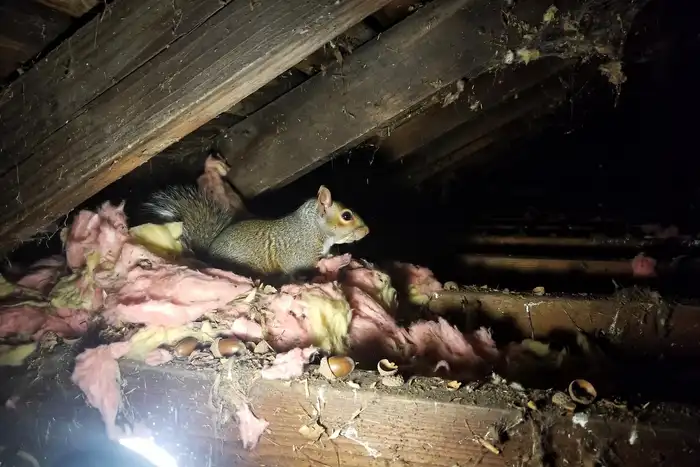
Squirrels in your Cuyahoga Falls home
Cuyahoga Falls gives squirrels a commute most suburbs cannot match. The gorge slopes and ravines are continuous woods running through town, and the canopy in the older neighborhoods meets that woods at street after street — a squirrel can travel from deep cover to your ridge line without touching the ground. On the rim streets, the question is rarely whether squirrels will test a house. It is whether the house's roofline, after another Ohio winter of ice and thaw, has a weak board or lifted seam to offer them.
The housing along the river raises the stakes. Older homes here have been re-roofed, re-sided and added onto in stages, and each stage leaves junctions — where an addition's eave meets the original wall, where flashing was layered rather than replaced. Squirrels find those junctions methodically in the fall, when the search for a winter den turns serious, and a den in the attic means months of nesting, droppings and gnawing directly over the bedrooms.
Gray squirrels by day, flying squirrels by night
Two different tenancies produce two different complaints. Gray squirrels announce themselves with daytime running and scratching, heaviest at dawn and in the last hours of light. Flying squirrels, which thrive in the wooded gorge neighborhoods, are small, big-eyed and strictly nocturnal — the house hears soft thumps and scurrying after midnight, sometimes for a whole colony, since flying squirrels den together for warmth. The distinction is not academic: flying squirrels enter through gaps barely an inch across, travel in groups, and are missed entirely by a seal job sized for grays. Our inspection identifies which animal — or both — before a single opening is closed.
How they reach a roof on a wooded slope
Homeowners trim the tree overhanging the house and wonder why squirrels still arrive. On gorge-side lots the answer is the slope itself: a squirrel climbs the bank, takes the retaining wall as a walkway, crosses a fence or a utility line, and steps onto a porch roof or a low addition eave — older Cuyahoga Falls homes present several roof levels, and the lowest one is the boarding ramp. From there it is a short climb to the gap it has been working at. Trimming helps where a limb truly bridges to the roof, but access control here is mostly about the structure: low roofs, junctions and vents get the inspection's closest attention.
What a winter in the attic costs
A squirrel denning from October to March is not a guest passing through — it is a resident renovating. Insulation gets torn into nests and packed down in runways, which shows up in heating bills on a Summit County winter. Stored items in the attic are gnawed and soiled. And the chewing habit itself — constant, because a squirrel's incisors grow continuously — finds the attic's wiring often enough that stripped, bare conductors are a standard find on these jobs. That fire risk, hidden above a ceiling, is why 'wait until spring' is advice our crew will not give for an occupied attic.
Litters: late winter and late summer
Gray squirrels typically raise young twice a year in Ohio — a late-winter litter and another in late summer — and flying squirrels follow a similar rhythm. A female who denned in your attic in the fall is very likely raising a litter in it by February. The removal plan has to account for that: closing an entry on a mother with nursing young inside produces a frantic animal chewing a new entrance — often through a worse place, like a ceiling-adjacent soffit — and young left to die in the insulation. Our crew checks the den for litters with care before exclusion is set, and sequences the work so the family leaves intact.
The exclusion, step by step
First, a full roofline inspection — every level of a staged older roof, both sides of every junction, chimney flashing, all vents — with each gap catalogued. Second, the main entry gets a one-way excluder door: squirrels exit to feed and cannot re-enter. Third, every secondary gap is closed in steel — flashing, hardware cloth, woven mesh — sized down to flying-squirrel standard where they are present. Fourth, a quiet period and a recheck confirm the attic is empty; only then is the main entry sealed for good. It is methodical rather than dramatic, and on a house under permanent woodland pressure it is the version that holds.
After the attic is quiet
Expect the excluded squirrels to test the house for a few days — scratching at the sealed entries is normal and fades as they take up a tree den instead. What keeps them from succeeding is the steel, and what keeps the next family from starting over is maintenance suited to this terrain: checking the low addition roofs and vents each fall, keeping feeders off the porch, and not letting a lifted piece of flashing wait a season. In Cuyahoga Falls, exclusion is not a one-time event so much as making the house the one address on the slope that does not open.
Common squirrel questions in Cuyahoga Falls
The noise in my attic only happens at night — are those squirrels?+
I trimmed my trees back — why are squirrels still getting on the roof?+
Can squirrels really start a fire?+
What if there are baby squirrels in the attic?+
Will a one-way door work in the middle of winter?+
How much does squirrel removal cost in Cuyahoga Falls?+
Other Cuyahoga Falls problems that come with squirrels
Our wildlife crew handles these closely related problems — the ones that most often turn up with a squirrel issue.
Got more than squirrels in Cuyahoga Falls?
Squirrels are rarely the only thing using an attic or yard in Cuyahoga Falls. See everything we handle locally on the Cuyahoga Falls wildlife removal hub, or jump to Ohio wildlife removal.
Serving all of Summit County
Cuyahoga Falls is one part of Summit County. See wildlife removal in Summit County, OH for the county-wide picture — the animals we get called about most, and the other towns we cover.
One call to your Cuyahoga Falls squirrel crew
The longer squirrels stay in the attic, the more they chew and the bigger the cleanup. Call us and tell us about the job — we will confirm the local crew for your county before any work starts.
- Local to Summit County. ODNR-compliant handling — call to ask about licensing and insurance.
- Humane exclusion. One-way doors and steel sealing, not poison.
- Done right. Removal, exclusion and cleanup.