Groundhog Removal in Cuyahoga Falls, OH
On a flat lot a groundhog is a nuisance. On a Cuyahoga Falls hillside, digging at the base of the wall that holds your yard up, it is something more urgent than that. Call us and tell us about the job — we will confirm the local crew for your county before any work starts.
Groundhogs in your Cuyahoga Falls home
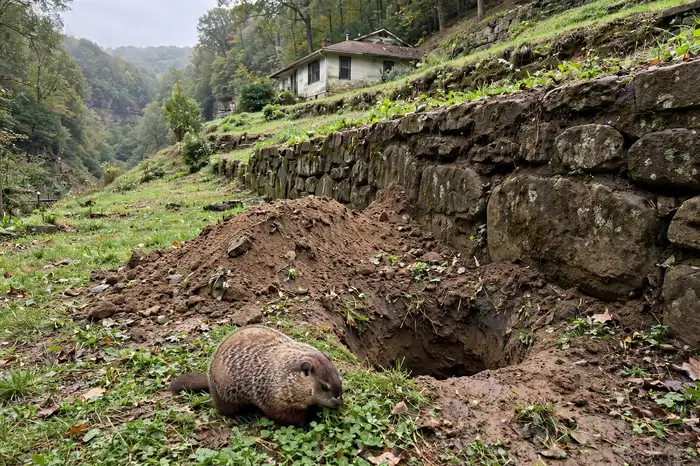
The woodchuck is the gorge's earthmover. Groundhogs keep the valley slopes and park edges burrowed as a matter of daily life, and the residential lots terraced into those same hillsides present them a familiar opportunity in a new material: the soil banked behind a retaining wall, the sheltered underside of a deck built out over the slope, the soft fill at a shed's downhill edge. A groundhog reads a terraced Cuyahoga Falls yard the way it reads a riverbank — as diggable shelter with grazing close by.
What the animal builds is not a hole but a system: a main entrance with its fan of excavated soil, one or more discreet boltholes, tunnels that can run twenty feet or more, and chambers below the frost line where it will sleep the winter away. Built under a lawn, that system is a tripping hazard and a gardening war. Built against a wall or a foundation on a slope, it is soil being quietly subtracted from the structure's support — and on a hillside, soil does not stay politely in place once its burrowed neighbor starts rearranging it.
Why the retaining wall is ground zero
A retaining wall concentrates everything a groundhog wants: backfill soil that is looser than undisturbed ground, drainage that keeps the burrow drier than the slope, and the wall face itself as a roof no predator can dig through quickly. Burrowing along the wall's base or behind it voids the material the wall's footing relies on, and the first evidence is often not the hole but the wall — a course beginning to lean, a bulge after a wet spring, pavers above it settling into a dip. By the time a wall shows distress, the system behind it is usually mature. Our inspection therefore starts at the wall, maps every entrance on both faces of the slope, and treats the burrow and the structure as one problem.
A tenant with a strict calendar
No local animal is as seasonal as this one. Groundhogs are true hibernators: they seal themselves below the frost line roughly from late October to late February, breathing a few times a minute, living on fat. A burrow problem discovered in November is, practically, an appointment to make for spring. Emergence in late winter is when the work opens — animals are up, hungry, visible at their entrances, and the season's digging has not yet begun in earnest. Spring and summer are the working months, with litters born in spring adding young to the system by early summer. By fall the animal is a digging-and-eating machine preparing to vanish, and burrows get their last expansion. Our crew will place your job honestly on this calendar rather than pretend a sleeping groundhog can be trapped in January.
Gardens on the slope
Terraced vegetable gardens are a Cuyahoga Falls tradition and a groundhog's favorite restaurant — beans, peas, greens, squash and melon vines taken with a thoroughness that feels personal. The animal can climb a low fence and will, so garden fencing alone disappoints unless it is tall, tight at the ground and ideally angled outward at the top. But the strategic point stands apart from fencing: a groundhog burrowed beneath your deck is not visiting the garden, it is commuting to it, and the conflict ends when the burrow address is retired, not when one crop is defended. Garden protection buys the season; removal plus proofing ends the tenancy.
Removal and hillside proofing
The crew first walks the slope and maps the whole system — main entrance, boltholes, and any runs reaching the wall, deck or foundation. Traps are set at the active burrow mouths, the approach Ohio's woodchuck rules are written around, and the system is cleared while the animal is in its active season. Then the hillside-specific half: the entrances are closed and the threatened structures are proofed with steel mesh buried and flared underground along wall bases, deck skirts and shed edges, following the contour of the slope. On this terrain, mesh placement matters as much as mesh itself — a barrier that stops at a terrace edge or leaves the wall's end open is a barrier a groundhog walks around in a night.
Half-measures the slope exposes quickly
Backfilling the visible mound hole is the most common wasted effort — the animal reopens it or uses a bolthole, and the mound was never the system's front door anyway. Dumping rubble into entrances has the same fate against an animal that moves yards of soil as a lifestyle. Mothballs in the burrow accomplish nothing except mothballs in the burrow. And on a slope, do not try flooding the system: water follows the tunnels and the gradient, and it can come out exactly where your wall's drainage is weakest. Empty the system, then engineer the closure — that ordering is what the terrain respects.
Common groundhog questions in Cuyahoga Falls
A groundhog is burrowing behind my retaining wall — how bad is it?+
It is December and I just found a groundhog burrow — what now?+
When do groundhogs have their young?+
I filled the hole and the digging came back in two days — why?+
Will a groundhog undermine my foundation?+
How much does groundhog removal cost in Cuyahoga Falls?+
Other Cuyahoga Falls problems that come with groundhogs
Our wildlife crew handles these closely related problems — the ones that most often turn up with a groundhog issue.
Got more than groundhogs in Cuyahoga Falls?
Groundhogs are rarely the only thing using an attic or yard in Cuyahoga Falls. See everything we handle locally on the Cuyahoga Falls wildlife removal hub, or jump to Ohio wildlife removal.
Serving all of Summit County
Cuyahoga Falls is one part of Summit County. See wildlife removal in Summit County, OH for the county-wide picture — the animals we get called about most, and the other towns we cover.
One call to your Cuyahoga Falls groundhog crew
The longer groundhogs stay in the attic, the more they chew and the bigger the cleanup. Call us and tell us about the job — we will confirm the local crew for your county before any work starts.
- Local to Summit County. ODNR-compliant handling — call to ask about licensing and insurance.
- Humane exclusion. One-way doors and steel sealing, not poison.
- Done right. Removal, exclusion and cleanup.