Skunk Removal in Cuyahoga Falls, OH
The smell reaches the second floor some nights — a skunk has taken the dry, dark space under your porch, within commuting distance of every grub-rich lawn on the street. Call us and tell us about the job — we will confirm the local crew for your county before any work starts.
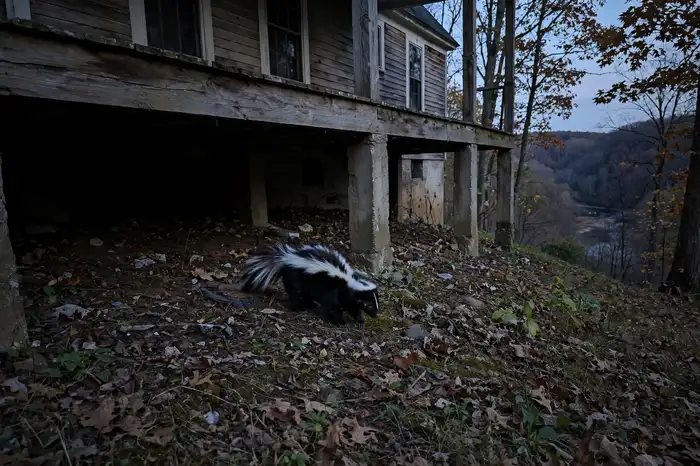
Skunks in your Cuyahoga Falls home
The older streets above the river are skunk architecture as much as they are human architecture. A porch raised on piers, skirted long ago, with the skirting rotted or gapped at the soil line. A low deck on a sloped lot, its downhill side open to a dark crawl of space. A shed set into the bank. Striped skunks prospect these spaces the way raccoons prospect chimneys, and the ones along the wooded slopes find them fastest — the gorge habitat keeps a healthy skunk population at the city's core, and the rim neighborhoods are its suburbs.
A denning skunk is, day to day, a quiet tenant — which is how the situation usually lasts until a dog, a startled teenager with a flashlight, or another skunk turns it into a spraying incident that closes the house's windows for a week. The time to deal with a skunk under the porch is while it is still a smell that comes and goes, not the night it becomes the street's story.
First, the legal frame: skunks stay in Ohio, on site
Skunks sit on the same Ohio list as raccoons — OAC 1501:31-15-03(E)(3) — and for the same reason: they are one of the state's principal rabies species. A captured skunk must be released on site or euthanized; a service that offers to trap your skunk and release it in the countryside is offering to break the rule that keeps rabies from being chauffeured around Summit County. Our crew's work is therefore structural: verify the den, clear it using exclusion and lawful, licensed handling, and then close it so completely that the address stops appearing in skunks' mental listings. The animal problem is solved at the porch, which is where it actually lives.
Signs the den is occupied
The odor is the famous one, but the earlier signs are subtler: a faint musk at the porch steps in the evening, strengthening on mild nights; a worn path in the mulch to a gap in the skirting; shallow, neat cones dug in the lawn where the tenant foraged grubs the night before; and a dog suddenly very interested in one specific corner of the deck. In the coldest weeks the sign may pause — skunks den up, sometimes several sharing a winter den, riding out deep cold — then reassert itself on the first warm evening. None of these signs require a guess: a crew visit confirms the den, its entrances, and whether young are part of the picture.
February to June: the skunk calendar
Skunk complaints in Summit County run on a mating calendar. Breeding season in late winter sets males wandering and spraying, and perfume complaints spike before spring officially arrives. Females then den to raise litters — a porch den occupied in April is very likely a nursery by May. That fact schedules the work: a known den is best cleared before the litter, or handled with the young accounted for, and never sealed blind in spring. Come fall, skunks feed hard toward winter and pick their cold-season dens, which makes autumn the second smart moment — clear and screen a summer den before it becomes a winter one.
Keeping the spray count at zero
Skunks are reluctant sprayers — the musk is expensive for the animal to make, and it warns with foot-stamping and a raised, turned tail before it fires. Sprays happen when a skunk is cornered and surprised, which in practice means dogs. While a den on your property awaits its appointment: leash the dog after dark, scout the yard with a light before letting it roam, close the pet door at night, and do not let children play detective at the skirting gap. Our crew works skunks slowly and at the den's own rhythm for the same reason — a calm skunk is an unsprayed skunk, and the neighborhood can tell the difference.
Screening: the part that ends the tenancy cycle
Under-structure spaces on sloped Cuyahoga Falls lots need more than a board nailed over a gap — a determined digger on a hillside goes around, under or through casual fixes. The durable closure is steel mesh trenched down and flared outward underground around the porch, deck or shed perimeter, following the slope, so an animal digging at the base meets an underground apron it cannot pass. Our crew installs it after the den is confirmed empty, and it does double duty: the same screening that retires a skunk den also closes the space to the opossums and groundhogs that would otherwise inherit it.
The lawn holes are a footnote
Homeowners sometimes call about the digging and miss the den. The little cones a skunk excavates after grubs heal over in weeks and are, by themselves, a fair trade for a grub-eating night patrol. But a lawn being worked nightly by a skunk that also lives under your porch is one integrated fact: food beside shelter. Grub-killing the lawn while the den stays open changes little. Clear the den, screen it, take up the outdoor pet food and secure the cans — and most gorge-side yards go back to hosting skunks only as occasional, unremarkable passersby, which is the natural arrangement.
Common skunk questions in Cuyahoga Falls
A skunk lives under my Cuyahoga Falls porch — how is it removed?+
Why can't the skunk just be released in a field?+
We smell skunk on mild winter nights but not in deep cold — is it denning here?+
How do I keep my dog from getting sprayed meanwhile?+
Are skunks in Summit County a rabies risk?+
How much does skunk removal cost in Cuyahoga Falls?+
Other Cuyahoga Falls problems that come with skunks
Our wildlife crew handles these closely related problems — the ones that most often turn up with a skunk issue.
Got more than skunks in Cuyahoga Falls?
Skunks are rarely the only thing using an attic or yard in Cuyahoga Falls. See everything we handle locally on the Cuyahoga Falls wildlife removal hub, or jump to Ohio wildlife removal.
Serving all of Summit County
Cuyahoga Falls is one part of Summit County. See wildlife removal in Summit County, OH for the county-wide picture — the animals we get called about most, and the other towns we cover.
One call to your Cuyahoga Falls skunk crew
The longer skunks stay in the attic, the more they chew and the bigger the cleanup. Call us and tell us about the job — we will confirm the local crew for your county before any work starts.
- Local to Summit County. ODNR-compliant handling — call to ask about licensing and insurance.
- Humane exclusion. One-way doors and steel sealing, not poison.
- Done right. Removal, exclusion and cleanup.