Snake Removal in Cuyahoga Falls, OH
Living above a river gorge means snakes are part of the scenery — the startling part is only when the scenery comes indoors, into the basement or the garage. Call us and tell us about the job — we will confirm the local crew for your county before any work starts.
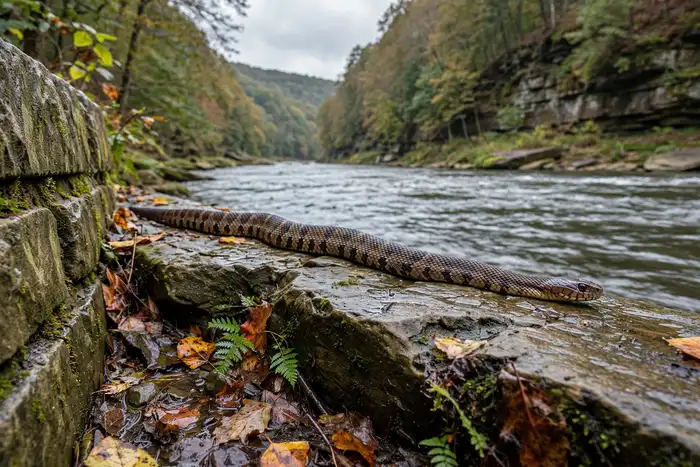
Snakes around your Cuyahoga Falls home
A city draped over a river gorge will have snakes the way it has water in the river. The Cuyahoga and its banks host northern watersnakes in numbers; every damp garden and stone wall in town has its garter snakes; eastern rat snakes climb the wooded slopes and the rafters of garages and older homes alike; and milk snakes hunt mice around the foundations of the older river neighborhoods. It is worth stating the regional truth plainly before the fear gets a vote: northeast Ohio's snakes are overwhelmingly nonvenomous, and the few venomous species on Ohio's list are rare, protected, and essentially absent from Summit County's suburbs.
So the work here is not emergency venom response, and we will not sell it as one. It is accurate identification — by someone who can tell a heavy-bodied, harmless watersnake from anything else at ten paces — and, when a snake has crossed from scenery to house guest, a calm removal plus the detective work of why it came in: almost always a gap in an older foundation, and almost always rodents on the other side of that gap.
Meet the gorge's regulars
Northern watersnakes are the river's own: thick-bodied, banded when young and darker with age, quick to drop into the water or, cornered on land, to bite repeatedly and musk — impressive theater, no venom. Anglers and gorge hikers meet them constantly. Garter snakes are the striped garden tenants, frog and worm hunters, too small to be a threat to anything larger than a toad. Eastern rat snakes are the giants of the local list — dark adults of five feet and better, climbers that turn up on porch beams and in garage rafters after rodents and birds' nests. Milk snakes, smooth and blotched in red-brown, patrol older foundations and outbuildings at night. Knowing the cast turns most encounters from an alarm into an identification exercise.
Basements in the older river homes
A hillside house presents a snake with a peculiar opportunity: the downhill face of its foundation is a full story of wall, pierced by windows, doors, vents and a century's worth of utility holes, standing directly against the wooded bank the snake already hunts. Rat snakes and milk snakes slip in through a gap at grade — sometimes the same quarter-inch generosity the mice use — and take up residence among the joists and stored boxes, close to the rodent supply. Homeowners discover them on the stairs, along a basement wall top, or by the shed skin left draped on a pipe. A snake that has wintered in a foundation may reappear season after season until the gap and the mice are both dealt with.
Yard encounters: the honest advice
A watersnake at the river's edge or a garter snake in the hostas is wildlife doing its job in its own habitat, and the right response is a respectful berth. Yard removals make sense where a snake has settled into a pattern a household cannot live with — coiled daily at the pool steps, resident in a play structure, or a large rat snake denning in a much-used outbuilding. Even then, expect our crew to be straightforward with you: relocation of a harmless snake a short distance within its home ground is straightforward work, and killing it is neither necessary nor a solution, since the rodents and cover that attracted it will simply attract its replacement.
What never to do
Never handle a snake you have not had identified, and never try to kill one at close quarters — that combination, not snakes minding their business, is how snakebites happen. Do not scatter mothballs: they do not repel snakes, and they are not legal or safe to use around a home for wildlife. Do not set glue traps, which take birds, bats and everything else in slow, miserable fashion. And do not rely on internet snake rules-of-thumb about head shape or pupil shape — several are unreliable even when you are close enough to check, and checking puts you exactly where you should not be.
Closing the house to snakes
Snakes do not create entries; they inherit them. So the permanent fix is the foundation audit our crew performs after a removal: cracks at grade repaired, pipe and wire penetrations packed with steel and sealed, basement windows and doors made to close true, vents screened in metal. In parallel, the attractions are thinned — the mouse problem treated by sealing and trapping, brush and woodpiles pulled back from the downhill foundation, clutter along basement walls cleared. You cannot fence the gorge out of Cuyahoga Falls, but you can retire your house from the list of buildings a snake can enter, and a snake that cannot enter goes back to being scenery.
Common snake questions in Cuyahoga Falls
Is there anything venomous living in Cuyahoga Falls?+
A big dark snake is in my garage — what is it, and what do I do?+
A snake fell still and is coiled by my pool steps every day — should it be removed?+
Do snakes come back to the same house?+
Are snake repellents worth buying?+
How much does snake removal cost in Cuyahoga Falls?+
Other Cuyahoga Falls problems that come with snakes
Our wildlife crew handles these closely related problems — the ones that most often turn up with a snake issue.
Got more than snakes in Cuyahoga Falls?
A rat snake in a Cuyahoga Falls basement is the second wildlife problem in that basement — the mice were the first. See everything we handle locally on the Cuyahoga Falls wildlife removal hub, or jump to Ohio wildlife removal.
Serving all of Summit County
Cuyahoga Falls is one part of Summit County. See wildlife removal in Summit County, OH for the county-wide picture — the animals we get called about most, and the other towns we cover.
One call to your Cuyahoga Falls snake crew
A snake at the foundation is hunting something. Take away the rodents and the cover and the hunting moves elsewhere — remove only the snake, and the job advertises a vacancy. Call us and tell us about the job — we will confirm the local crew for your county before any work starts.
- Local to Summit County. ODNR-compliant handling — call to ask about licensing and insurance.
- Identify, then remove. Species confirmed from a safe distance, removal where it belongs indoors or in traffic areas, and the entry and food source addressed.
- Done right. Removal, exclusion and cleanup.