Wildlife Removal in Chesterland, OH
Chesterland spreads out the way township Geauga does — houses set back on larger wooded lots, a barn or shed behind the house, a woodpile by the drive and woods on two or three sides. Wildlife does not visit a property like that; it lives on it, and the job is deciding which of its addresses are yours. Call us and tell us about the job — we will confirm the local crew for your county before any work starts.
Why Chesterland homes see the wildlife they do
A Chesterland wildlife problem rarely has a single address. The same lot that holds the house holds a barn, a shed or two, a woodpile, maybe a chicken coop or a detached garage — and animals distribute themselves across all of it. Raccoons den in the barn hayloft and raid the house trash. A groundhog undermines the shed while skunks winter under the deck. Bats summer in the house attic and a snake works the barn for the mice the feed attracts. Treating only the structure where you first noticed something is how township jobs half-finish.
The houses themselves are a septic-era, township mix: ranch and colonial homes built across several decades on acre-plus lots, many with crawlspaces, well houses, buried lines and outbuildings that were never sealed to a suburban standard. Deep woods press against the clearings, so the animals at the foundation arrived from habitat measured in steps, not miles. Add snowbelt winters that load roofs, bury fences and give voles months of covered runways across the lawn, and a Chesterland property presents wildlife with a year-round, multi-building invitation.
Our crew works the whole lot the way the animals do: house first, then barn, sheds, woodpile and the tree line, mapping which structures are occupied and which are simply open. Animals are handled as Ohio law requires, young are found before anything closes, and exclusion is built to a woods-lot standard — metal, buried screening, caps and covers — because out here the next tenant is already living at the edge of the yard.
Barns, sheds and woodpiles: the other half of the property
Start the inspection where the feed is. Barns and sheds on Chesterland lots store the things wildlife eats and nests in — grain and seed, hay and straw, pet food, bird seed, stacked firewood full of insects and mice. A barn with a hayloft is a raccoon apartment building; a shed with a gap under the door is a skunk or opossum winter rental; a woodpile against the house is a covered corridor that delivers rodents, chipmunks and snakes to the foundation without crossing open ground.
Outbuildings also explain mysteries at the house. Mice that seem to reappear after a good sealing are often commuting from a barn population twenty yards away. A snake in the basement may winter in the woodpile and hunt both buildings. The crew therefore inventories outbuildings as part of the job — which are occupied, which are food stores, which have burrows under their sills — and the plan closes the ones that matter rather than pretending the lot ends at the back door.
The fixes out here are structural and practical: doors that sit flush and latch, sills screened or set in metal, feed in sealed metal bins, firewood stacked away from the house on a rack. None of it asks a township lot to become a suburb; all of it changes whether wildlife treats your buildings as habitat.
Septic-era houses on deep-woods lots
A Chesterland house was often built in stages, on a lot its owners cleared themselves, and it shows in the details animals exploit: crawlspaces vented and forgotten, additions whose roof junctions never quite married, buried utility and septic lines running through soil that burrowing animals also favor, and porches and decks built low over open ground. The foundation level of such a house is a landscape, not a line.
Woods complete the pressure. A deep-woods lot means squirrel highways in the canopy over the roof, deer mice and flying squirrels at the tree line, chipmunks in every stone pile and retaining edge, and raccoons and opossums patrolling a nightly route that includes your porch. The background traffic never stops, so exclusion here is not about keeping animals off the property — an impossible promise on a Geauga township lot — it is about making the buildings themselves unavailable while the traffic flows past.
That is why township sealing uses heavier material and more of it: longer runs of buried screening at decks and porches, caps on chimneys that serve wood stoves only part of the year, vent covers that survive a falling branch. The standard is a building a woods animal inspects, fails to enter, and leaves for the hollow tree it should have chosen.
Snowbelt winters on a rural-suburban lot
Chesterland takes the same lake-effect snow that buries the rest of the Geauga snowbelt, and on a large lot the snow rewrites the property for months. Fences disappear as barriers, drifts pile travel ramps against outbuildings and decks, roofs carry real loads and ice dams pry at the eaves of house and barn alike. Animals use the transformed landscape: what a fence kept out in October walks over a drift in February.
Under that snow, the lawn is a worksite. Voles tunnel and feed beneath the pack from first snow to melt, girdling young trees and carving trail systems across turf that only appear in April. Mice read the first frost as a starting gun and press into houses, barns and garages for a winter that lasts until spring is well advanced. Groundhogs and skunks simply wait it out in burrows and dens chosen in the fall — which is why fall decisions on a township lot echo all winter.
The seasonal counter is timing: outbuildings and the house inspected and sealed in fall before the push, feed secured before it draws a crowd, and a spring walk of the whole lot once the snow leaves — checking what the ice opened, what the drifts let in and what the voles did under cover.
Ohio law on a township lot: licensing, bats and the on-site rule
Wildlife removal for hire in Ohio requires the ODNR Commercial Nuisance Wild Animal Control Operator license under Ohio Revised Code section 1531.40, whether the job is a village attic or a township barn. Ask any crew about that license and about insurance before work starts. Three parts of the state rulebook shape most Chesterland jobs.
Bats first, because barns and big attics both hold colonies: exclusion is prohibited from May 16 to July 31 when five or more bats are present, while pups are flightless, and from October 15 to March 31, when big brown bats may be hibernating inside the structure — in either season only prior written permission from the Chief of the Division of Wildlife opens an exception. The lawful working windows are April 1 through May 15 and August 1 through October 15, and a colony found in June gets an inspection, a map of entries and an August date.
Rabies and the on-site rule finish the picture. Raccoons, skunks, foxes and bats are the wild animals Ohio names as its main rabies carriers, so a bold or unsteady animal on a township lot is a keep-the-dogs-in, make-a-call situation. And under Ohio Administrative Code 1501:31-15-03(E)(3), a caught raccoon, skunk or opossum may not be hauled away to be let go, however much woods the county offers; the lawful outcomes are release on the same property or humane euthanasia. Our wildlife crew leads with exclusion — one-way doors and sealing so animals leave a barn, porch or attic under their own power — and handles the rest exactly as that rule requires.
Wildlife we remove in Chesterland
From groundhogs under the shed to bats over the hayloft and mice in the house walls, these are the animals Chesterland lot owners call about most.
🐿️ Squirrels
Woods on every side means squirrels on every roof — grays in the house attic, flying squirrels arriving by glide at night, reds in the conifers. They also den in barn and garage ceilings, and they chew wiring wherever they settle. See our full Chesterland squirrel removal guide →
🦝 Raccoons
Barn lofts, wood-stove chimneys and big township attics all serve as spring nurseries, and the lot itself feeds the mothers. Ohio law does not allow a raccoon to be carried off and released, so exclusion, kit accounting and latrine cleanup carry the job. See our full Chesterland raccoon removal guide →
🦇 Bats
Big brown bats colonize Chesterland attics and some barn roosts in summer, then hibernate in the same buildings through the snowbelt winter. State closure dates fix when exclusion can run — plan on spring or late summer windows. See our full Chesterland bat removal guide →
🦨 Skunks
Skunks winter under decks, porches, sheds and barn floors all over township lots, then whelp there in spring. A rabies vector that Ohio law keeps on the property where it is caught — calm exclusion plus buried screening is the answer. See our full Chesterland skunk removal guide →
🦫 Groundhogs
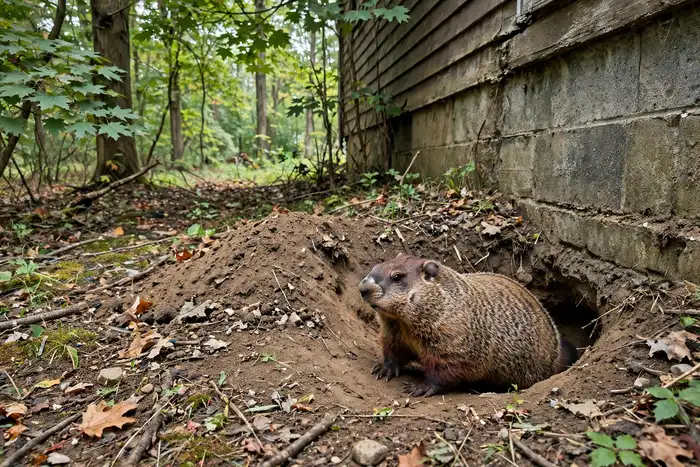
Groundhogs burrow under sheds, barns, decks and slab edges wherever a lot gives them open feeding ground next to cover, then hibernate through the long Geauga winter. Spring emergence restarts the excavation in earnest. See our full Chesterland groundhog removal guide →
🐾 Opossums
Opossums patrol the woods edge nightly and sleep the day in garages, under decks, in sheds and in the barn. Ohio law keeps a caught opossum on its own property, so closing the shelter it chose is the lasting half of the work. See our full Chesterland opossum removal guide →
🐿️ Chipmunks
Chipmunks colonize stone piles, retaining edges and the soil along house and barn foundations, hauling excavated dirt away a cheekful at a time. Woodpiles and feeder spill at the buildings keep the whole colony close. See our full Chesterland chipmunk removal guide →
🐀 Rats, mice & voles
House and deer mice storming the buildings at first frost, Norway rats around barns and feed storage, and voles spending the snow season tunneling under the pack across big lawns. On a township lot the three often arrive together. See our full Chesterland rodent removal guide →
🐍 Snakes
Rat snakes in the barn after mice, garter snakes in the garden, milk snakes at stone foundations and woodpiles, watersnakes near ponds and wet woods. A nearly all-harmless cast — identification and, indoors, removal are the service. See our full Chesterland snake removal guide →
🪰 Dead animals
Animals die over winter in wall voids, porch dens, barn lofts and crawlspaces on township lots, and the thaw announces them. Locating and removing the carcass — then sealing the den — ends a smell that distance from neighbors does not make bearable. See our full Chesterland dead animal removal guide →
Animal-specific help in Chesterland
Deep, local guides for the problems we get called about most — with our wildlife crew behind every one.
How to get help in Chesterland
Tell us what you're hearing
Scratching in the attic, a snake by the porch, holes in the yard — call with your problem and your Chesterland address.
We connect you locally
Call us and tell us about the job — we will confirm the local crew for your county before any work starts.
They solve it — for good
Inspection, humane removal, full exclusion and cleanup — handled by our wildlife crew, following Ohio rules.
Common wildlife removal questions in Chesterland
Who do I call for wildlife removal in Chesterland?+
The animals seem to be in my barn, not my house — do you handle that?+
Can bats be excluded from my attic or barn in summer or winter?+
With all this woods around, can you just release a raccoon deeper in the trees?+
Does a woodpile really cause wildlife problems at the house?+
How much does wildlife removal cost in Chesterland?+
Serving all of Geauga County
Chesterland is one part of Geauga County. See wildlife removal in Geauga County, OH for the county-wide picture — the animals we get called about most, and the other towns we cover.
One call to your Chesterland wildlife crew
Whether it's squirrels in an older in-town attic or a raccoon in a new subdivision crawlspace, the fastest fix is our wildlife crew, who knows Geauga County wildlife. Call us and tell us about the job — we will confirm the local crew for your county before any work starts.
- Local to Geauga County. ODNR-compliant handling — call to ask about licensing and insurance.
- One company, one call. Call us and tell us about the job.
- Done right. Removal, exclusion and cleanup.