Snake Removal in Chesterland, OH
A long snake stretched along the barn beam, or one slipping between the woodpile and the foundation? On a wooded Chesterland lot, snakes are staff, not intruders — rodent hunters that occasionally take their work indoors, where they understandably alarm the management. Call us and tell us about the job — we will confirm the local crew for your county before any work starts.
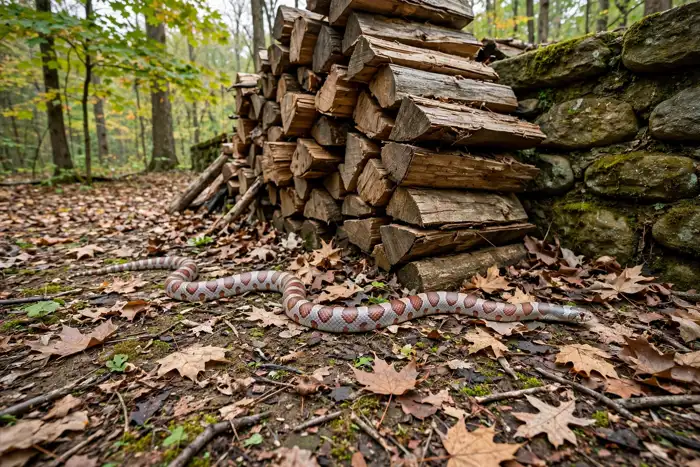
Snakes around your Chesterland home and barn
A Chesterland lot, with its woods, stone piles, ponds and outbuildings, is prime snake habitat — and the resident species are a reassuring roster. Eastern rat snakes patrol barns and enter basements after mice. Eastern garter snakes work gardens and lawn edges. Milk snakes haunt stone foundations, barns and woodpiles. Northern watersnakes hold the ponds, ditches and wet woods. Ohio's venomous species are rare specialists of particular habitats, not township-lot animals.
The service is therefore twofold: certainty and placement. Certainty, because several harmless local species are routinely misread as dangerous on pattern alone. Placement, because a snake in the yard is an asset to leave alone, a snake in the barn is negotiable, and a snake in the basement is a removal — followed by the mouse and foundation work that explains why it came in.
The rat snake runs the barn
If a Chesterland building has a resident snake, odds favor the rat snake: long, dark, an exceptional climber, and drawn to barns by the mice that feed storage guarantees. It coils on beams, along sills and behind equipment, holding still in the hope of being overlooked. In the house it favors basements for the same menu. This is a beneficial animal in exactly the wrong room — the crew removes it safely, and the conversation turns to the rodent population that employed it.
Milk snakes, garter snakes and the pond tenant
Milk snakes — blotched, secretive, nocturnal — live around stone foundations, barns and woodpiles and are chronically mistaken for venomous species their markings only vaguely echo. Garter snakes are the small striped snakes of every garden and field edge, eating slugs and frogs and asking nothing. Watersnakes are the heavy, dark, short-tempered fishermen of ponds and creek banks — nonvenomous, best admired from the bank. All three are yard residents to leave in place; calls are warranted when one is trapped in a well or building, or when identification itself is the peace of mind being purchased.
Woodpiles and stone piles: snake housing by the house
Snakes live where their prey shelters and where they can hide — which on a township lot is the woodpile, the stone pile and the cluttered barn corner, preferably adjacent to a foundation full of mice. A woodpile stacked against the house is, in effect, a snake ramp to your basement wall. Moving firewood off the house on a rack, and keeping the ground along foundations mowed and open, does not banish snakes from a wooded lot; it removes their covered approach to the buildings, which is the part that generates calls.
Why killing it is the dangerous option
The statistics of snakebite are consistent: most bites happen to people trying to kill or handle a snake, and here they would be risking that over animals that are almost uniformly harmless. A killed rat snake is also a staffing cut — its mouse route reopens for the next snake, which will find the same foundation gap. A call, by contrast, ends with the snake identified, removed alive if it is indoors, and still on rodent duty somewhere appropriate.
Closing the route the snake reported
An indoor snake has filed a precise report: mice inside, and a way in — a pipe penetration, a failed vent, crumbled mortar in a stone or block foundation, a gap at a bulkhead or sill. The complete job answers it with rodent control and foundation sealing in metal and mortar. Do both, and the snake problem solves itself as a side effect, because the restaurant and its door have closed.
Common snake questions in Chesterland
There is a big snake in my Chesterland barn — is it dangerous?+
How do I tell the harmless snakes from a venomous one?+
Should snakes around the woodpile and garden be removed?+
Why did a snake come into my basement?+
How much does snake removal cost in Chesterland?+
Other Chesterland problems that come with snakes
Our wildlife crew handles these closely related problems — the ones that most often turn up with a snake issue.
Got more than snakes in Chesterland?
Snakes reach Chesterland basements through the same foundation gaps mice use — sealing and rodent work together close the snake route permanently. See everything we handle locally on the Chesterland wildlife removal hub, or jump to Ohio wildlife removal.
Serving all of Geauga County
Chesterland is one part of Geauga County. See wildlife removal in Geauga County, OH for the county-wide picture — the animals we get called about most, and the other towns we cover.
One call to your Chesterland snake crew
An indoor snake is a report on your mice and your foundation gaps, delivered in person. Answer the report — rodent control and sealing — and the visits mostly stop. Call us and tell us about the job — we will confirm the local crew for your county before any work starts.
- Local to Geauga County. ODNR-compliant handling — call to ask about licensing and insurance.
- Name it, then handle it. Species identified from a safe distance first; harmless building snakes removed by hand, and the mouse activity and foundation route behind the visit addressed.
- Done right. Removal, exclusion and cleanup.