Skunk Removal in Chesterland, OH
Skunk odor drifting from under the deck on a thaw night, and dogs suddenly very interested in the shed floor? On a Chesterland lot, a skunk can choose among the porch, the deck, the barn and three outbuildings for its winter den — and spring turns the best of them into a nursery. Call us and tell us about the job — we will confirm the local crew for your county before any work starts.
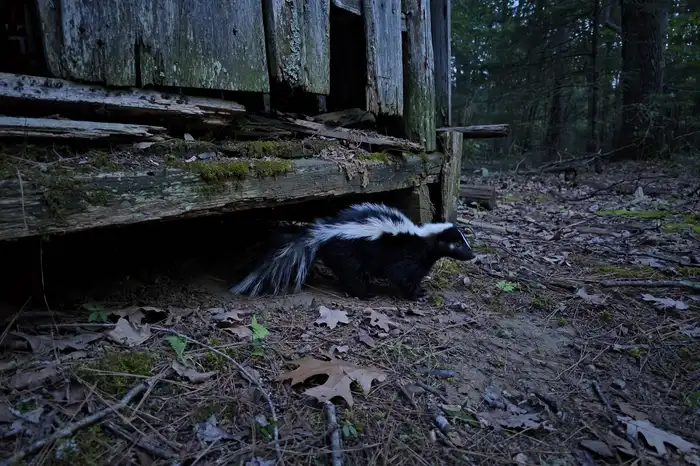
Skunks in your Chesterland home
Shelter is the one thing a Chesterland lot never runs short of. Low decks and porches on the house, shed and barn floors out back, brush piles, hollow logs at the tree line — a striped skunk prospecting in fall takes the driest, quietest option, which is usually a building somebody owns. By the deep-snow months the tenant is settled, sleeping through the worst cold and emerging on mild nights, largely invisible to the household above it.
Late winter changes the terms. Skunks breed as the snow still lies deep in Geauga County, roaming males get sprayed for their optimism, and pregnant females double down on the den they chose — under your deck boards. Skunks are also an Ohio rabies vector and sit squarely under the state rule that forbids carrying one away, so the response wants to be calm, early and lawful rather than a midnight confrontation with a shovel.
Which shelter, and is it connected to the house?
The inspection inventories the lot the way the skunk did: the entry dug at a deck skirt or shed corner, the size of the void, any route from a porch den through an old foundation opening into a crawlspace or basement, and the other shelters standing open nearby. It also settles the tenant question — a solitary wintering adult, or a female who will raise a litter in that void come spring. Excluding a skunk from the deck while the barn floor offers an identical den next door is a job that migrates rather than ends, so the plan names its closures.
A quiet winter tenant, a busy spring
Striped skunks sleep through the hardest weather in their dens, sometimes several together, rousing on thaw nights to forage under bird feeders and around barns. Breeding in late winter puts males on the move and odor in the air; by spring the complaint season peaks with litters under structures and dogs discovering dens at close range. The cheapest skunk job in Chesterland is the known den handled before that season — checked, excluded and screened while it is still a one-animal problem.
Ohio keeps a caught skunk on the property
Under Ohio Administrative Code 1501:31-15-03(E)(3), a trapped skunk has two lawful outcomes only: release on the same property or humane euthanasia. Driving it to a park, a farm or a deeper woods and letting it go is not among them, on a township lot any more than in town. That law makes exclusion the main instrument: a one-way fitting at the den entry lets the skunk leave at night to feed and bars its return, the crew verifies the void is empty, and the opening is screened for good. Handling, where it cannot be avoided, is unhurried work by a licensed operator inside that rule.
Keeping the encounter odor-free
A skunk sprays as a last resort and warns first — stamped feet, a pivot, a raised tail. Nearly every spray story on a township lot involves a dog: charging a den at dusk, cornering a skunk by the barn. Removal work done calmly, at the right hour, with dogs kept well away, almost never triggers it. If your dog does connect, keep it outdoors if you can; fresh air clears a yard in days, while spray worked into indoor fabrics lingers for weeks.
Buried screening across several structures
The durable close, at the house or the shed, is buried metal screening: mesh trenched around the structure's perimeter and bent outward below grade, so a digging animal strikes steel from any approach. On a Chesterland lot the screening decisions are plural — the deck den for certain, the shed floor if it is the obvious fallback, the barn corner where feed draws visitors. The crew will rank them honestly, because screening everything is rarely necessary and screening only the den often is not enough.
Grubs, feed and the lot at night
Skunks dig lawns into neat cone-pocked patterns hunting grubs, and they work a nightly route past trash, fallen fruit, chicken feed and pet food left out. None of that excavates a den by itself — but a lot that feeds a skunk dependably is the lot it chooses when den season comes. Securing feed in bins, latching trash and feeding pets inside all reduce the traffic your newly screened den has to refuse.
Common skunk questions in Chesterland
A skunk is denned under my Chesterland deck — how do you remove it?+
Can you let it go in the woods at the back of my lot?+
Why does the skunk smell peak in late winter?+
My dog keeps finding the den — what should I do?+
How much does skunk removal cost in Chesterland?+
Other Chesterland problems that come with skunks
Our wildlife crew handles these closely related problems — the ones that most often turn up with a skunk issue.
Got more than skunks in Chesterland?
Skunks are rarely the only thing using an attic or yard in Chesterland. See everything we handle locally on the Chesterland wildlife removal hub, or jump to Ohio wildlife removal.
Serving all of Geauga County
Chesterland is one part of Geauga County. See wildlife removal in Geauga County, OH for the county-wide picture — the animals we get called about most, and the other towns we cover.
One call to your Chesterland skunk crew
The longer skunks stay in the attic, the more they chew and the bigger the cleanup. Call us and tell us about the job — we will confirm the local crew for your county before any work starts.
- Local to Geauga County. ODNR-compliant handling — call to ask about licensing and insurance.
- Humane exclusion. One-way doors and steel sealing, not poison.
- Done right. Removal, exclusion and cleanup.