Raccoon Removal in Chesterland, OH
Heavy footsteps in the attic, feed bins tipped in the barn and chattering from the chimney in spring? Chesterland lots give raccoons food, water and a choice of dens on one property — and spring turns the coziest of them into a nursery. Call us and tell us about the job — we will confirm the local crew for your county before any work starts.
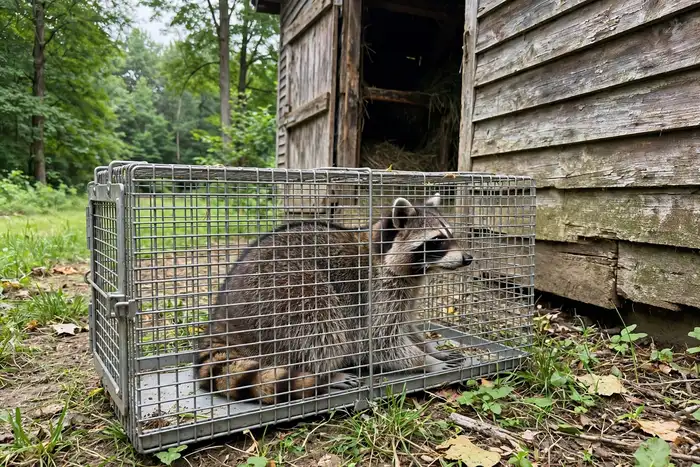
Raccoons in your Chesterland home
A raccoon could design Chesterland itself: woods for travel, ponds and ditches for washing food, gardens and corn in season, barns with feed, houses with trash — and for spring, a menu of raised, dry dens. Barn haylofts head the list, followed by chimneys on houses that heat with wood only part of the year, big attics, and the spaces under low decks and outbuilding floors. A female in April picks the best of them and moves in with intent to stay through summer.
The work is constrained, properly, by biology and by Ohio law. Kits are born helpless and cannot leave a den for weeks, so every removal plan has to account for animals that cannot walk out. And a raccoon may not be caught and let go somewhere else in this state — a rule that rules out the borrowed-trap approach and puts inspection, exclusion and serious sealing at the center of the job.
The on-site rule applies in the country too
It feels counterintuitive on a township lot surrounded by woods, but Ohio Administrative Code 1501:31-15-03(E)(3) makes no rural exception: a caught raccoon must be released on the same property or humanely euthanized. The rule is about rabies — raccoons are a principal Ohio vector — and about not exporting a problem animal into another area. Our crew therefore leads with one-way exclusion that lets the raccoon leave a loft, flue or attic itself, and reserves hands-on handling for the cases exclusion cannot solve, conducted strictly within the rule.
Haylofts, part-time chimneys and big attics
The hayloft is the classic Chesterland den: high, dry, insulated by hay, quiet for days at a time, and entered where loft doors or eaves have gaps. Inside the house, the equivalent is a chimney serving a wood stove or fireplace used only in deep winter — a flue that sits cold and uncapped through spring is a den with a masonry shell. Prints in soot, debris in the firebox and kit noises mark it. Attics over garages and additions round out the list. Every one of these gets its cap, screen or seal only after the family is verifiably out.
Finding every kit before the plan is set
Spring litters hide well — deep in hay, on a smoke shelf, in insulation at the far end of a soffit run. Miss them and the job collapses: a mother excluded from her kits will tear at a barn door or a roof to return, and kits left inside die where they lie, trading a removal for a carcass search in the least accessible part of the building. Our crew inspects with lights and cameras where the structure demands it, locates the litter, and builds the timeline around the kits — including hand-removal by the crew where that is the humane option.
Latrines in lofts and attics, and feed-room raids
Raccoons defecate communally in one latrine spot, and in a loft or attic that spot concentrates droppings that can carry raccoon roundworm eggs — a genuine concern around stored feed, hay handled daily and any space people work in. Cleanup removes the fouled material and treats the area. At ground level the same animal tips feed bins, tears bags and scatters grain, which is both a cost and an attractant for everything else on the lot. Sealed metal feed storage is pest control, not tidiness.
Sealing work built for strong hands
A raccoon tests a repair the way it made the opening — by force. Closures are heavy-gauge metal: proper chimney caps, reinforced covers on vents and louvers, flashing at rooflines where additions and porch roofs meet, loft doors repaired to sit flush with their frames, and eave gaps meshed in steel. In barns the crew thinks like the animal: any edge a raccoon can hook claws behind and pull is an edge that gets armored or rebuilt.
Making the lot pay less for a visit
Woods guarantee raccoon traffic; the lot decides whether traffic becomes tenancy. Feed in sealed metal bins, trash secured in the garage or a latched can, pet food fed indoors, fallen fruit picked up in season and grills cleaned all lower the nightly wage for inspecting your buildings. Combined with metal sealing at the dens, it redirects the next spring mother to the hollow trees the woods provide in quantity.
Common raccoon questions in Chesterland
Raccoons are denning in my Chesterland barn — what should I do?+
Can you trap them and release them in the state forest?+
Something is getting into our feed bins at night — raccoons?+
A raccoon near the barn shows no fear of us — is that normal?+
How much does raccoon removal cost in Chesterland?+
Other Chesterland problems that come with raccoons
Our wildlife crew handles these closely related problems — the ones that most often turn up with a raccoon issue.
Got more than raccoons in Chesterland?
Raccoons are rarely the only thing using an attic or yard in Chesterland. See everything we handle locally on the Chesterland wildlife removal hub, or jump to Ohio wildlife removal.
Serving all of Geauga County
Chesterland is one part of Geauga County. See wildlife removal in Geauga County, OH for the county-wide picture — the animals we get called about most, and the other towns we cover.
One call to your Chesterland raccoon crew
The longer raccoons stay in the attic, the more they chew and the bigger the cleanup. Call us and tell us about the job — we will confirm the local crew for your county before any work starts.
- Local to Geauga County. ODNR-compliant handling — call to ask about licensing and insurance.
- Humane exclusion. One-way doors and steel sealing, not poison.
- Done right. Removal, exclusion and cleanup.