Bat Removal & Exclusion in Chesterland, OH
Droppings raining from a barn loft joint, or a colony pouring out of a gable at dusk all summer? Chesterland buildings — big attics and barns alike — host big brown bats in the warm months and sleeping bats through the snowbelt winter, and Ohio law sets the dates for moving them out. Call us and tell us about the job — we will confirm the local crew for your county before any work starts.
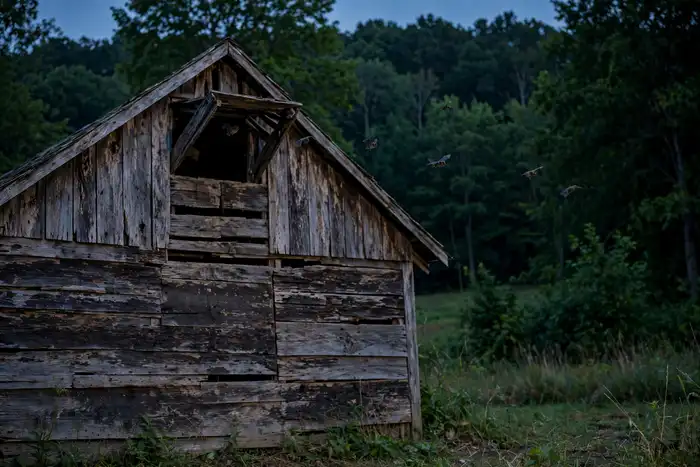
Bats in your Chesterland home
The big brown bat is as much a building animal in Chesterland as a woods animal. Summer maternity colonies want height, heat and room, and they find all three in the upper reaches of older township houses and in barn lofts that bake under metal or dark shingle roofs. Come winter, the same species settles into wall voids and quiet attic corners of those buildings and hibernates through the Geauga cold. Many Chesterland colonies are not seasonal guests; they are permanent residents on a two-season lease.
Ohio protects that arrangement with its most detailed wildlife rules. Exclusion is the only lawful removal method, a licensed operator must do it for hire, and the state's closed seasons guard the colony at its two helpless moments — flightless young in summer, hibernating adults in winter. On a property with several buildings, the inspection also has to answer a township question: which structures actually hold bats, and which merely look as if they should.
Two closed seasons, two working windows
The controlling rule, Ohio Administrative Code 1501:31-15-03(H)(5), closes bat exclusion from May 16 through July 31 when five or more bats are present — the maternity weeks, when pups cannot fly — and from October 15 through March 31, the hibernation months. Only prior written permission from the Chief of the ODNR Division of Wildlife overrides either closure. That leaves April 1 to May 15 and August 1 to October 15 to work in. A colony discovered in a Chesterland barn in June is therefore an inspection and a mapped plan now, and an exclusion booked for August — well before the colony settles in for winter.
The winter colony is asleep in the building
No dusk flights in January does not mean no bats. Big brown bats routinely hibernate inside Ohio houses and outbuildings, tucked into voids singly or in small groups, silent and easy to overlook. Sealing a building in midwinter on the theory that its bats migrated can trap animals that never left — the precise outcome the October-to-March closure exists to prevent. Winter bat work in Chesterland starts with a careful hibernation inspection, conducted without disturbing any sleepers found.
Entries on houses and barns
A bat slips through a gap about the width of a finger, and township buildings collect such gaps generously: gable louvers with failed screens, chimney flashing lifted by ice, corner boards and trim shrunk with age, barn eave and loft-door gaps, and the seams where additions meet an original house. Guano is the map — droppings beneath a joint, staining at a vent, pellets accumulating on a loft floor or a porch below an entry. The crew works from that evidence building by building, because sealing a barn the bats do not use while missing the house gable they do is a wasted afternoon.
Guano in the loft, and a bat in the house
Years of colony life deposit guano deep under a roost, and dried droppings can harbor the fungus linked to histoplasmosis — in a hayloft or attic, cleanup is respirator work, not a broom. Bats are also Ohio's most frequently confirmed rabies species. A colony overhead is not a household crisis, but a bat in living space is a health question: if it was in a room with a sleeping person, a child or a pet, do not release it and do not handle it — close the room and seek guidance from your doctor or county health department, as the bat may need to be tested.
Staging an exclusion across a lot
Inside a lawful window the method is exact and unhurried. All gaps on the structure are sealed except the entries the colony is actively using; those receive one-way valves that let bats drop out at dusk to hunt and refuse their return. Exit watches and inspections confirm the roost is empty, the valves come off, and the final entries are sealed permanently. Where a house and a barn both test positive, the two are staged so the colony cannot simply cross the yard and re-let the other building mid-job.
Shortcuts that backfire in barns and attics
Nailing a board over the entry you found is the fastest way to scatter bats into walls, stalls and living rooms — or to kill them where they cannot be recovered. Mothballs and sprays do not move colonies and contaminate hay and attic air to no purpose; ultrasonic gadgets are ignored by any colony that matters. Inspect, respect the calendar, exclude one-way, seal — and book early, because Geauga bat work concentrates into the same spring and late-summer weeks for every property in the county.
Common bat questions in Chesterland
How do you legally remove bats from a Chesterland attic or barn?+
Why is midwinter the wrong time, even though the bats seem gone?+
We found a bat in a bedroom — what should we do?+
How do I know whether the bats are in the house or the barn?+
How much does bat removal cost in Chesterland?+
Other Chesterland problems that come with bats
Our wildlife crew handles these closely related problems — the ones that most often turn up with a bat issue.
Got more than bats in Chesterland?
A township building open enough for a bat colony usually has other ice-and-age gaps too — the same inspection maps entries for squirrels and mice. See everything we handle locally on the Chesterland wildlife removal hub, or jump to Ohio wildlife removal.
Serving all of Geauga County
Chesterland is one part of Geauga County. See wildlife removal in Geauga County, OH for the county-wide picture — the animals we get called about most, and the other towns we cover.
One call to your Chesterland bat crew
Sealing a Chesterland building at the wrong season can entomb a hibernating colony in January or orphan a loft full of pups in July — the calendar is not a detail on a bat job, it is the job. Call us and tell us about the job — we will confirm the local crew for your county before any work starts.
- Local to Geauga County. ODNR-compliant handling — call to ask about licensing and insurance.
- Valves only in the window. Every gap sealed first except the active entries, one-way valves fitted during April 1–May 15 or August 1–October 15, and final sealing after the roost is confirmed empty.
- Done right. Removal, exclusion and cleanup.