Groundhog Removal in Chesterland, OH
A dirt fan growing beside the barn and a bolt-hole appearing under the shed? A groundhog is building its burrow system against your Chesterland outbuildings — feeding in your clearing, sleeping under your floors and expanding the excavation every week of the warm season. Call us and tell us about the job — we will confirm the local crew for your county before any work starts.
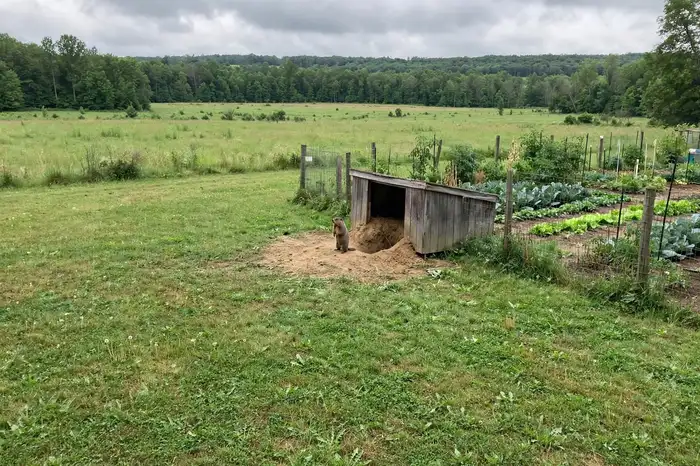
Groundhogs in your Chesterland home
The groundhog, or woodchuck, is the township lot's resident excavator, and Chesterland lots suit it precisely: open ground for grazing — lawn, garden, pasture edge and clover — meeting cover in the form of barn and shed floors, decks, slab edges and brushy fence lines. It burrows where the two meet. The result is a system, not a hole: a mounded main entrance, discreet escape doors under structures, a nest chamber and sleeping quarters, lengthened a little every season the animal is left alone.
Its year is split by one of Ohio's longest hibernations. From late fall into late winter the system is occupied by a sleeping animal and shows nothing at the surface. Emergence flips the switch: mating, litters born in the burrow in spring, and a summer of feeding and digging ahead. Reading which season — and therefore which groundhog situation — a burrow is in determines everything about how the job should be done.
What the excavation does to outbuildings
Every mound of soil at a burrow mouth came out from under something — a shed sill, a barn floor edge, a deck footing, a slab. Seasons of that subtraction leave voids that settle floors, rack doors, tilt small buildings and open runs along foundation walls that conduct water and invite skunks, opossums and snakes to use the same system. On a working lot the garden losses are the visible tax; the undermined buildings are the capital cost, and they accrue whether or not anyone is watching the burrow.
Long Geauga hibernation and the spring restart
Groundhogs here sleep deep and long — underground from roughly late October into late winter, in a dedicated hibernation chamber below the frost line. A silent burrow in a Chesterland January is therefore evidence of a sleeper, not a vacancy, and filling or capping it can trap the animal to die in place. Males emerge first in late winter; females follow, and litters are born in the burrow in spring. Fresh dirt, a swept-clean main entrance and a stout brown animal grazing the clearing's edge at midday announce that the system is open for the season.
Reading a township burrow system
The main door advertises itself with its dirt apron. The escape entrances do not — look for clean, mound-less holes under shed floors, deck edges and barn sills, the doors the animal actually uses when a fox or a dog appears. Add clipped vegetation near the burrow, droppings at the entrance and the animal's whistle when startled. Mapping all the doors matters: a plan built on the famous entrance while two quiet ones stay open is a plan the groundhog routes around in a night.
Removal and exclusion under Ohio woodchuck rules
Ohio's nuisance regulations carry a subsection written specifically for woodchucks, including trap placement, and a licensed operator works within it. Matched to the burrow's position, the plan is trapping at the active entrances or a one-way arrangement that lets the animal leave the system and not return. Only when the system is verified empty — no litter in the nest chamber, no sleeper in the deep chamber — are entrances closed, backfilled properly and the structure edges fitted with buried metal screening bent outward below grade, so the next excavator on the lot meets steel.
Garden fences and filled holes, honestly assessed
A fence deters a groundhog only if it is buried and flared outward at the base — the animal climbs what it cannot dig under, and digs under what it cannot climb. Loose dirt shoveled into an active entrance is re-dug or bypassed within days; repellents fade under snowmelt and rain. And the winter version of the filled hole is worse than useless if a hibernator is below. The intervention that changes the animal's calculation is screening at the structures it burrows under, removing the cover half of its cover-and-clearing equation.
Common groundhog questions in Chesterland
A groundhog is undermining my Chesterland barn — what is the process?+
No digging since fall — has the groundhog moved on?+
When exactly do Chesterland groundhogs emerge?+
Can one groundhog really damage a building?+
How much does groundhog removal cost in Chesterland?+
Other Chesterland problems that come with groundhogs
Our wildlife crew handles these closely related problems — the ones that most often turn up with a groundhog issue.
Got more than groundhogs in Chesterland?
Groundhogs are rarely the only thing using an attic or yard in Chesterland. See everything we handle locally on the Chesterland wildlife removal hub, or jump to Ohio wildlife removal.
Serving all of Geauga County
Chesterland is one part of Geauga County. See wildlife removal in Geauga County, OH for the county-wide picture — the animals we get called about most, and the other towns we cover.
One call to your Chesterland groundhog crew
The longer groundhogs stay in the attic, the more they chew and the bigger the cleanup. Call us and tell us about the job — we will confirm the local crew for your county before any work starts.
- Local to Geauga County. ODNR-compliant handling — call to ask about licensing and insurance.
- Humane exclusion. One-way doors and steel sealing, not poison.
- Done right. Removal, exclusion and cleanup.