Wildlife Removal in Stuart, FL
Something is living in your attic, under your dock or inside your seawall — you can hear it over the ceiling at night, or you found the burrow mouth at the waterline. Call us, describe what you are seeing, and we will tell you honestly what animal it sounds like.
Why Stuart homes see the wildlife they do
Stuart exists because of a river junction. The North Fork and South Fork of the St. Lucie River meet here and run east together to the St. Lucie Inlet, and the town grew up on the banks where they join — the Martin County seat, and the self-declared Sailfish Capital of the World, a title the winter sailfish fleet backs up from November through April. That forked river is also a wildlife highway: miles of mangrove shoreline, canal mouths and wooded banks delivering animals directly into residential streets.
The receiving end is a particular kind of housing stock. Downtown holds older riverfront homes and condos built across most of the last century, their attics shaded by mature oaks and palms. Across the water sit the peninsulas — Sewall's Point between the forks and Sailfish Point out at the inlet — deep-water estate lots where nearly every backyard ends in a dock, a boat lift and a seawall. Stuart has deliberately stayed low and slow: growth limits and height caps kept the skyline small, which means the canopy, the rooflines and the waterfront stayed close together, exactly the geometry wildlife prefers.
Our Stuart work is done by a licensed & insured crew, with removal performed under FWC Rule 68A-9.010 with the property owner's authorisation. Every job follows the same order of operations: identify the animal correctly, remove it lawfully and humanely, close the structure or shore up the seawall so the next animal finds no opening, and clean what was left behind. In a town built on the water, that last step — closing the way in — is where most of the long-term value sits.
Two forks, one long shoreline of attics
Nearly every Stuart neighborhood touches one of the forks, a canal or the inlet, and riverfront wildlife works a short commute: raccoons travel the mangrove edges at night and den in the first dry attic they find, roof rats run the palm rows along the banks, and opossums work the docks for fallen bait and pet food. A house two streets from the water is not insulated from the river — it is the river's second row.
Docks, seawalls and lifts: the working waterfront at home
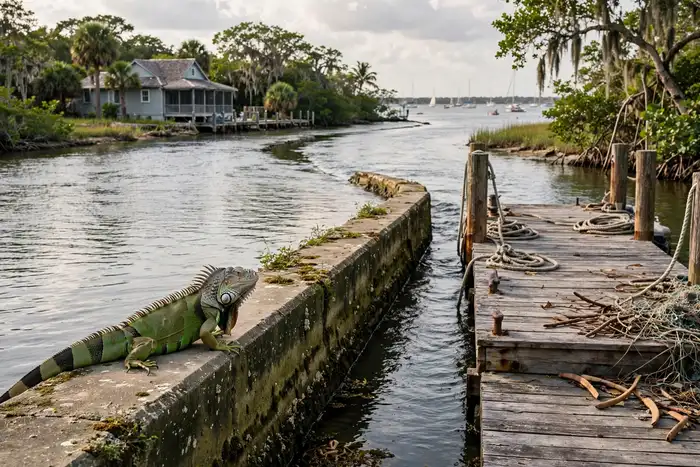
Boating is daily life here, so the structures animals exploit are nautical as much as architectural. Green iguanas burrow into canal banks and under seawall caps, undermining the wall from behind until sections lean or sink. Raccoons den in stored dock boxes and under waterfront decks. Roof rats nest in the palm-frond skirts hanging over boat lifts. A Stuart inspection that stops at the roofline misses half the property — we walk the waterline too.
Older downtown roofs, newer animal pressure
Downtown's older homes and low condos carry the classic Treasure Coast openings: soffits softened by decades of wet summers, barrel tile and shingle transitions at additions, unscreened gable vents, and utility penetrations at the wall plate. Hurricane season, June through November, reopens the list every year — a lifted tile edge or torn soffit panel in September is a roof rat's engraved invitation by October. Pre-season sealing work in the spring, March through May, is when Stuart houses are cheapest to defend.
A town with two populations: residents and the returned
Stuart's seasonal rhythm shapes its wildlife calls. Sailfish season fills the town all winter; summer empties a share of its condos and second homes. A house left closed through the hot months can host months of undetected attic activity — and a dried-out drain trap in a vacant home is a documented route for roof rats entering from the sewer line. Return inspections in October and November, and pre-departure roofline seals in the spring, are built for exactly this cycle.
Wildlife we remove in Stuart
From downtown attics to Sailfish Point seawalls, these are the ten calls Stuart and Martin County homeowners make to us most often.
🐀 Rodents
The Stuart rodent is the roof rat — also called the fruit rat, palm rat and citrus rat on this coast. It nests in palm skirts and soffits along the river, rides backyard citrus all winter, and treats a pool-cage roofline as a front porch. Stuart rodent removal
🦝 Raccoons
River-fed raccoons raise litters in riverfront attics from the downtown banks to Sewall's Point, raid dock boxes, and wash their food at the waterline below your seawall. Strong, dexterous, and a genuine rabies concern — professional work, not a weekend project. Stuart raccoon removal
🦇 Bats
Brazilian free-tailed and evening bats roost in Stuart attics, under barrel tile and beneath the river bridges, then pour out at dusk to hunt over the forks. Exclusion is one-way devices only, inside Florida's legal window — never harm, never hurry. Stuart bat removal
🐿️ Squirrels
Gray squirrels own the oak canopy over Stuart's older streets and drop from it onto roofs daily, chewing soffits and nesting over the bedrooms below. Dawn-and-dusk attic noise downtown is this animal, most of the year. Stuart squirrel removal
🐾 Opossums
Slow night foragers off the riverbanks that settle under waterfront decks, inside dock storage and in garage corners near food. Mild-tempered, but a resident that fouls a den space — or dies in one — needs removing all the same. Stuart opossum removal
🦔 Armadillos
Nine-banded armadillos root up Stuart lawns hunting grubs and burrow under pool decks, seawall backfill and slab edges, moving a surprising amount of Martin County soil one night at a time. Stuart armadillo removal
🐍 Snakes
Identification leads every Stuart snake call: the Florida banded water snake at the dock is harmless and constantly mistaken for a cottonmouth, while racers and rat snakes patrol the yards. The genuinely venomous few are handled with distance and care. Stuart snake removal
🕊️ Dead animals
Florida heat finds a carcass fast. When an animal dies in a wall, attic or under a dock, we trace the odor to its source, remove it, sanitize the space and seal the opening that started the story. Stuart dead animal removal
🐦 Birds
Muscovy ducks claim the ponds and canal banks of Stuart's HOA communities and answer to no agency — removal is a landowner's job, done by hired help. Pigeons and starlings take the downtown rooflines and vents. Stuart bird removal
🦎 Iguanas
Martin County is where green iguanas are established on this coast, and Stuart's seawalls, docks and canal banks are their chosen ground — burrowing that undermines waterfront structures, and a mess on every pool deck. Removal is encouraged year-round; release never happens. Stuart iguana removal
Animal-specific help in Stuart
Deep, local guides for the problems we get called about most — with our wildlife crew behind every one.
How to get help in Stuart
Tell us what you're hearing
Scratching in the attic, a snake by the porch, holes in the yard — call with your problem and your Stuart address.
We connect you locally
Call us and tell us about the job — we will confirm the local crew for your county before any work starts.
They solve it — for good
Inspection, humane removal, full exclusion and cleanup — handled by our wildlife crew, following Florida rules.
Common wildlife removal questions in Stuart
Who do I call for an animal in my Stuart house or yard?+
Can you trap the animal and relocate it out in the country?+
I found bats in my attic in July. Can they come out now?+
A neighbor says he saw a skunk near the river. Do you remove skunks?+
There is an alligator in the canal behind my house. Is that your job?+
How much does wildlife removal cost in Stuart?+
Serving all of Martin County
Stuart is one part of Martin County. See wildlife removal in Martin County, FL for the county-wide picture — the animals we get called about most, and the other towns we cover.
One call to your Stuart wildlife crew
Whether it's squirrels in an older in-town attic or a raccoon in a new subdivision crawlspace, the fastest fix is our wildlife crew, who knows Martin County wildlife. Call us and tell us about the job — we will confirm the local crew for your county before any work starts.
- Local to Martin County. FWC-compliant handling — call to ask about licensing and insurance.
- One company, one call. Call us and tell us about the job.
- Done right. Removal, exclusion and cleanup.