Rodent Removal in Stuart, FL
Scratching that runs the ceiling at night, droppings along the attic insulation, citrus hollowed out on the tree in the morning. Stuart's climbing rat has moved in overhead. Call us and tell us where the noise travels — the route map matters.
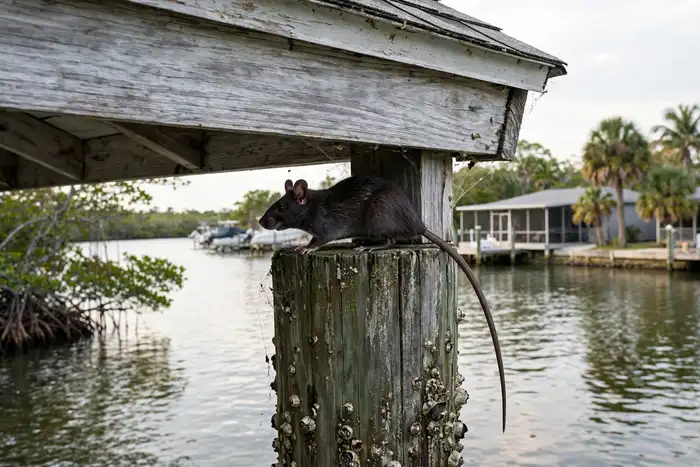
Rodents in your Stuart home
Stuart's rodent problem has one name with four aliases: the roof rat, known up and down this coast as the fruit rat, palm rat and citrus rat. It is a climbing animal, built for the vertical world of palm trunks, dock lines and rooflines, and Stuart — riverfront palms, backyard citrus, pool cages on every other lot — is close to its ideal habitat. Roof rats nest in the dead-frond skirts of untrimmed palms, in soffits and wall tops, and commute along fence lines, utility wires and the pool-cage roofline to food.
The food calendar is written by the citrus in Stuart yards. Backyard fruit ripens from September through March, and a roof rat colony times its year to it: hollowed oranges on the ground beneath the tree are often the first evidence a homeowner notices. Inside, the evidence is droppings along runways, gnawed stored goods, and insulation tunneled into nesting runs. Our Stuart rodent work is trap-and-seal from first to last — no poison, because a poisoned rat dies in a wall and becomes a different, worse call.
The palm skirt is the nursery
An untrimmed palm carries a skirt of dead fronds, and to a roof rat that skirt is a thatched, predator-proof nursery hanging beside your roof. Rats raise litters in skirts overhanging Stuart pool cages and docks, then step from frond to roofline without ever touching the ground. Trimming skirts back and keeping fronds off the roof is not cosmetic — on rat-active streets it is half the job, and we will tell you plainly which of your palms are housing the colony.
Soffits: the Stuart front door
The working entry on most Stuart homes is the soffit — vinyl or aluminum panels softened by decades of humidity, gapped at the corners, or torn loose in a storm and never quite refitted. A roof rat needs a gap it can push a head through, and it will gnaw a near-gap the rest of the way. Our sealing closes soffits, ridge and valley transitions, pipe and conduit penetrations, and the gap where a pool-cage roofline meets the house — the four routes cover nearly every Stuart attic we open.
The vacant-house sewer route
Stuart's seasonal homes hide a second, stranger entry. A house closed up for the summer lets its drain traps dry out, and a dry trap is an open pipe between the sewer line and the house — a route roof rats genuinely use, documented by University of Florida extension researchers. Rats entering this way appear inside with no roofline breach at all, which baffles homeowners and any crew that only inspects from a ladder. Our Stuart inspections check the plumbing side too, especially on homes that sat empty through the hot months.
Why trapping without sealing is a subscription
A riverfront Stuart street holds more roof rats than any attic ever will. Remove the animals inside and leave the soffit gaps, and the vacancies refill from the palm rows within weeks — the new tenants often arrive smelling the old colony's runways. That is why our sequence is fixed: seal the structure first or alongside, trap the animals already inside, then verify quiet. The trap count matters far less than the integrity of the seal.
The Norway rat, briefly
The heavy ground-dwelling Norway rat of northern cities is rare on this coast — a Stuart rodent call is a roof rat until the evidence says otherwise. House mice turn up occasionally in garages and stored goods, a minor sideshow next to the climbing colony overhead.
After the quiet: keeping the roofline closed
Post-job, the habits that hold the result are simple and local: pick citrus as it ripens rather than letting it fall and ferment, keep bird seed and pet food in sealed containers, maintain the palm trimming, and walk the soffit line after any hurricane-season storm. We point out the specific trees, gaps and food sources on your lot that were doing the inviting, so the maintenance list is yours rather than generic.
Common rodent questions in Stuart
How do I know the rats are roof rats and not something else?+
Why won't you just put out poison?+
We were away all summer and came back to rats. How did they get in?+
Will the rats come back after you seal?+
How much does roof rat removal cost in Stuart?+
Other Stuart problems that come with rodents
Our wildlife crew handles these closely related problems — the ones that most often turn up with a rodent issue.
Got more than rodents in Stuart?
Rodents are rarely the only thing using an attic or yard in Stuart. See everything we handle locally on the Stuart wildlife removal hub, or jump to Florida wildlife removal.
Serving all of Martin County
Stuart is one part of Martin County. See wildlife removal in Martin County, FL for the county-wide picture — the animals we get called about most, and the other towns we cover.
One call to your Stuart rodent crew
The longer rodents stay in the attic, the more they chew and the bigger the cleanup. Call us and tell us about the job — we will confirm the local crew for your county before any work starts.
- Local to Martin County. FWC-compliant handling — call to ask about licensing and insurance.
- Humane exclusion. One-way doors and steel sealing, not poison.
- Done right. Removal, exclusion and cleanup.