Dead Animal Removal in Stuart, FL
The smell arrived Tuesday and by Thursday it owns the house — worst in one room, stronger when the air conditioning runs. Something died inside your home's structure. Call us now; in this climate, every day of waiting is a worse day.
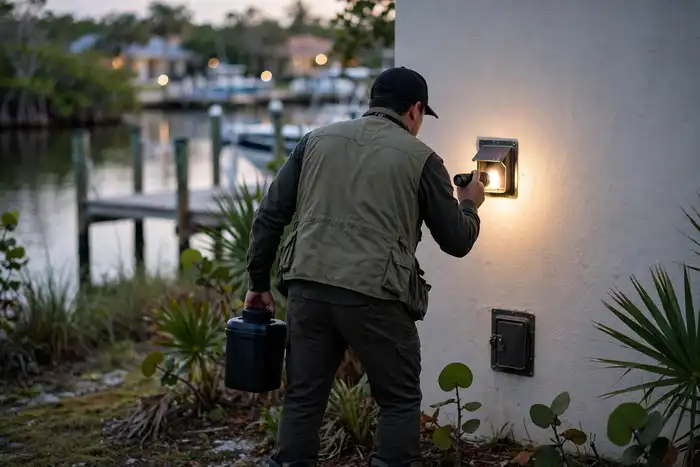
Dead Animals in your Stuart home
Stuart's climate compresses the dead-animal timeline brutally. Heat and humidity that sit on Martin County from May through October accelerate everything: an animal that dies in a wall void or attic on Monday is a whole-house event by the weekend, with odor drawn through the ductwork every time the air handler runs. The usual casualties are a roof rat or opossum that found its way in and could not find its way out, and — a Stuart specialty — the animal that died while the house sat empty for the summer, discovered by returning owners in the worst possible way.
Our dead-animal work runs a fixed sequence: locate, remove, sanitize, seal. Locating is the skilled part — odor evidence, fly activity and the architecture of the void narrow the search before anything is opened. Removal and sanitation restore the space. Sealing is what makes it a finished job rather than a recurring subscription, because the opening that admitted this animal is still there, advertising itself to the next one.
Reading the odor like a map
Odor is evidence, not just misery. It concentrates nearest the carcass, intensifies when the air conditioning pushes air through the same cavities, and often presents stronger in one room, one wall, one end of the attic. Blowflies at a window and a sudden interest from the family dog at one baseboard are corroborating witnesses. Our crew maps these clues against the framing before cutting anything — most Stuart retrievals are reached from an attic, crawlspace or existing opening, and a wall is opened only when the evidence is conclusive and the cut can be small.
The snowbird discovery
The signature Stuart case arrives in October and November: owners return to a condo or second home closed since spring and open the door on months of consequences — an animal that entered through a storm-loosened soffit or a dried-out drain trap in May, died inside by June, and has been ripening in a sealed, un-air-conditioned house through the hottest months on the calendar. The retrieval is the same work, but the sanitation scope is larger, and the prevention conversation at the end — pre-departure sealing, return inspections — is one we have with hard-earned sympathy.
Where Stuart animals actually die
Wall voids beside plumbing runs, where an animal falls from the attic plate and cannot climb the smooth interior. Attics themselves, especially above garage ceilings nobody enters. Crawlspaces under older downtown homes. And the waterfront additions: the void beneath a dock's decking, a boat lift's gear housing, the hollow of a stored hull. Each location has its own access problem, and the dock cases carry the extra gift of a tide working the evidence twice a day.
Sanitation is not a spray bottle
Removing the carcass removes the source; it does not finish the job. Fluids soak insulation and drywall paper, and in Stuart humidity that material holds odor and feeds bacteria and insects long after retrieval. The affected insulation section comes out, hard surfaces are cleaned and treated with an enzymatic sanitizer, and heavily soaked drywall is cut back to clean material. We will show you exactly which materials we judge salvageable and which are not, before the scope is set.
Sealing the story shut
Every dead-animal job ends at the entry: the soffit gap the rat used, the vent the opossum pushed, the plumbing penetration nobody screened. Closing it in the same visit is the difference between a bad week and a recurring season, because the pheromone trail of one animal's residency is a map other animals read fluently. If the entry turns out to be a dried drain trap in a seasonally vacant home, the fix is a trap primer conversation and a pre-departure checklist, not metalwork — we fit the seal to the actual door.
Common dead animal questions in Stuart
How long will the smell last if I just wait it out?+
Will you have to cut into my wall?+
We just returned for the season and the house smells terrible. Where do we start?+
I can smell it but cannot find anything. Is it always an animal?+
How much does dead animal removal cost in Stuart?+
How do we keep this from happening again?+
Other Stuart problems that come with dead animals
Our wildlife crew handles these closely related problems — the ones that most often turn up with a dead animal issue.
Got more than dead animals in Stuart?
Dead Animals are rarely the only thing using an attic or yard in Stuart. See everything we handle locally on the Stuart wildlife removal hub, or jump to Florida wildlife removal.
Serving all of Martin County
Stuart is one part of Martin County. See wildlife removal in Martin County, FL for the county-wide picture — the animals we get called about most, and the other towns we cover.
One call to your Stuart dead animal crew
The longer dead animals stay in the attic, the more they chew and the bigger the cleanup. Call us and tell us about the job — we will confirm the local crew for your county before any work starts.
- Local to Martin County. FWC-compliant handling — call to ask about licensing and insurance.
- Humane exclusion. One-way doors and steel sealing, not poison.
- Done right. Removal, exclusion and cleanup.