Bat Removal in Stuart, FL
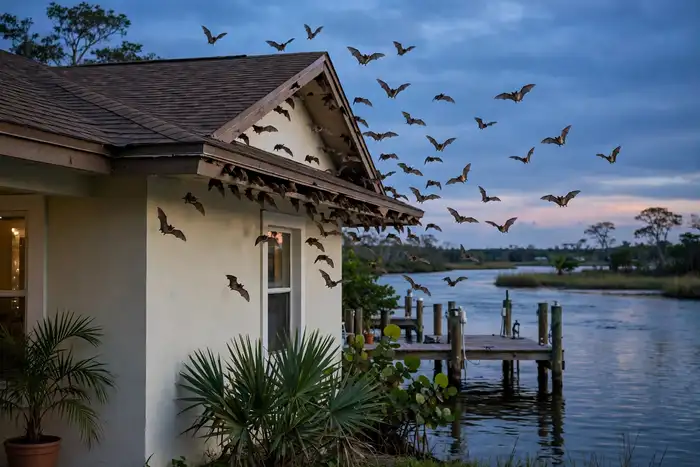
Guano sifting from a gable vent, a papery rustling in the wall at dusk, a stream of wings leaving the roofline at sunset over the river. Stuart attics host colonies their owners never suspected. Call us — with bats, the calendar is half the job.
Bats in your Stuart home
Watch a Stuart roofline at dusk in September and you may see the colony leave: a thin stream of bats pouring from a gable seam to hunt over the St. Lucie River, where insects over the water are thick enough to feed hundreds. Stuart's house bats are two species — the Brazilian free-tailed bat, Florida's most common, a colony bat that roosts in attics, under barrel tile and beneath bridges, and the smaller evening bat, a frequent tenant of gable ends and soffit voids. Both are quiet, tidy and easy to live above for years without knowing.
Florida law frames everything about their removal. Bats may never be harmed or killed here, and exclusion — one-way devices that let bats leave and not return — is the only legal method. Exclusion is lawful from August 15 to April 15 and prohibited during maternity season, mid-April to mid-August, when flightless young are in the roost. Stuart's complication is the overlap: the maternity blackout sits inside hurricane season, so a colony found in June gets an honest answer — inspect and seal what can be sealed now, exclude the week the window opens.
Why the August 15 date drives Stuart bat work
By mid-August the summer's pups are flying, and the whole colony commutes nightly — out at dusk to the river, back before dawn. That traffic is exactly what a one-way device needs. Our crew books Stuart exclusions against that rhythm, and devices stay in place across the required consecutive nights while the colony empties itself. Wait until deep winter and the work is still legal, but August and September are when exclusion runs fastest and cleanest on this coast.
Where bats enter Stuart houses
The entry is rarely a hole — it is a slot. A shrunk mortar joint at a chimney shoulder, the open corner of a gable vent, the gap under a lifted barrel tile, the seam where a pool-cage roofline meets the fascia. Free-tailed bats pour from bridge roosts over the river at dusk, and house colonies use slots just as narrow. A dusk watch settles which of a dozen candidate gaps the colony actually uses; that seam receives the device, and every other seam on the structure gets sealed.
The maternity blackout, honestly explained
From mid-April to mid-August, Stuart colonies are nurseries. The young cannot fly for their first weeks, so any device or seal installed then strands them inside to die — illegal, inhumane and, practically speaking, an odor disaster in the walls. If your call comes in those months, our visit still matters: we identify the species, count the exits, photograph the guano situation, seal openings the bats are not using, and put your exclusion first in line for August 15.
Hurricane season rewrites rooflines
Storms tear at exactly the seams bats use — soffit panels, ridge caps, tile edges — and a colony displaced from a damaged roost nearby will test your gaps within nights. Post-storm Stuart inspections find new bat entries alongside the rat and raccoon ones, and pre-season work in spring, before both the blackout and the storms, is when a roofline is cheapest to make bat-tight. If a summer storm opens your roof, call during the blackout anyway: temporary repairs can protect the house without illegally excluding the colony.
Guano, and the bat in the bedroom
Long-used roosts accumulate guano that stains ceilings and smells sweetly musty; dried droppings can carry a fungus whose dust should not be breathed, so cleanup proceeds carefully and with protection. A single bat found flying in a bedroom is a different protocol: do not handle it, close the door on the room, keep people and pets out, and call us for the capture — and if anyone slept in that room, a call to your doctor or the county health department about possible rabies exposure is the cautious step.
One protected exception to know
Florida is also home to the Florida bonneted bat, a federally endangered species that turns up occasionally in the southern half of the state. It is not the typical Stuart attic bat — but if identification ever pointed that way, exclusion stops entirely and the job becomes an FWC matter. A crew that cannot tell its bats apart has no business sealing a Stuart attic; identification comes first on every colony we touch.
Common bat questions in Stuart
What is the best month for bat removal in Stuart?+
Why can't you just exclude them in June when I found them?+
Are the bats under the river bridges a problem for my house?+
If I seal one gap, will the colony leave on its own?+
How much does bat exclusion cost in Stuart?+
Other Stuart problems that come with bats
Our wildlife crew handles these closely related problems — the ones that most often turn up with a bat issue.
Got more than bats in Stuart?
Bats are rarely the only thing using an attic or yard in Stuart. See everything we handle locally on the Stuart wildlife removal hub, or jump to Florida wildlife removal.
Serving all of Martin County
Stuart is one part of Martin County. See wildlife removal in Martin County, FL for the county-wide picture — the animals we get called about most, and the other towns we cover.
One call to your Stuart bat crew
The longer bats stay in the attic, the more they chew and the bigger the cleanup. Call us and tell us about the job — we will confirm the local crew for your county before any work starts.
- Local to Martin County. FWC-compliant handling — call to ask about licensing and insurance.
- Humane exclusion. One-way doors and steel sealing, not poison.
- Done right. Removal, exclusion and cleanup.