Raccoon Removal in Stuart, FL
Heavy, deliberate footsteps crossing the attic after dark, a dock box raided, trash scattered with suspicious intelligence. Stuart's river raccoons den big and stay long. Call us while the tenancy is young and the repair is still small.
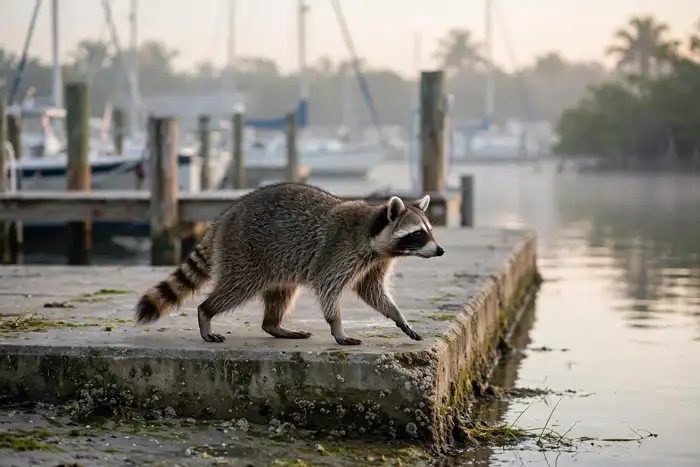
Raccoons in your Stuart home
Stuart's raccoons work the water. The forks of the St. Lucie River, the canal mouths and the mangrove banks give them fish, crabs and oysters; the neighborhoods behind the shoreline give them trash carts, dock boxes, fallen citrus and pet food on lanais. Night belongs to the river, but the day's sleep wants a dry, elevated, defensible den — and the attics of riverfront Stuart, from the historic downtown streets to the Sewall's Point peninsula, answer perfectly.
Two facts shape every Stuart raccoon job. First, capability: a raccoon unscrews, unbends and unhooks, treating latches as puzzles and thin vent covers as suggestions, so any removal that does not end in a materially stronger structure is a postponement. Second, disease: raccoons are a rabies-vector species in Florida, and their attic droppings can carry a roundworm whose eggs persist in material for years. This is licensed, careful work — removal performed under FWC Rule 68A-9.010 with the property owner's authorisation — not a ladder and a borrowed trap.
Signs that say raccoon, not rat
Weight is the tell. Raccoon movement sounds deliberate — a walking pace overhead with pauses and the occasional thud — against a roof rat's light scurry. Add hand-like tracks in the dust of a dock or the mud at a seawall, a soffit panel pushed in rather than gnawed, shingles worried at an edge, and droppings the size of a small dog's gathered in one attic corner, and identification is settled before the ladder comes out.
The latrine corner and what it costs
A raccoon attic develops a latrine: one corner used repeatedly until insulation is soaked and the ceiling below is at risk. That corner is the health heart of the job, because raccoon droppings can carry roundworm eggs that survive for years in the material. The contaminated insulation comes out and the area is treated; we draw the line honestly, showing you whether yours is a few batts around one corner or a broader cleanup before recommending scope.
Working around the litter
Spring raccoon jobs in Stuart are family jobs. Kits cannot climb out, walk a one-way door or regulate their own temperature, so sequence is everything: locate the litter precisely, arrange the mother's exit so the family reunites outside, and only then close the structure. A plan that starts by sealing the entry is a plan we will talk you out of — a mother locked away from her young will open your roof somewhere worse trying to get back.
Docks, decks and the outdoor den
Not every Stuart raccoon lives in an attic. Dock boxes with fishy residue, the dry void beneath a waterfront deck, and stacked gear in a boat shed all serve as day dens, and a raccoon denning outdoors still raids the house nightly. Our inspection follows the whole property — waterline to roofline — because evicting the attic tenant while the dock tenant stays is a half-finished job.
What Florida law does with a captured raccoon
Homeowners often picture the raccoon released in a distant forest. Florida's rule is stricter: a captured native must be released or euthanized within 24 hours, and release is on the same property or within the same county onto at least 40 contiguous acres with that landowner's written permission. That is why our method leads with exclusion — the animal leaves the structure under its own power, and steel keeps it from returning.
Locking the larder afterward
With the family out and the entries armored, the yard itself can be made poorer raccoon habitat: carts with latched lids, no pet food left on the lanai overnight, dock boxes scrubbed of bait residue, citrus picked up off the ground. River streets will never be raccoon-free — the forks see to that — but a sealed house on a tidy lot drops to the bottom of the den list, which is the achievable goal.
Common raccoon questions in Stuart
A raccoon is in my Stuart attic — what is the first move?+
Can you relocate the raccoon to a preserve in western Martin County?+
Should I worry about rabies from a raccoon on my dock?+
How destructive is an attic raccoon, really?+
How much does raccoon removal cost in Stuart?+
Other Stuart problems that come with raccoons
Our wildlife crew handles these closely related problems — the ones that most often turn up with a raccoon issue.
Got more than raccoons in Stuart?
Raccoons are rarely the only thing using an attic or yard in Stuart. See everything we handle locally on the Stuart wildlife removal hub, or jump to Florida wildlife removal.
Serving all of Martin County
Stuart is one part of Martin County. See wildlife removal in Martin County, FL for the county-wide picture — the animals we get called about most, and the other towns we cover.
One call to your Stuart raccoon crew
The longer raccoons stay in the attic, the more they chew and the bigger the cleanup. Call us and tell us about the job — we will confirm the local crew for your county before any work starts.
- Local to Martin County. FWC-compliant handling — call to ask about licensing and insurance.
- Humane exclusion. One-way doors and steel sealing, not poison.
- Done right. Removal, exclusion and cleanup.