Iguana Removal in Stuart, FL
A four-foot green iguana owns your seawall cap, the burrow mouths are multiplying in the bank behind it, and the pool deck needs hosing every morning. This is Martin County's signature wildlife call. Phone us — iguana work here is structural, not cosmetic.
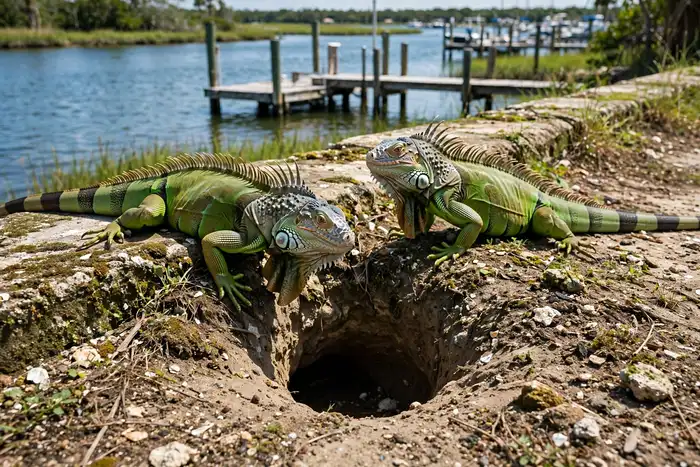
Iguanas in your Stuart home
Ask FWC where green iguanas are established on Florida's Atlantic coast and the answer draws a line that runs through Martin County. Stuart sits on the established side of that line: the town's miles of canal banks, seawalls, docks and rock revetments are prime iguana ground — sunny basking surfaces over diggable banks, water at the doorstep, and landscaping planted with the flowers, shrubs and fruit iguanas eat. Sewall's Point, Sailfish Point and the riverfront neighborhoods in between carry the densest populations, but any Stuart lot with a seawall is candidate habitat.
The green iguana is a Prohibited species under Florida rules, and the state's position is unusually direct: FWC encourages removal, and iguanas may be taken on private property year-round with the landowner's permission. The rule with no exceptions is disposition — a captured iguana can never be relocated or released anywhere in Florida. Stuart iguana work is therefore removal plus bank repair: get the animals out, then close the burrow systems that are quietly eating your seawall from behind.
The burrow is the real damage
An iguana on the seawall cap is a photo opportunity; its burrow is an engineering problem. Iguanas dig sloping tunnels into canal banks and the soil behind seawalls — for shelter, and for nesting chambers where females lay large clutches — and a worked bank can hold a system of them. Every burrow removes support from behind the wall, opens channels for rain and tide to wash more soil out, and contributes to the leaning panels, sinking caps and hollowed yards that Stuart waterfront owners discover expensively. Counting burrow mouths along your bank is the fastest way to size your actual problem.
Pool decks, docks and the daily mess
Above ground, the iguana economy runs on droppings and appetites. A resident group fouls pool decks, dock surfaces and seawall caps daily, grazes ornamental plantings to the stems, and strips hibiscus, bougainvillea and garden fruit with an efficiency gardeners describe in disbelief. They are not aggressive animals, but a large male cornered on a dock by a dog will bite and tail-whip, and their droppings on surfaces people walk barefoot are a sanitation issue, not merely an aesthetic one.
Why the established line stops at Martin County
Iguanas are tropical animals running on borrowed warmth. A hard cold snap — temperatures falling below about 50°F — slows them into torpor, and colder nights knock stunned iguanas out of Stuart trees entirely, a local winter spectacle that also does real population control. North of Martin County those cold snaps bite harder and more often, which is why the established population thins to scattered reports up the coast while Stuart's seawall colonies persist and breed. Your iguanas are not passing through; they are the resident population, at the climate's edge but holding it.
How removal works on a Stuart waterfront lot
Our crew surveys the bank first: burrow mouths, basking sites, the travel routes between water, burrow and feeding areas. Removal proceeds by capture at those sites — active animals taken by hand and noose by trained handlers, burrow systems worked methodically — under the landowner's permission the rules require. Because release is prohibited, disposition is lawful and final, and we explain it plainly before work begins: no Stuart iguana we remove is ever turned loose to colonize another bank.
Closing the bank behind them
Removing today's iguanas from an open burrow system invites tomorrow's: a vacant, well-dug bank on a sunny canal is advertised housing. Once the animals are out, burrows are collapsed and filled, the seawall cap and joint gaps the animals used are noted for repair, and vulnerable stretches of bank can be armored or regraded to shed the diggable profile iguanas prefer. Pair the closure with planting changes — iguanas graze some Stuart landscaping like a salad bar and ignore other species entirely — and the lot becomes the least attractive bank on the canal.
What not to do about iguanas
Do not feed them, ever — a fed iguana colony is a trained one. Do not attempt to catch a large male by hand; the bite and claws of a five-foot animal are a genuine injury risk, and a botched attempt educates the whole colony. And do not hire anyone who offers to release your iguanas 'somewhere out in the country' — that release is prohibited in Florida, and a company willing to break that rule in your hearing is telling you how it handles the rest of the job.
Common iguana questions in Stuart
Are iguanas really established in Stuart, or are these escaped pets?+
Can you catch my iguanas and release them somewhere they will be happy?+
Iguanas keep falling out of my tree on cold mornings. Are they dead?+
The burrows are behind my seawall. How urgent is that?+
How much does iguana removal cost in Stuart?+
Got more than iguanas in Stuart?
Iguanas are rarely the only thing using an attic or yard in Stuart. See everything we handle locally on the Stuart wildlife removal hub, or jump to Florida wildlife removal.
Serving all of Martin County
Stuart is one part of Martin County. See wildlife removal in Martin County, FL for the county-wide picture — the animals we get called about most, and the other towns we cover.
One call to your Stuart iguana crew
The longer iguanas stay in the attic, the more they chew and the bigger the cleanup. Call us and tell us about the job — we will confirm the local crew for your county before any work starts.
- Local to Martin County. FWC-compliant handling — call to ask about licensing and insurance.
- Humane exclusion. One-way doors and steel sealing, not poison.
- Done right. Removal, exclusion and cleanup.