Snake Removal in Stuart, FL
A dark snake is coiled at the dock piling, and the whole household is on the porch deciding what it is from a safe distance. That distance is the right instinct. Call us with a description — identification leads everything we do with snakes.
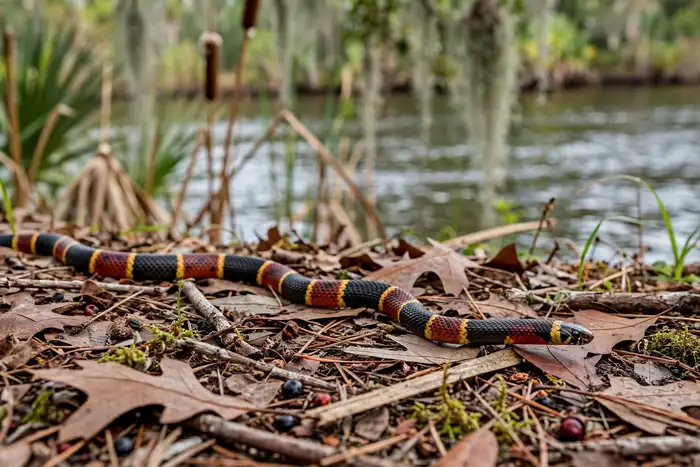
Snakes in your Stuart home
Stuart is waterside Florida, and waterside Florida has snakes — most of them harmless, a few of them genuinely dangerous, and several pairs that look enough alike to fool a worried homeowner at ten feet. The snake draped on your dock or sunning at the seawall cap is most often a Florida banded water snake, a nonvenomous fish-eater that is the coast's champion cottonmouth impersonator. The black snake crossing the driveway is a southern black racer. The one coiled in the pine straw by the pool cage deserves a slower, more careful look.
Four venomous species live in Martin County: the cottonmouth around the river and canal banks, the eastern diamondback rattlesnake in dry scrub and open pine ground, the small dusky pygmy rattlesnake near wet edges and marshy lots, and the shy, banded eastern coral snake in leaf litter. Against them stand the common harmless residents — racers, corn snakes and eastern rat snakes that hunt the same roof rats Stuart homeowners call us about, and the water snakes. Our snake work is ID-led by design: the species decides the response, every time.
The dockside identification that matters most
Banded water snake versus cottonmouth is the Stuart exam question. The harmless water snake is slender-headed, round-pupiled, with dark vertical bars on its chin scales, and it flees into the water flat and fast when approached. A cottonmouth is heavy-bodied with a blocky, angular head, a dark band through the eye, and a habit of holding its ground — sometimes gaping to show the white mouth that names it. Both are banded and brown at a glance. Nobody should make this call at arm's length; make it with a phone photo from distance, or let us make it in person.
The four to treat as venomous until proven otherwise
The cottonmouth owns the wet edges — riverbanks, canal margins, dock shade. The eastern diamondback is the heavy, diamond-patterned rattlesnake of drier, open ground west of the riverfront density. The dusky pygmy is small, gray, blotched and bad-tempered, common near wet prairies and marshy vacant lots, and the species most often met by gardeners. The eastern coral snake — red touching yellow in its bright bands — is fossorial and retiring, a snake of leaf litter and mulch that almost never bites unless handled. Assume any unidentified snake is on this list; the cost of caution is zero.
The harmless majority, and why they are near your house
Racers patrol yards by day for frogs and lizards. Rat snakes — the corn snake in its orange-red phase and the larger eastern rat snake — are climbing hunters that follow roof rats into soffits, pool cages and boat houses, which means a rat snake sighting is often a free inspection report on your rodent situation. Water snakes work the docks and seawall rocks for fish. None of these animals wants anything from you but to be left to the hunt, and most Stuart snake calls end with identification, reassurance and habitat advice rather than a capture.
The one snake nobody touches
The eastern indigo snake — a heavy, glossy blue-black snake that can pass seven feet — is federally protected and fully off-limits: it is never handled, harassed or removed by a wildlife crew. If a very large, docile, dark snake with an orange-cream chin turns up in your yard, admire it from a distance and call FWC. It is a gentle, increasingly uncommon neighbor, and its presence says good things about your patch of Stuart.
How a removal actually proceeds
On arrival we identify first — from a safe distance, with optics if the snake is coiled and settled. A harmless snake in a bad place, a pool cage or a garage, is captured and released on site at the property's wild edge, which Florida's rules allow and the snake's territory prefers. A venomous snake is captured with hooks and tubes by a trained handler and dispositioned lawfully — live venomous reptiles move only under permit in Florida, another reason this is never a DIY exercise with a pillowcase.
Making the yard less snaky
Snakes follow food and cover. Rodent control removes the rat snake's reason and the pygmy's prey base alike; trimming the brush line back from the pool cage, raising woodpiles and dock clutter off the ground, and keeping the grass edge short along the seawall all shrink the welcome. Waterfront Stuart will always have snakes passing through — the goal is a yard with nothing on the menu and nowhere to hide beside the steps.
Common snake questions in Stuart
There is a snake in my pool cage. What should I do right now?+
How can I tell a water snake from a cottonmouth at my dock?+
A big black snake lives near my seawall. Should it be removed?+
Will removing one snake keep others away?+
How much does snake removal cost in Stuart?+
Other Stuart problems that come with snakes
Our wildlife crew handles these closely related problems — the ones that most often turn up with a snake issue.
Got more than snakes in Stuart?
Snakes are rarely the only thing using an attic or yard in Stuart. See everything we handle locally on the Stuart wildlife removal hub, or jump to Florida wildlife removal.
Serving all of Martin County
Stuart is one part of Martin County. See wildlife removal in Martin County, FL for the county-wide picture — the animals we get called about most, and the other towns we cover.
One call to your Stuart snake crew
The longer snakes stay in the attic, the more they chew and the bigger the cleanup. Call us and tell us about the job — we will confirm the local crew for your county before any work starts.
- Local to Martin County. FWC-compliant handling — call to ask about licensing and insurance.
- Humane exclusion. One-way doors and steel sealing, not poison.
- Done right. Removal, exclusion and cleanup.