Armadillo Removal in Stuart, FL
The lawn looked fine at dinner and reads like a plowed field by morning, with a burrow mouth gaping under the pool deck. A nine-banded armadillo is working your yard on the night shift. Call us before the burrow reaches the slab.
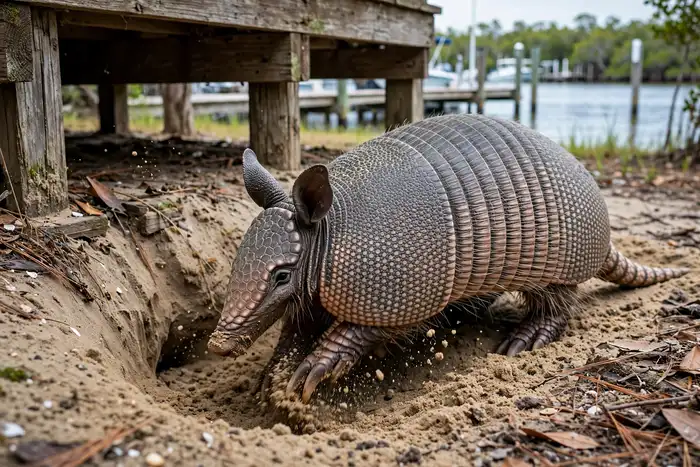
Armadillos in your Stuart home
The nine-banded armadillo is a relative newcomer that acts like it owns the place. This coast was one of the founding grounds of Florida's armadillo population in the last century, and Stuart's sandy soils, irrigated lawns and grub-rich riverfront yards suit it completely. An armadillo does not enter houses — its work is all outdoors and all excavation: shallow rooting holes across the turf in search of grubs and insects, and burrows dug for daytime shelter under whatever structure offers shade and dry ground.
In Stuart that means pool decks, air-conditioner pads, slab edges and the backfill behind seawalls. A burrow is not a hole; it is a chambered tunnel system that removes the soil your concrete is standing on. One more fact shapes every armadillo conversation here: the species is nonnative in Florida, which means captured armadillos may never be relocated or released — any company promising to trap yours and let it go in the country is promising something Florida law does not allow.
Reading the night's work
Armadillo sign is unmistakable once you know it: dozens of shallow, conical rooting holes scattered across the lawn where the animal nosed for grubs, a torn-up strip along a flower bed, and — the serious item — a burrow entrance roughly the size of the animal, with excavated soil fanned outside it. Tracks show four toes in front and a dragging tail line in soft sand near the waterline plantings.
What burrowing does to pool decks and seawalls
A chamber hollowed beneath a pool deck or patio slab removes the support the concrete was poured on, and voids migrate upward as the remaining soil settles — the visible results are cracked decking, a paver field gone uneven, a slab edge that begins to drop. Behind a seawall, burrowing in the backfill opens paths for tidal water to wash soil out through the wall's weep holes and joints, quietly hollowing the yard side. Stuart's waterfront lots make that second pattern the one we watch hardest.
Why the lawn keeps getting chosen
An irrigated Stuart lawn in the wet season is a grub buffet kept at perfect digging moisture, and a well-fed armadillo is a creature of route and habit — it will work the same yards in the same order for weeks. Treating the grubs alone rarely ends it, because the animal eats earthworms and insects of a dozen kinds and digs from memory as much as hunger. The burrow, and the animal, are the problem; the lawn is just where you see it.
Removal under Florida's nonnative rule
Because armadillos are nonnative, Florida prohibits transporting or releasing them — the lawful outcomes at capture are the ones the rule allows, handled by our crew without ceremony or cruelty. We set removal at the burrow system itself, timed to the animal's dusk emergence habits, and we tell you this part of the law plainly before work begins rather than letting a relocation promise sell the job.
Closing the burrow as a system
A filled-in burrow mouth accomplishes an afternoon: the animal that excavated the system reopens it, or a raccoon or opossum adopts the vacancy by the weekend. Once the burrow is confirmed empty we close the entrances properly, and the edges that matter — the deck perimeter, the slab line, the seawall cap joint — can be armored with buried screening against the next prospector working your street.
Fences, graded honestly
Armadillos push under ordinary fence lines and squeeze gaps a homeowner would swear were animal-tight, so a standard yard fence is a speed bump, not a barrier. A fence line trenched with buried mesh works, but at that point you have built the same barrier we install around structures. For most Stuart lots, removing the resident and closing its burrows is the arithmetic that adds up.
Common armadillo questions in Stuart
Can you trap my armadillo and release it somewhere wild?+
Will it dig under my pool deck again after removal?+
I filled the burrow with dirt twice and it keeps reopening. Why?+
Are armadillos dangerous to my family or pets?+
How much does armadillo removal cost in Stuart?+
Other Stuart problems that come with armadillos
Our wildlife crew handles these closely related problems — the ones that most often turn up with a armadillo issue.
Got more than armadillos in Stuart?
Armadillos are rarely the only thing using an attic or yard in Stuart. See everything we handle locally on the Stuart wildlife removal hub, or jump to Florida wildlife removal.
Serving all of Martin County
Stuart is one part of Martin County. See wildlife removal in Martin County, FL for the county-wide picture — the animals we get called about most, and the other towns we cover.
One call to your Stuart armadillo crew
The longer armadillos stay in the attic, the more they chew and the bigger the cleanup. Call us and tell us about the job — we will confirm the local crew for your county before any work starts.
- Local to Martin County. FWC-compliant handling — call to ask about licensing and insurance.
- Humane exclusion. One-way doors and steel sealing, not poison.
- Done right. Removal, exclusion and cleanup.