Wildlife Removal in Hobe Sound, FL
Holes appearing in the lawn overnight, something sizeable in the attic, a snake stretched across the cart path at first light — describe what you found and where, and we will identify the likely culprit before anyone talks about a plan.
Why Hobe Sound homes see the wildlife they do
Hobe Sound, home to roughly thirteen thousand people, is the southern anchor of Martin County — the last community down the US-1 corridor before the Palm Beach County line. Its defining neighbour is not a city at all. To the west lies Jonathan Dickinson State Park, thousands of acres of sand pine scrub, flatwoods and the Loxahatchee River, and that park boundary runs close behind subdivisions, golf communities and older streets for much of the town's length.
East of US-1 the texture changes street by street: canal and lagoon-side roads, mid-century blocks mixed with newer subdivisions, and across the water the island estates whose mail comes through Hobe Sound. Housing here puts wildlife at close quarters in both directions — scrub animals moving east out of the park edge into yards and attics, and water animals working the canals, docks and seawalls from the lagoon side. A Hobe Sound house can honestly have one of each in the same season.
We work here licensed & insured, with removal performed under FWC Rule 68A-9.010 with the property owner's authorisation. Every job runs the same course: name the animal from its evidence, remove it lawfully, close the house or address the burrow so the pattern does not simply restart, and clean up what it left. On the park edge especially, where the habitat is protected and going nowhere, the closing work is the part that decides whether you call us once or every year.
Living beside a state park, honestly assessed
The park is why people love it here, and it is also a standing wildlife reservoir: scrub and river habitat holding raccoons, opossums, armadillos, snakes and rodents in numbers no suburb could sustain alone. Park-edge lots will always see more animal traffic than streets deep inside town. That is not a problem to eliminate — it cannot be eliminated — it is a condition to build for, with sealed rooflines, screened vents and yards that do not cater.
Golf communities: fairways are feeding grounds
Hobe Sound's golf-course communities give wildlife a second landscape inside the first: irrigated fairways full of grubs for armadillos, course ponds and water hazards for raccoons, Muscovy ducks and the occasional water snake, and roughs and scrub margins where pygmy rattlesnakes lie up. Homes backing onto a fairway inherit the course's animal traffic along with its view, and the cart paths at dawn are where many residents first meet it.
Two Hobe Sounds: older blocks and newer builds
The older streets east and west of the corridor carry low ranch homes with vented soffits, mature palms and decades of small additions — entry points accumulate with every remodel. The newer subdivisions bring tile roofs, tighter construction and community ponds, which trade soffit problems for roof rats travelling the pond landscaping and iguanas along the canal banks. Our inspection reads whichever Hobe Sound your house belongs to; the checklists genuinely differ.
Seasons that move animals in Hobe Sound
Hurricane season, June through November, pushes lagoon and river wildlife inland and tears the rooflines that keep attic animals out — spring is the time to seal, before the storms do the opening. The snowbird rhythm matters here too: houses and island-side homes left empty through the summer, opened again from October, with whatever moved in during the vacancy discovered in the first week back. A return inspection is cheap insurance against a season-old tenancy.
Wildlife we remove in Hobe Sound
Between the scrub on one side and the lagoon on the other, these are the ten calls Hobe Sound homeowners make to us most often — with iguanas, established here in Martin County, closing the list.
🐀 Rodents
Roof rats — fruit rats, palm rats, citrus rats in local speech — commute from palms and course landscaping into attics across Hobe Sound. Trap-and-seal, with no poison, is how a rat job is finished here. Hobe Sound rodent removal
🦝 Raccoons
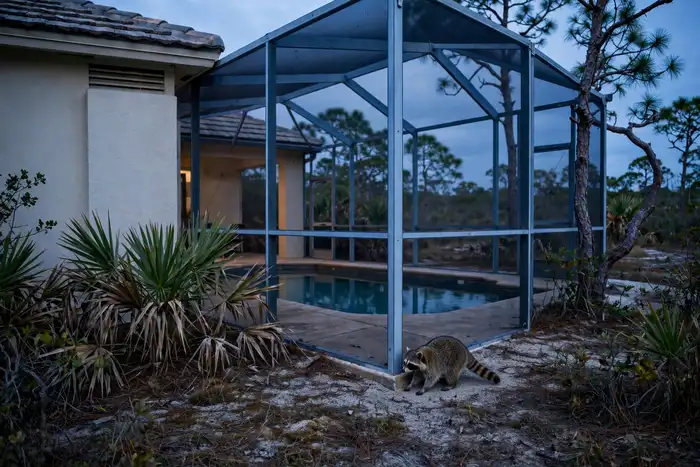
River and park-edge raccoons den in attics near the Loxahatchee corridor and work the ponds and dumpsters of the golf communities nightly. Spring dens hold litters, and the litter sets the timetable. Hobe Sound raccoon removal
🦇 Bats
Brazilian free-tailed and evening bats hunt the river at dusk and roost in tile gaps and gables. Exclusion is the only lawful method in Florida, in the August-to-April window only. Hobe Sound bat removal
🐿️ Squirrels
Gray squirrels run the oak and pine canopy over the older Hobe Sound streets and take attics where fascia has softened. Dawn noise overhead is the classic first report we hear. Hobe Sound squirrel removal
🐾 Opossums
Opossums drift out of the scrub at night and day-shelter under decks, sheds and low homes from the park boundary to the canal streets. Harmless in manner, untidy in residence. Hobe Sound opossum removal
🦔 Armadillos
The scrub-edge specialist: armadillos root up fairway-side lawns, garden beds and the soft ground along foundations all over Hobe Sound, and burrow beneath slabs and lanais. Hobe Sound armadillo removal
🐍 Snakes
Sand pine scrub is snake country — pygmy rattlesnakes in the plantings, racers on the paths, water snakes at the ponds, and a banded look-alike problem at every dock. Identification leads. Hobe Sound snake removal
🕊️ Dead animals
A carcass in a wall, attic or crawlspace ripens fast in South Florida heat, and summer-vacant homes concentrate the discovery into one bad October morning. Locate, remove, sanitise, seal. Hobe Sound dead animal removal
🐦 Birds
Muscovy ducks colonise the community ponds and course water features, while pigeons and starlings occupy vents and rooflines. Duck control is a landowner matter; roosts are a fittings matter. Hobe Sound bird removal
🦎 Iguanas
Established in Martin County, green iguanas burrow the canal banks and seawalls on Hobe Sound's east side, graze the landscaping and foul the docks. Prohibited species; never released. Hobe Sound iguana removal
Animal-specific help in Hobe Sound
Deep, local guides for the problems we get called about most — with our wildlife crew behind every one.
How to get help in Hobe Sound
Tell us what you're hearing
Scratching in the attic, a snake by the porch, holes in the yard — call with your problem and your Hobe Sound address.
We connect you locally
Call us and tell us about the job — we will confirm the local crew for your county before any work starts.
They solve it — for good
Inspection, humane removal, full exclusion and cleanup — handled by our wildlife crew, following Florida rules.
Common wildlife removal questions in Hobe Sound
Does living near Jonathan Dickinson State Park mean more wildlife calls?+
What areas around Hobe Sound do you cover?+
Can a captured animal be released in the state park?+
Our house sits empty all summer. What is the sensible routine?+
Is that a skunk that my neighbour saw near the scrub?+
How much does wildlife removal cost in Hobe Sound?+
Serving all of Martin County
Hobe Sound is one part of Martin County. See wildlife removal in Martin County, FL for the county-wide picture — the animals we get called about most, and the other towns we cover.
One call to your Hobe Sound wildlife crew
Whether it's squirrels in an older in-town attic or a raccoon in a new subdivision crawlspace, the fastest fix is our wildlife crew, who knows Martin County wildlife. Call us and tell us about the job — we will confirm the local crew for your county before any work starts.
- Local to Martin County. FWC-compliant handling — call to ask about licensing and insurance.
- One company, one call. Call us and tell us about the job.
- Done right. Removal, exclusion and cleanup.