Snake Removal in Hobe Sound, FL
Coiled in the mulch by the front walk, stretched along the pond bank, gone under the lanai before you could look twice. Do not get closer for a better description — call from where you stand and describe what you safely saw.
Snakes in your Hobe Sound home
Hobe Sound is snake habitat in a way a purely suburban town is not. Sand pine scrub — the dry, open woodland filling Jonathan Dickinson State Park and fingering into park-edge lots — is prime country for snakes that hunt, bask and shelter in low plantings, while the ponds, canals and the Loxahatchee add a waterside cast. Residents here do not meet snakes despite the landscape; they meet them because of it, and the service that matters is accurate identification delivered calmly.
The local venomous list has four names: the cottonmouth at the waterside, the eastern diamondback rattlesnake of open scrub, the dusky pygmy rattlesnake — small, thick and the one most often met at gardening distance — and the shy, burrowing eastern coral snake. Against those stand the harmless regulars: southern black racers on the paths, corn snakes and eastern rat snakes around outbuildings, and the Florida banded water snake, the heavy banded pond snake routinely misreported as a cottonmouth.
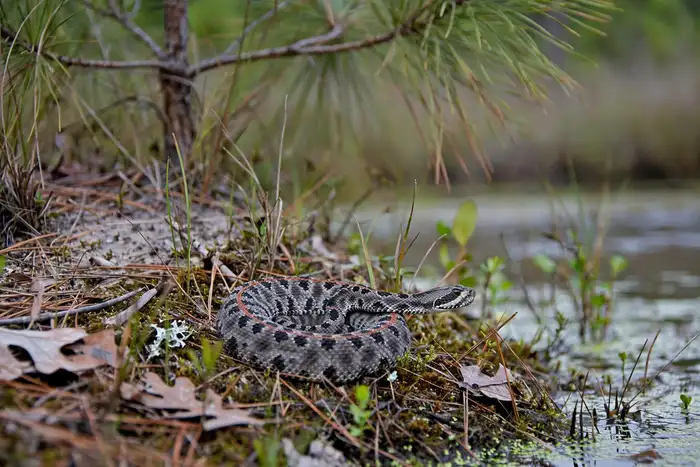
The pygmy rattlesnake and the gardening encounter
More Hobe Sound snake calls begin with a rake than with a sighting. The dusky pygmy is a foot or so of grey, blotch and reddish dorsal stripe, fond of lying in mulch and low plantings near water and frogs, and possessed of a tiny rattle most people never hear. It does not flee far and it does not bluff long. Gloves are not protection against it; awareness is — looking before reaching into beds near ponds, using a tool to move debris, and treating any small thick snake in the plantings as a pygmy until identified.
Pond banks: water snake or cottonmouth
The community ponds and canal banks stage the coast's standing identification problem. The Florida banded water snake is banded, thick-bodied, swims, basks at the edge and flattens its head when pressed — a convincing performance of a cottonmouth by an animal with no venom to back it. Genuine cottonmouths also use these banks, which is precisely why the call is made from a distance, with a photo if one can be taken safely, and settled by someone who reads the two apart daily, not by a closer walk along the bank.
Racers, rat snakes and the case for leaving them
The thin black snake that vanishes across the fairway rough is a southern black racer, a daytime hunter that eats, among other things, smaller snakes and rodents. Rat snakes work the vertical world — fences, palms, pool-cage corners — after rats and nesting birds. For both, our usual professional advice is to keep them and fix their reasons: a yard cleaned of rodent harbourage and spilled feed stops subsidising every snake species at once, venomous hunters of those same rodents included.
Scrub diamonds and coral snakes, in perspective
The eastern diamondback is the region's largest venomous snake and a true scrub animal, tied to open ground and tortoise burrows; it is uncommon close to houses and best met, if met, by backing away. The coral snake is smaller, secretive and fossorial — red, yellow and black in touching bands — and almost never seen unless unearthed by digging. Perspective is a service in itself: Hobe Sound's realistic daily risk concentrates in the pygmy and the waterside pair, and those are where our prevention advice concentrates too.
Protected neighbours at the scrub edge
The eastern indigo snake — big, heavy, glossy blue-black, entirely nonvenomous — is protected, shelters in tortoise burrows and is not an animal we handle; a confirmed indigo becomes a call to the FWC, and we will help you make it. The same referral logic covers the tortoise whose burrow an indigo may be sharing. On scrub-edge lots, assuming a large dark snake might be an indigo until identified is the right default posture for dogs, children and gardeners alike.
What happens on a Hobe Sound snake call
Identification, from photo or description. A venomous snake in a yard, lanai or enclosure is removed with professional equipment. A harmless snake is generally left or steered out with its role explained. Then the property walk: rodent sign, harbourage piles against walls, untrimmed pond-edge planting reaching the house, door and cage gaps that admit a snake indoors. One snake removed from a yard that still feeds and shelters snakes is a result measured in weeks; the walk is what stretches it into seasons.
Common snake questions in Hobe Sound
A small grey snake in my mulch did not move off. What is it likely to be?+
Is the thick snake at our pond a cottonmouth?+
Should the black snakes in the rough be removed?+
A snake has got into the lanai. What now?+
Can you snake-proof a scrub-edge yard?+
How much does snake help cost in Hobe Sound?+
Other Hobe Sound problems that come with snakes
Our wildlife crew handles these closely related problems — the ones that most often turn up with a snake issue.
Got more than snakes in Hobe Sound?
Snakes are rarely the only thing using an attic or yard in Hobe Sound. See everything we handle locally on the Hobe Sound wildlife removal hub, or jump to Florida wildlife removal.
Serving all of Martin County
Hobe Sound is one part of Martin County. See wildlife removal in Martin County, FL for the county-wide picture — the animals we get called about most, and the other towns we cover.
One call to your Hobe Sound snake crew
The longer snakes stay in the attic, the more they chew and the bigger the cleanup. Call us and tell us about the job — we will confirm the local crew for your county before any work starts.
- Local to Martin County. FWC-compliant handling — call to ask about licensing and insurance.
- Humane exclusion. One-way doors and steel sealing, not poison.
- Done right. Removal, exclusion and cleanup.