Armadillo Removal in Hobe Sound, FL
By morning the lawn reads like a ploughing contest and there is a burrow mouth under the lanai you did not order. On the scrub edge, armadillo work is a Hobe Sound speciality — bring us the fresh digging.
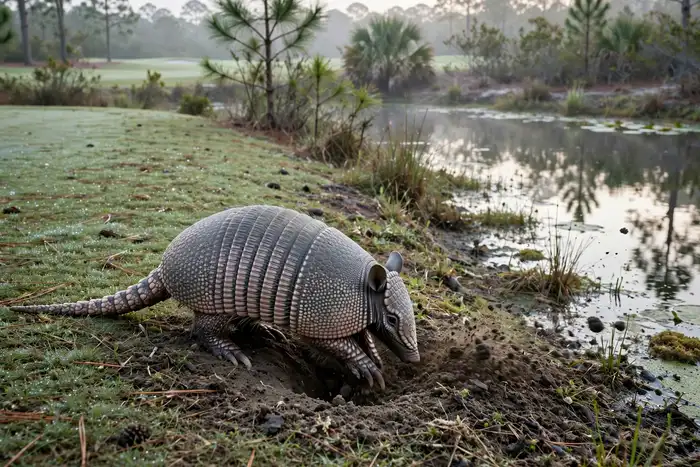
Armadillos in your Hobe Sound home
If the roof rat owns the Hobe Sound attic, the nine-banded armadillo owns its ground floor. Sandy soil, scrub cover at the park boundary, irrigated fairways and gardens through the golf communities, and grub-rich lawns on every street: the town is a continuous armadillo habitat with houses in it. The animal works by night and by nose, rooting shallow feeding holes across turf and excavating burrows — refuges from heat and predators — under slabs, lanais, sheds and the brushy edges of lots.
Expect straight talk about two things. Armadillos in Florida are nonnative, and the rules treat them accordingly, with no release at the end of the job. And their damage is a volume business: one night of feeding holes is cosmetic, but a burrow system growing under concrete for a season, on lots where the soil is sand to begin with, ends as cracked lanais, settled pavers and undermined edges.
Reading a worked-over Hobe Sound lawn
Feeding sign is shallow and everywhere: neat conical holes in turf and mulch, beds turned along their edges, a trail of disturbance that follows the irrigation lines where grubs gather. Burrow sign is singular and serious: an opening roughly a foot across, spoil fanned outside, sited where cover meets structure — the lanai edge, the air-conditioning pad, the scrub line at the back of the lot. A proper survey counts burrows, not holes, and checks the neighbours' side of the fence line for entrances that belong to the same system.
Fairways, roughs and the backyard extension
Golf communities concentrate the pressure. Fairway turf is grub habitat maintained at public expense, the roughs and pond margins give daytime cover, and the homes ringing the course provide slab edges to burrow beneath — armadillos simply extend the course's hospitality into the nearest garden. Residents backing onto a fairway or a scrub margin should read fresh digging as a resident on the property, not a visitor from the rough, and the burrow search should start at their own structures.
Sand, slabs and what undermining means here
Hobe Sound building ground is sand, and sand vacates. A chamber excavated under a lanai slab, a paver drive or a pool deck leaves that surface spanning a void it was never designed to span; the results arrive as hairline cracks, then settlement, then a repair bill with a mason's name on it. Burrows dug at the landward side of a seawall on the canal streets carry the same arithmetic for the wall's footing soil. The armadillo phase of that story is by far the cheapest chapter to intervene in.
No relocation: the nonnative rule
Because armadillos are nonnative in Florida, a captured animal may not be transported or released — never relocated, never let go elsewhere. Any operator who promises to take your armadillo out to the country and free it is promising something Rule 68A-9.010 forbids for nonnative wildlife. Our work is performed under that rule with the property owner's authorisation, and we state the disposition plainly at the inspection, before a trap is set, so the terms are understood rather than discovered afterward.
Burrows that are not armadillo work
The scrub edge teaches caution. A broad burrow with a wide, flat apron in open sandy ground may be a gopher tortoise burrow — a state-Threatened species whose burrows are protected and permit-only. We do not disturb tortoises or their burrows; we will identify the burrow and point you toward the FWC permitting route. Rabbit holes, in turn, are smaller, cleaner and usually a look before anyone budgets. Identification first is free; the wrong assumption is not.
Common armadillo questions in Hobe Sound
Can the armadillo be released near the park?+
Why does the digging explode after rain?+
One burrow filled in — why is it back?+
Will grub treatment for the lawn solve it?+
How much does armadillo removal cost in Hobe Sound?+
Other Hobe Sound problems that come with armadillos
Our wildlife crew handles these closely related problems — the ones that most often turn up with a armadillo issue.
Got more than armadillos in Hobe Sound?
Armadillos are rarely the only thing using an attic or yard in Hobe Sound. See everything we handle locally on the Hobe Sound wildlife removal hub, or jump to Florida wildlife removal.
Serving all of Martin County
Hobe Sound is one part of Martin County. See wildlife removal in Martin County, FL for the county-wide picture — the animals we get called about most, and the other towns we cover.
One call to your Hobe Sound armadillo crew
The longer armadillos stay in the attic, the more they chew and the bigger the cleanup. Call us and tell us about the job — we will confirm the local crew for your county before any work starts.
- Local to Martin County. FWC-compliant handling — call to ask about licensing and insurance.
- Humane exclusion. One-way doors and steel sealing, not poison.
- Done right. Removal, exclusion and cleanup.