Dead Animal Removal in Hobe Sound, FL
The house smells wrong and nothing is visible anywhere. Somewhere in the framing, the floor or the flue, an animal's story ended — and in this climate the announcement does not wait. Call; finding hidden carcasses is methodical work, and we do it methodically.
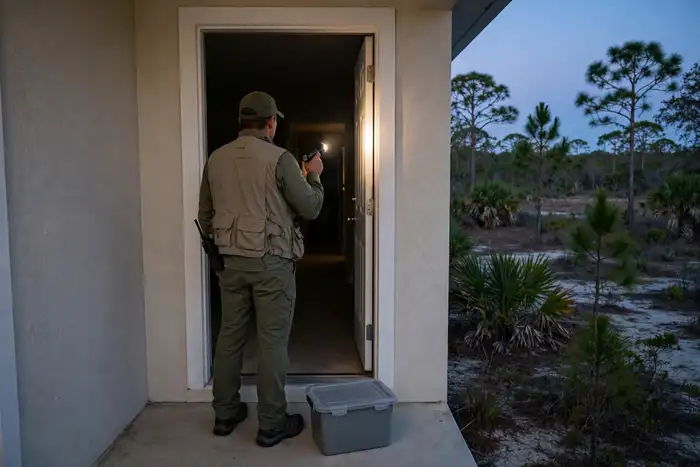
Dead Animals in your Hobe Sound home
Hobe Sound's version of this call has a geography. Park-edge houses collect the animal that denned under the deck or in the crawlspace and died there — an opossum at the end of its short life is the frequent tenant. Vacant seasonal houses collect the other version: a roof rat or squirrel that got in during the empty summer and never got out, marinating in a closed house until the owners return down US-1 in the autumn and open the door on the whole summer at once.
The discipline is locate, remove, sanitise, seal, in that sequence and no other. Odour is mapped — which rooms, which heights, how it moves when the air handler runs — and read against the plan of the house until it indicts one void. Only then is anything opened, through the least invasive route available. What comes out is the animal and the material it ruined; what goes on the surfaces is treatment, not perfume; and the visit ends at the opening that admitted a living animal, which is closed.
The October door-opening, and how triage runs
Returning owners meet the worst version of this problem at the worst moment — luggage in hand, guests expected. Triage is deliberate: ventilate what can be ventilated, identify the worst room, and search by the odour gradient rather than by hope. A carcass that spent July and August in a hot attic or wall does not require demolishing the unit to find; it requires reading the evidence the heat has been broadcasting. Island-side and golf-community homes alike get the same method, and neighbours sharing a wall benefit from it being applied quickly.
Under decks and floors near the scrub
The under-structure deaths here belong mostly to the denning species: opossums first, then the occasional raccoon that wintered or sickened beneath a low house. The smell rises through flooring and duct chases, strongest over the den site. Access is from outside — skirting, a crawlspace hatch, a deck panel — and the clearance includes checking the den for anything else the tenant left behind. The den opening is then screened and trenched shut, because a shelter that has hosted one death will advertise itself to the next tenant on the scrub's nightly rounds.
Walls and attics: rats, squirrels and the fall
Roof rats explore wall voids from the attic and fall where the framing gives them no climb back; squirrels die in eave insulation; both are found by an odour that concentrates at one wall and surges when the cooling system runs. Retrieval from the attic side is preferred. Where the void closes every other route, a single small opening at the mapped point — agreed with you beforehand, finish patching discussed honestly — beats a week of guessing with the nose as the only instrument.
Sanitising in a humid climate
Moisture is the multiplier in Hobe Sound: fluids from a carcass wick into insulation and drywall and keep working in the humidity long after the source would have dried out in a northern house. We remove contaminated material that is reachable, treat the void surfaces, and ventilate. Masking the smell with fragrance is explicitly not the service — if treated material still offends, we say so and scope the next step, rather than declaring victory over a problem your nose will re-litigate tonight.
Sealing is the memorial that matters
Behind every one of these retrievals stands an entry: a soffit gap on an older ranch, a vent screen rusted through at the floor line, a dried drain trap in a house that sat empty, a deck void left open to the scrub. Closing the entry after verifying the structure is empty is what converts this call from a recurring subscription into a story with an ending. Sealing an occupied structure, by contrast, manufactures the next dead-animal call — which is why verification precedes every closure we make.
Common dead animal questions in Hobe Sound
How long would the smell last if we did nothing?+
We just reopened our house for the season and it is unbearable. Can you prioritise the search?+
Will walls need cutting at my house?+
Why is the smell worse in one room and when the air runs?+
How much does dead animal removal cost in Hobe Sound?+
Other Hobe Sound problems that come with dead animals
Our wildlife crew handles these closely related problems — the ones that most often turn up with a dead animal issue.
Got more than dead animals in Hobe Sound?
Dead Animals are rarely the only thing using an attic or yard in Hobe Sound. See everything we handle locally on the Hobe Sound wildlife removal hub, or jump to Florida wildlife removal.
Serving all of Martin County
Hobe Sound is one part of Martin County. See wildlife removal in Martin County, FL for the county-wide picture — the animals we get called about most, and the other towns we cover.
One call to your Hobe Sound dead animal crew
The longer dead animals stay in the attic, the more they chew and the bigger the cleanup. Call us and tell us about the job — we will confirm the local crew for your county before any work starts.
- Local to Martin County. FWC-compliant handling — call to ask about licensing and insurance.
- Humane exclusion. One-way doors and steel sealing, not poison.
- Done right. Removal, exclusion and cleanup.