Rodent Removal in Hobe Sound, FL
Scurrying over the ceiling tiles after the house goes quiet, fruit stripped on the tree, a trail worn along the top of the fence. Hobe Sound roof rats are commuters with a fixed route — and your attic is the terminus.
Rodents in your Hobe Sound home
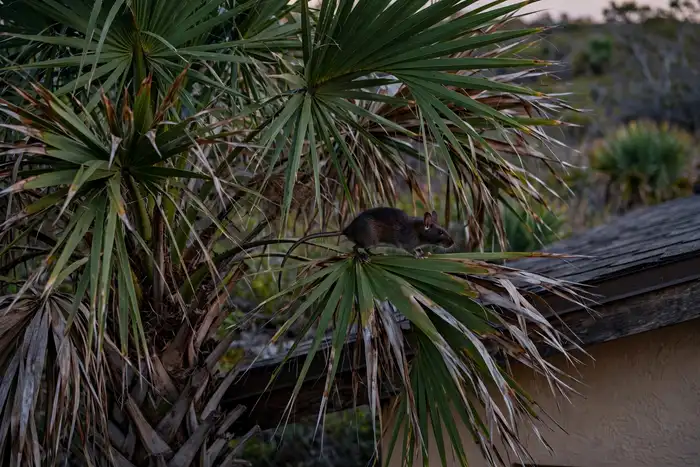
In Hobe Sound the rodent conversation starts and mostly ends with the roof rat, known around Martin County yards as the fruit rat, palm rat or citrus rat. It lives high: nesting in palm crowns and dense landscaping, travelling fences, wires and fronds, and entering houses at the roofline rather than the foundation. The community ponds and golf-course landscaping of the newer subdivisions, and the mature citrus and palms of the older blocks, give it connected cover across most of the town.
Its year has a flavour. Backyard citrus ripens from September through March, and a Hobe Sound rat population that was present but inconspicuous in summer becomes audible, visible and numerous at the fruit trees all autumn. The house mouse turns up indoors as a minor guest. The Norway rat, the burrowing rat of northern basements, is rare on this coast and is almost never the animal behind a Hobe Sound call.
Where the route runs on a Hobe Sound property
Trace it as the rat does: from the pond landscaping or a neighbour's palm, along a fence line or the beam of a pool cage, up a frond or a downspout, and onto the roof. Entry is typically a soffit corner, a tile-roof gap or the junction where an addition meets the original roofline. Inside, droppings string along the attic runs like a route map, which is useful — a well-read attic tells us which entries matter before we seal a single one.
Golf-course landscaping and the pond effect
Newer Hobe Sound communities wrapped around ponds and fairways are exceptionally good rat habitat, and that is not a criticism of the landscaping — dense waterside plantings, palms and year-round irrigation are cover, water and food in one design. Rats nest at the pond edge and commute into the surrounding houses. Sealing in these streets has to be thorough at the individual house, because community-scale habitat will keep supplying candidates for any roofline left open.
The seasonal-home sewer entry
Hobe Sound has many houses that sit empty from May to October, and an unused house develops a rodent door that is not on the roof at all. Water standing in drain traps evaporates over a vacant summer; with the trap dry, rats can pass from the sewer side into the plumbing and the house. Owners who locked up carefully return to droppings and no visible entry. Our vacant-home inspections check both ends of the building — roofline above, drains below — and the prevention advice covers keeping that water barrier alive while a house is empty.
Why the method is trap-and-seal
We trap the rats in residence and seal the structure behind them, and we do not use poison. Poison leaves the entries exactly as inviting as before, and in this climate it too often trades a live rat in the attic for a dead one in a wall. Traps are attended, the count is verified by sign going quiet, and only then are entries closed in materials rats cannot gnaw through in a night's work. That sequence, in that order, is what finishes a rat job rather than pausing it.
Cutting the subsidy in your own yard
A sealed house beside a catering yard will still host rat traffic, just not rat tenants. Harvest citrus as it ripens rather than letting it fall and soften, lift fallen fruit off the ground, trim palm skirts and any frond that bridges to the roof, and keep seed and pet food out of the lanai. On park-edge and pond-edge lots the goal is honest: not a rat-free property, which the surroundings will not permit, but a house they pass on the way to easier feeding.
Common rodent questions in Hobe Sound
Are palm rats different from roof rats?+
I hear them only in the autumn. Do they leave in spring?+
Could rats be entering through the toilets or drains?+
My neighbour has rats too. Is there any point sealing only my house?+
How much does roof-rat work cost in Hobe Sound?+
Other Hobe Sound problems that come with rodents
Our wildlife crew handles these closely related problems — the ones that most often turn up with a rodent issue.
Got more than rodents in Hobe Sound?
Rodents are rarely the only thing using an attic or yard in Hobe Sound. See everything we handle locally on the Hobe Sound wildlife removal hub, or jump to Florida wildlife removal.
Serving all of Martin County
Hobe Sound is one part of Martin County. See wildlife removal in Martin County, FL for the county-wide picture — the animals we get called about most, and the other towns we cover.
One call to your Hobe Sound rodent crew
The longer rodents stay in the attic, the more they chew and the bigger the cleanup. Call us and tell us about the job — we will confirm the local crew for your county before any work starts.
- Local to Martin County. FWC-compliant handling — call to ask about licensing and insurance.
- Humane exclusion. One-way doors and steel sealing, not poison.
- Done right. Removal, exclusion and cleanup.