Bat Removal in Hobe Sound, FL
A dusk exodus from the roofline, droppings collecting under one eave, a faint musk in the attic. Before you book anything, check the month — Florida bat work is a calendar with a service attached.
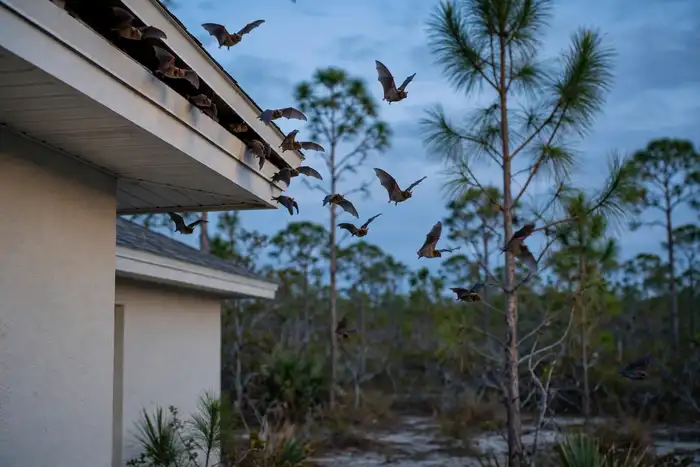
Bats in your Hobe Sound home
The bats of Hobe Sound houses are principally the Brazilian free-tailed bat, a fast, high hunter of the river corridor, and the evening bat, which works lower over the ponds and fairways. Both roost by day in the narrow architecture of a Florida roof: beneath tile, behind barrel-tile edges, in gable peaks and along ridge lines, in colonies that can live above a household for years while the residents below notice nothing but, eventually, the droppings under the entry slot.
Florida protects its bats with one of the clearest rules in this trade. A bat is never harmed or killed, and the sole lawful remedy for a roost in a building is exclusion: one-way devices fitted at the used entries so the colony leaves at dusk and cannot return. That work may be done only from August 15 to April 15. The closed stretch between, mid-April to mid-August, is maternity season, when the roost holds young that cannot fly.
Hurricane season collides with maternity season
Hobe Sound discovers many of its colonies in summer — a storm loosens a tile, a soffit is opened for repair, a roost that was invisible becomes obvious in June. The lawful summer deliverable is an inspection: species identified, entries watched at dusk and mapped, any sealing done that cannot trap a bat inside, and the exclusion itself booked for the first days after August 15. Owners who had a summer discovery and an August booking are, by September, the people whose bat problem is actually finished.
Tile roofs and island rooflines
The tile roofs common in the golf communities and on the island side are generous bat architecture — every ridge and eave offers a slot of exactly roosting width. Older corridor homes substitute gable vents and fascia gaps. Either way, fitting a device at the one slot a homeowner spotted and ignoring the rest of the roofline merely relocates the colony twelve feet. Full-structure sealing alongside the device is not thoroughness for its own sake; it is what makes the colony's next choice a tree rather than your other eave.
Why nobody works on a maternity roost
In summer the roost is a nursery of pups clinging where their mothers left them, unable to fly, unable to use an exit device. Excluding then orphans them inside the roof to die — unlawful under Florida rules and, practically, a worse smell and cleanup problem than the living colony ever was. Waiting until the young are airborne is the entire discipline. Any operator willing to seal your Hobe Sound roost in June is telling you something important about the rest of their work.
Droppings, odour and how cleanup is scoped
Guano accumulates beneath the roost slot, streaks tile and stucco outside, and collects in attic insulation inside. It should be treated as contaminated material: not dry-swept by the homeowner, not blown through the house. After a confirmed-empty roost, we scope removal of what is reachable and fouled, treat the surfaces, and close the final entry to the same standard as the rest of the roofline. Small, recent roosts are a modest cleanup; a decade under the tiles is a larger one, and we say which yours is at inspection.
A single bat indoors is a different call
One bat circling a bedroom is usually a lost individual, not evidence of a colony. Do not handle it or try to towel it out of the air. Confine it to one room by closing the door, keep people and pets out of that room, and call us. If someone slept where the bat was found, mention it when you call — and to your doctor — because the health advice differs from the wildlife advice and both matter.
Common bat questions in Hobe Sound
What months can a Hobe Sound bat roost be excluded?+
Which species is in my roof?+
Why not seal the slot the day we found it?+
Do bats do any good around Hobe Sound?+
How much does bat exclusion cost in Hobe Sound?+
We found the colony in July. Is there anything to do now?+
Other Hobe Sound problems that come with bats
Our wildlife crew handles these closely related problems — the ones that most often turn up with a bat issue.
Got more than bats in Hobe Sound?
Bats are rarely the only thing using an attic or yard in Hobe Sound. See everything we handle locally on the Hobe Sound wildlife removal hub, or jump to Florida wildlife removal.
Serving all of Martin County
Hobe Sound is one part of Martin County. See wildlife removal in Martin County, FL for the county-wide picture — the animals we get called about most, and the other towns we cover.
One call to your Hobe Sound bat crew
The longer bats stay in the attic, the more they chew and the bigger the cleanup. Call us and tell us about the job — we will confirm the local crew for your county before any work starts.
- Local to Martin County. FWC-compliant handling — call to ask about licensing and insurance.
- Humane exclusion. One-way doors and steel sealing, not poison.
- Done right. Removal, exclusion and cleanup.