Iguana Removal in Hobe Sound, FL
An orange-spined male on the dock, burrow mouths along the canal bank, the hibiscus hedge eaten to sticks. Hobe Sound sits inside established iguana country — this is population work, and it starts with clear terms.
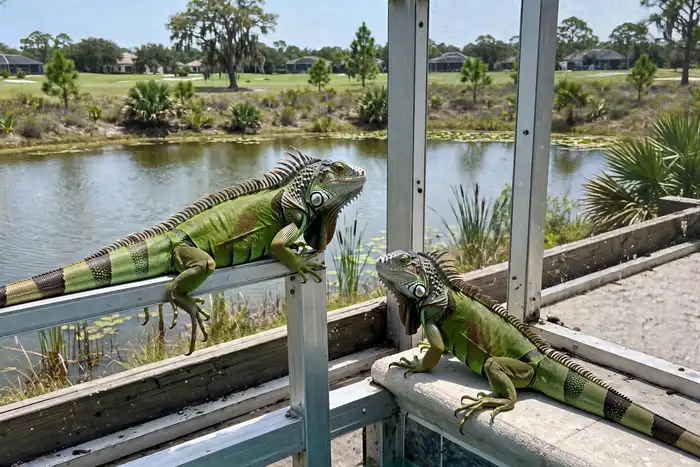
Iguanas in your Hobe Sound home
Green iguanas are established in Martin County — a breeding population at the northern edge of its cold tolerance — and Hobe Sound's east side gives them their preferred arrangement: canal and lagoon banks for burrows, seawalls and docks for basking, golf-course roughs and lush private landscaping for food. The island estates and canal streets see them at estate scale; the mainland canal blocks see the same animals in smaller gardens. Damage arrives in three currencies: burrows that undermine banks and structures, grazing that strips ornamental planting, and droppings on every hard surface a basking iguana favours.
The regulatory position is short enough to quote in full. The green iguana sits on Florida's Prohibited species list; it holds no protected status beyond the general anti-cruelty law; and the FWC encourages removal from private property all year round with the landowner's permission. Its counterpart is absolute: a captured iguana may never be relocated or released anywhere in Florida. Our Hobe Sound iguana work is described to you in exactly those terms before it begins.
Burrows along banks, seawalls and course ponds
An iguana burrow is not a scrape. Both sexes dig shelter burrows and females excavate deep nesting chambers, and in Hobe Sound's sandy ground the preferred sites are exactly the engineered ones: the bank above a canal, the landward foot of a seawall, the soil behind a dock, the pond margins of the golf communities, occasionally beneath a pool deck or a path. Soil removed from behind a seawall is support the wall was designed with. Owners meet the problem as a slumping bank, a path edge giving way, or a burrow mouth appearing where the mower passes — each an argument for dealing with the tenancy before the structure files its own complaint.
The grazing bill: hedges, gardens and new planting
Iguanas eat leaves, flowers and fruit with a preference list that reads like a Hobe Sound planting plan: hibiscus, bougainvillea, orchids, roses, vegetables and almost any fresh annual in its first month. Island and canal-side gardens that took years to establish can be cropped hard in a season by a resident group, and new landscaping installed without protection is, to the local iguanas, a delivery. Removal visits are paired with honest planting advice — what to net while it establishes, what the iguanas reliably ignore, and which hedge along the water is effectively a feeding station for the burrows beneath it.
Docks, decks and the droppings problem
Basking is a daily iguana obligation, and docks, seawall caps and pool decks are its furniture. The droppings follow the basking, deposited where people step barefoot, handle dock lines and set down drinks. Around pools the issue is hygiene as much as housekeeping. Large males add a startle factor — dropping from a palm or a piling beside swimmers, or holding ground on a narrow dock — and a household with dogs will eventually stage the confrontation nobody wants. Those three complaints, more than the grazing, are what turn Hobe Sound tolerance into a removal call.
How an established-population job is scoped
Iguanas are observant, quick over short ground and loyal to good burrows, so removal is skilled, repeated work rather than a single sweep: visits timed to basking and feeding patterns, attention to the burrow entrances a group is actually using, and follow-up matched to the property's burrow count. We scope Hobe Sound jobs per property and say clearly what a first round achieves — the resident group removed and burrows addressed — and why an established canal bank, with neighbouring banks still tenanted, may warrant a maintenance rhythm rather than a declaration of final victory.
Cold snaps and the Martin County line
Every few winters a cold snap drops iguanas out of Hobe Sound's palms, stunned by temperatures below roughly fifty degrees, and local conversation concludes the problem has died. It has thinned. Cold is the reason the established population stops at about this latitude — Martin County is the line, with only scattered individuals reported beyond it — but the banks here warm again, the survivors breed, and the burrows refill. Treat a snap as a discount on the resident population and a good week to start a removal programme, not as the programme itself.
Terms we will not soften
No one from our crew will offer to release your iguanas at a canal with fewer houses, because the law forbids any release, anywhere, and the FWC's position is removal. Nor will we present one visit as the end of an established bank's story. The offer that survives scrutiny is the plain one: the animals on your property removed under the rules, their burrows dealt with, attractants named, and a follow-up pattern sized to the pressure your stretch of waterfront actually carries.
Common iguana questions in Hobe Sound
Are the Hobe Sound iguanas a breeding population or stray pets?+
What happens to an iguana after it is caught?+
Do iguanas bite or chase people?+
The burrows are behind my seawall. How serious is that?+
Did the last cold snap finish them on my street?+
How much does iguana removal cost in Hobe Sound?+
Got more than iguanas in Hobe Sound?
Iguanas are rarely the only thing using an attic or yard in Hobe Sound. See everything we handle locally on the Hobe Sound wildlife removal hub, or jump to Florida wildlife removal.
Serving all of Martin County
Hobe Sound is one part of Martin County. See wildlife removal in Martin County, FL for the county-wide picture — the animals we get called about most, and the other towns we cover.
One call to your Hobe Sound iguana crew
The longer iguanas stay in the attic, the more they chew and the bigger the cleanup. Call us and tell us about the job — we will confirm the local crew for your county before any work starts.
- Local to Martin County. FWC-compliant handling — call to ask about licensing and insurance.
- Humane exclusion. One-way doors and steel sealing, not poison.
- Done right. Removal, exclusion and cleanup.