Wildlife Removal in Willoughby, OH
Willoughby's older houses stand in mature trees a short walk from the Chagrin River, and the river brings the wild neighborhood with it — raccoons, skunks and snakes travel the corridor nightly and den in the chimneys, attics and porches of in-town homes. Call us and tell us about the job — we will confirm the local crew for your county before any work starts.
Why Willoughby homes see the wildlife they do
The Chagrin River is Willoughby's wildlife highway. It runs through town in a green corridor of mature trees and brush, and animals travel it the way people travel the streets above it — raccoons working the banks, skunks and opossums moving lot to lot under cover of the ravine slopes, snakes hunting the edges, herons standing in the shallows. A house near the river, or on a street that slopes down to it, is not near wildlife habitat. It is in the middle of the route.
The housing on those streets has its own long history with animals. Around the historic downtown and the older in-town neighborhoods stand homes built across many eras — nineteenth-century houses, early suburbs, postwar ranches and colonials — most of them shaded by mature trees that have reached the rooflines, many with masonry chimneys, deep eaves and basements that have weathered a century of lake-effect snow and freeze-thaw. Every decade of winters has opened small gaps, and animals read them fluently.
Our wildlife crew works a Willoughby house with both halves in view: the river corridor supplying the animals, and the older house offering the shelter. We find the entries at roofline and foundation, remove the animals the way Ohio law requires, seal in metal and masonry-grade materials that can take snowbelt winters, and clean up what the animals left behind.
The Chagrin River corridor runs through the neighborhood
River corridors concentrate wildlife in a city because they join everything an animal needs — water, food, cover and a protected route — in one continuous strip. In Willoughby that strip passes close behind in-town lots, climbs the ravine slopes in brush and downed timber, and sends its residents out at night along predictable lines: up the slope, across the yard, to the trash cans, the garden, the bird feeder, and the porch void that smells like a dry den.
Proximity shows in the call pattern. Homes backing onto the corridor or its side ravines get the steadiest raccoon, skunk and opossum traffic in town, plus watersnakes near the banks and the occasional animal simply passing a fenced yard it cannot be kept out of. The river is not a problem anyone gets to remove, nor should they — it is the reason the town is beautiful. The work belongs at the house: entries sealed, shelters screened, food secured, so corridor traffic stays traffic instead of tenancy.
Streets farther from the river are not exempt, only quieter. Mature trees knit the neighborhoods together into a canopy animals travel without ever touching the ground, and a squirrel can cross a Willoughby street through the branches the way it crosses the corridor itself.
Older in-town houses: chimneys, eaves and old foundations
Willoughby's older housing stock offers animals a variety newer construction does not. Masonry chimneys — many serving fireplaces used rarely or not at all — stand uncapped over dark, warm flues. Deep eaves and built-up trim hide soffit gaps from the ground. Foundations of block and stone have settled through generations of winters, opening mortar joints and gaps where pipes and wires pass through, and porches built over open voids give skunks and opossums a dry room at street level.
Basements matter here the way they do in any older Ohio town. A gap at the sill plate or a broken vent admits mice and the occasional snake at ground level, and the chases and voids of older framing let animals travel from that basement entry to an attic two floors up. A Willoughby inspection that starts at the roof and skips the foundation will misdiagnose a share of its houses.
The repair standard follows the house: repointing and metal set into mortar at the foundation, heavy flashing and screening at the roofline, a real chimney cap. Materials chosen for a house that has already survived a hundred winters should be chosen to survive the next stretch of them.
Lake-effect snow, freeze-thaw and the fall entry peak
Lake County sits in the snowbelt, and Willoughby takes lake-effect snow seriously — deep falls off Lake Erie that load older roofs, followed by thaws that send meltwater into every imperfect joint, followed by refreezes that pry those joints wider with ice. A flashing seam or soffit joint that was snug in one October can admit a squirrel by a later one, and vent screening rusts and fails under the same cycle. The housing here does not age in a straight line; it ages one winter at a time.
That cycle sets the calendar of complaints. Fall is the peak: as the first cold arrives, squirrels, raccoons and house mice push to get inside for the winter, testing every gap the recent winters have made. A house quiet for years can have animals in the attic within a single cold week — the animals did not change; the roofline finally opened enough.
The practical response is timing. Sealing done in fall, ahead of the push, in metal that will not split when it freezes, prevents most winter attic problems in this town. Sealing attempted in foam and hope, in January, usually becomes a story told the following fall.
Ohio law for bats, rabies and the animals that cannot be moved
Wildlife removal for hire in Ohio is licensed work: the ODNR Commercial Nuisance Wild Animal Control Operator license, under Ohio Revised Code section 1531.40. Bats follow the strictest rules attached to that license. Exclusion is not allowed from May 16 through July 31 when five or more bats are present, because the pups of the season cannot fly, nor from October 15 through March 31, when big brown bats may be hibernating inside the attic itself — either period only with prior written ODNR permission. The lawful windows are April 1 to May 15 and August 1 to October 15, which is why a bat call in July usually becomes an inspection now and a scheduled exclusion in August.
Rabies shapes the rest of the work. Raccoons, skunks, foxes and bats are Ohio's principal rabies vectors, bats the most frequently confirmed of them. Under Ohio Administrative Code 1501:31-15-03(E)(3), a captured raccoon, skunk or opossum cannot be carried away and released elsewhere — the lawful outcomes are release on the same property or humane euthanasia, a rule that exists because moving animals moves disease. Our crew leads with exclusion, one-way doors and sealing that let an animal leave a structure under its own power where that can work, and handles the rest exactly the way Ohio rules require.
Wildlife we remove in Willoughby
From big brown bats in a tall old attic to a watersnake at the riverbank, these are the calls Willoughby homeowners make most.
🐿️ Squirrels
Gray squirrels travel Willoughby's mature canopy street to street and move into attics at the fall peak, through gaps lake-effect winters have pried open. Chewed wiring in an older attic is the urgent part. See our full Willoughby squirrel removal guide →
🦝 Raccoons
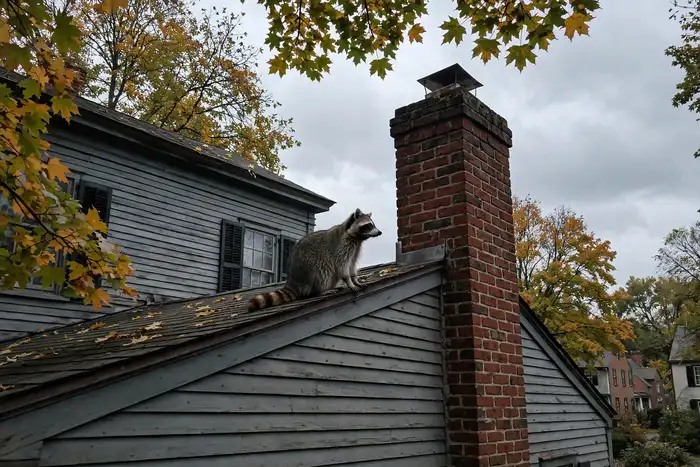
Raccoons commute up from the Chagrin River and den in uncapped chimneys and attics of in-town homes. A rabies-vector species Ohio law does not allow to be moved off the property — exclusion first, young accounted for. See our full Willoughby raccoon removal guide →
🦇 Bats
Big brown bats fill the tall attics of older Willoughby houses and may hibernate in them through a snowbelt winter. Exclusion is legal only April 1–May 15 and August 1–October 15 without written ODNR permission. See our full Willoughby bat removal guide →
🦨 Skunks
Skunks travel the river corridor and den under the porches and decks of older homes, where the voids are dry and street-level. A rabies vector that cannot be moved off the property under Ohio law — careful on-site work plus screening. See our full Willoughby skunk removal guide →
🦫 Groundhogs
Groundhogs burrow under porches, sheds and retaining walls where in-town yards meet the ravine slopes and open ground, then sleep away the winter in hibernation. Fresh spring dirt marks an active system. See our full Willoughby groundhog removal guide →
🐾 Opossums
Opossums wander out of the river corridor nightly and bed down in garages, under porches and in window wells. Ohio law does not allow them to be carried off the property, so removal pairs with closing the shelter. See our full Willoughby opossum removal guide →
🐿️ Chipmunks
Chipmunks tunnel along older foundations, stone porch edges and garden walls under the mature trees, undermining soil where mortar is already weathered. Small animal, patient excavation. See our full Willoughby chipmunk removal guide →
🐀 Rats, mice & voles
House mice pour into older Willoughby homes at first frost, Norway rats work the riverbanks and older housing near the water, and voles trail lawns under the deep snow until melt exposes them. See our full Willoughby rodent removal guide →
🐍 Snakes
Almost always harmless — garter snakes in gardens, rat snakes in basements after mice, and northern watersnakes along the Chagrin River. The Willoughby snake call is identification and calm removal. See our full Willoughby snake removal guide →
🪰 Dead animals
A smell building in one room of an older home, often surfacing at thaw, usually means something died in a wall, an attic or under a porch. Our crew locates it, removes it, cleans the area and closes the entry. See our full Willoughby dead animal removal guide →
Animal-specific help in Willoughby
Deep, local guides for the problems we get called about most — with our wildlife crew behind every one.
How to get help in Willoughby
Tell us what you're hearing
Scratching in the attic, a snake by the porch, holes in the yard — call with your problem and your Willoughby address.
We connect you locally
Call us and tell us about the job — we will confirm the local crew for your county before any work starts.
They solve it — for good
Inspection, humane removal, full exclusion and cleanup — handled by our wildlife crew, following Ohio rules.
Common wildlife removal questions in Willoughby
Who do I call for wildlife removal in Willoughby?+
Why do animals keep getting into my older Willoughby house?+
Can bats be removed from my Willoughby attic in summer or winter?+
Will you relocate a raccoon or skunk away from my property?+
Does living near the Chagrin River mean more wildlife at my house?+
How much does wildlife removal cost in Willoughby?+
Serving all of Lake County
Willoughby is one part of Lake County. See wildlife removal in Lake County, OH for the county-wide picture — the animals we get called about most, and the other towns we cover.
One call to your Willoughby wildlife crew
Whether it's squirrels in an older in-town attic or a raccoon in a new subdivision crawlspace, the fastest fix is our wildlife crew, who knows Lake County wildlife. Call us and tell us about the job — we will confirm the local crew for your county before any work starts.
- Local to Lake County. ODNR-compliant handling — call to ask about licensing and insurance.
- One company, one call. Call us and tell us about the job.
- Done right. Removal, exclusion and cleanup.