Dead Animal Removal in Willoughby, OH
A heavy smell gathering around a fireplace that is never lit, or seeping from a parlor wall in a house that has stood for a century? Old framing hides old pathways — and winter tenants sometimes do not leave them. Call us and tell us about the job — we will confirm the local crew for your county before any work starts.
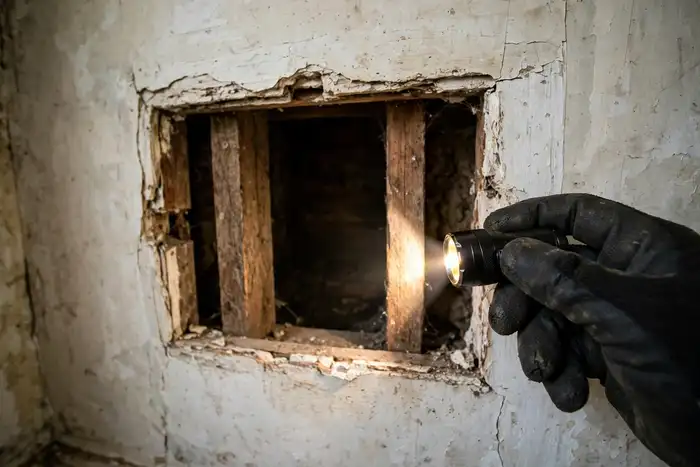
A dead animal inside an older Willoughby house
Historic houses keep their secrets in a particular way. A Willoughby home framed in the balloon style has wall cavities that run, uninterrupted, from cellar sill to attic plate — two full storeys of hidden vertical street. An animal that slips into that street at the eaves can fall, or wander, or die at any level, while the chimney next door offers a second, parallel shaft with its own ledges and soot-dark hiding places. Odor in such a house obeys the framing, not the floor plan.
That is why the first conversation matters so much here. Which chimney breast? Which side of a dividing wall? Does the smell strengthen when the house warms in afternoon sun, or when the furnace draws air down the old chases? Answers place the search inside one or two cavities before anyone drills a single inspection hole.
The unused fireplace: smoke shelves, damper gaps and fallen birds or mammals
Begin at the hearth in any Willoughby house with a cold flue. Above the damper sits the smoke shelf — a flat ledge designed to catch downdraught debris — and over a winter it can also catch a starling, a squirrel that lost its footing, or a juvenile raccoon that explored too far and could not climb the slick flue back out. Odor from a smoke shelf presents distinctively: strongest in the firebox room, worse when humidity rises, sometimes with flies emerging around the damper frame. Access, fortunately, is often through the firebox itself once the damper is opened or removed by someone who knows old ironwork — no plaster harmed.
Balloon-frame walls: a two-storey drop with no fire stops
Modern framing blocks each storey with horizontal plates; balloon framing does not. A mouse or young squirrel entering at a cornice can descend the full height inside one bay and lodge behind parlor plaster at ankle height, while its odor rises through the same bay and convinces the household the source is upstairs. Crews work this geometry deliberately — listening, comparing odor at baseboard and picture rail, checking the cellar top plate directly below — until the bay and the level agree. Extraction then comes from whichever face is plainer: often a closet interior or a cellar-side opening rather than the finished parlor surface.
Beneath porches with lattice, stone piers and a century of tenants
The classic front porch here rests on stone piers with lattice or boards between, enclosing a shallow, earth-floored chamber that generations of skunks, opossums and neighbourhood cats have regarded as public housing. A loss in that chamber perfumes the front rooms and the cellar wall behind it, and it is frequently misdiagnosed as a wall case because the floor above is the only surface anyone can inspect. Rolling under the porch — or removing one lattice panel — settles the question in minutes, and re-screening that perimeter with buried mesh afterward is the cheapest prevention in this entire catalogue.
Attic eaves and the insulation archaeology of old roofs
Where a steep Willoughby roof meets the upstairs ceiling, the eave triangle is too low to enter and too tempting for squirrels to ignore. Animals lost in that wedge die beyond reach of a casual attic look, under insulation that may include layers added across decades. A borescope slipped along the eave, plus odor comparison at the ceiling line below, locates the spot; removal may mean lifting a small section of attic floorboards — frequently loose-laid in older homes — rather than cutting any ceiling at all. Contaminated insulation is drawn out in a margin around the find, because old blown material holds odor stubbornly.
Reading fly behaviour in a house with many chimneys and chases
In a modern open plan, flies gather near the source. In a compartmented historic house they gather at the first light and warmth along their escape route — a gap at a chimney flashing, a keyhole, the seam of an attic hatch two rooms away from the cavity. Crews therefore treat fly location as a vector, not a destination: useful for direction, misleading for distance. Combined with the chimney map and the balloon-bay logic, it still narrows a twelve-room search to a shortlist that can be checked with a scope before any surface is opened.
Patching, plasterers and honest expectations for finished rooms
When an opening is unavoidable, its placement is a conservation decision: closet walls, the inside of a cupboard, the back of a chimney cupboard — surfaces where a patch will never catch the eye. Original lime plaster patches differently from gypsum, and a wildlife crew will say plainly that a specialist plasterer gives the invisible finish a show wall deserves. What the crew does guarantee is the unglamorous half done properly — source out, void cleaned and treated, and the entry route outside capped, screened or repointed so the same shaft does not host a repeat.
Common dead animal questions in Willoughby
The odor centres on our unused fireplace — what is likely in there?+
Smell is upstairs but flies are downstairs — which floor is the source on?+
Will original plaster have to be cut in our parlor?+
We never heard scratching at all — can an animal still have died in the walls?+
How much does dead animal removal cost in Willoughby?+
Other Willoughby problems that come with dead animals
Our wildlife crew handles these closely related problems — the ones that most often turn up with a dead animal issue.
Got a live animal problem in Willoughby too?
A chimney or wall route used by one generation of animals is marked for the next — capping, screening and repointing now closes the family tradition. See everything we handle locally on the Willoughby wildlife removal hub, or jump to Ohio wildlife removal.
Serving all of Lake County
Willoughby is one part of Lake County. See wildlife removal in Lake County, OH for the county-wide picture — the animals we get called about most, and the other towns we cover.
One call to your Willoughby dead animal crew
Original plaster and old-growth framing deserve a search that respects them. Most sources can be reached from a closet, an attic floor or a cellar ceiling once the right cavity is identified. Call us and tell us about the job — we will confirm the local crew for your county before any work starts.
- Local to Lake County. ODNR-compliant handling — call to ask about licensing and insurance.
- Map the framing, reach it from the plain side. Using chimney and chase geometry to pinpoint the cavity, extracting from the least finished surface available, then cleaning the void and sealing the historic entry.
- Done right. Removal, exclusion and cleanup.