Raccoon Removal in Willoughby, OH
Deliberate, heavy footsteps in the attic at night, or chattering from the chimney? Willoughby raccoons commute from the river corridor and raise their young in the flues and attics of in-town homes. Call us and tell us about the job — we will confirm the local crew for your county before any work starts.
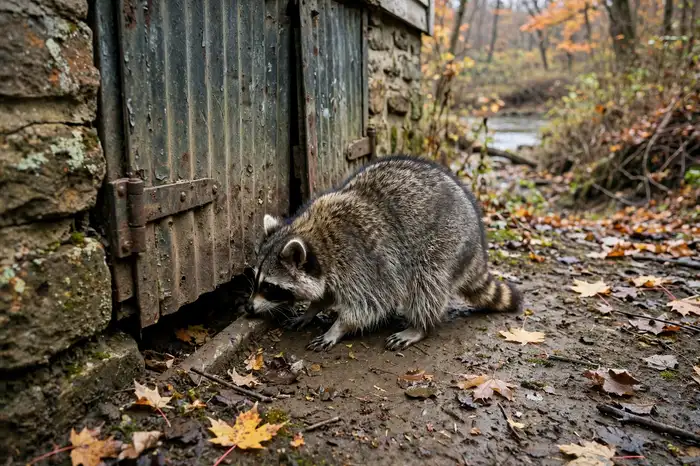
Raccoons in your Willoughby home
The Chagrin River keeps Willoughby's raccoons fed — crayfish and fish along the banks, frogs in the shallows, plus the gardens, trash cans and pet dishes of every street the corridor touches. What the river cannot give a female raccoon in spring is a den. For that she inspects the housing: an uncapped masonry chimney on an older home, a soffit corner she can pull at, a big quiet attic over a garage. In-town Willoughby offers all three within a short night's walk of the water.
The job is then governed by biology and law together. Kits stay in the den for weeks before they can travel, and a raccoon may not lawfully be transported away and released in Ohio. Raccoon work here is therefore deliberate — the family located, the young accounted for, the structure closed only when it is empty — rather than a hurried evening with a borrowed trap.
Ohio law: a raccoon is not taken away for release
Ohio Administrative Code 1501:31-15-03(E)(3) requires a captured raccoon to be released on the same property or humanely euthanized. Carrying one out of town and letting it go is unlawful, and the reason is rabies: raccoons are a leading vector, and transported animals transport the disease into new populations. Our crew leads with exclusion — one-way doors and sealing that let a raccoon leave the structure under its own power where that can work — and handles any animal that must be taken directly exactly as Ohio rules require. An offer to haul a Willoughby raccoon away for release is an offer of an illegal service.
The uncapped chimney, a Willoughby specialty
Older in-town homes carry original chimneys in numbers newer suburbs cannot match, and many serve fireplaces that are seldom or never lit. A cold, open flue is a manufactured hollow tree: dark, dry, vertical and warm. A female will raise kits on the smoke shelf above the damper, announced by chattering from the chimney and soot-marked prints at the flue. The order of work is fixed — family out first, confirmed, and only then a cap. A chimney capped over a den converts a removal into a carcass recovery inside a flue.
Locating the litter before a single seal
Kits arrive in spring and cannot climb or follow their mother for their first weeks. If she is excluded and the entry shut, the litter dies in the attic or chimney — the household trades a raccoon problem for a dead-animal problem in the least accessible space it owns. Our crew inspects with cameras and lights, locates the young, and builds the removal plan around accounting for every kit before any door is fitted or opening closed.
The attic latrine and what it leaves behind
Raccoons keep a latrine — one spot, used repeatedly — and in a spacious older attic that deposit can grow for a long time before anyone climbs up to find it. The droppings can carry raccoon roundworm, whose eggs persist in contaminated material and matter most where children could contact it later. A complete job removes the fouled insulation at the latrine and sanitizes the area. Full-attic insulation replacement is sometimes presented as automatic; often only the affected section needs to come out, and a plain answer about which applies is part of the work.
Sealing work a strong animal cannot peel back
A raccoon that opened a soffit once will examine the repair with the same forepaws. Closures are therefore heavy-gauge metal: a sound chimney cap, reinforced vent covers, flashing at porch-roof seams and roof returns, and gable ends checked as carefully as the entry the animal actually used. Wood and foam do not survive inspection by a raccoon. On homes where two roof planes and a dormer converge, the crew assumes there is a second weak point until the ladder work proves otherwise.
Corridor pressure, household habits
The river guarantees a background raccoon population in Willoughby permanently, so sealing has to be complete — but habits decide how hard the sealed house gets tested. Trash in cans with lids that latch, pet food indoors after dark, grills cleaned and bird seed kept away from the walls all reduce how often a commuting raccoon stops to investigate your roofline on its way up from the water.
Common raccoon questions in Willoughby
There is a raccoon in my Willoughby attic — what should I do?+
Can you trap a raccoon and release it along the river or in a park?+
I hear chattering in my chimney — is that baby raccoons?+
A raccoon is active in my yard in daylight — is it sick?+
How much does raccoon removal cost in Willoughby?+
Other Willoughby problems that come with raccoons
Our wildlife crew handles these closely related problems — the ones that most often turn up with a raccoon issue.
Got more than raccoons in Willoughby?
Raccoons are rarely the only thing using an attic or yard in Willoughby. See everything we handle locally on the Willoughby wildlife removal hub, or jump to Ohio wildlife removal.
Serving all of Lake County
Willoughby is one part of Lake County. See wildlife removal in Lake County, OH for the county-wide picture — the animals we get called about most, and the other towns we cover.
One call to your Willoughby raccoon crew
The longer raccoons stay in the attic, the more they chew and the bigger the cleanup. Call us and tell us about the job — we will confirm the local crew for your county before any work starts.
- Local to Lake County. ODNR-compliant handling — call to ask about licensing and insurance.
- Humane exclusion. One-way doors and steel sealing, not poison.
- Done right. Removal, exclusion and cleanup.