Squirrel Removal in Willoughby, OH
Running and rolling acorns overhead once the cold sets in? Willoughby squirrels cross the neighborhood through the mature canopy and step onto older rooflines that lake-effect winters have been loosening for years. Call us and tell us about the job — we will confirm the local crew for your county before any work starts.
Squirrels in your Willoughby home
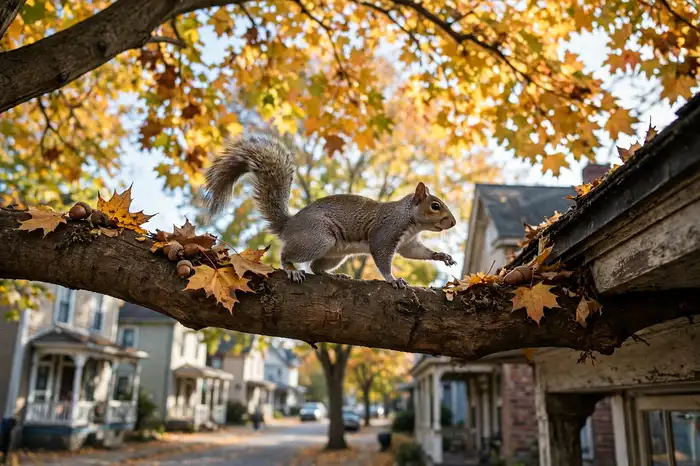
Willoughby's trees are the squirrel highway and the squirrel pantry at once. The mature oaks and maples over the older streets drop mast all fall, shelter dreys all summer, and — the part homeowners underestimate — touch or overhang a great many roofs. A gray squirrel in this town often does not climb a house at all. It walks out a branch, steps onto the roof, and starts testing the edges it finds there.
What it finds depends on the winters. Snowbelt freeze and thaw pry at soffit corners, lift flashing at chimneys, and rust the screening in gable vents, so older Willoughby rooflines accumulate candidate entries the way they accumulate character. Fall is when the testing turns serious: a squirrel choosing its winter den works a street of roofs the way a shopper works a row of doors.
The fall peak, written by the weather
Attic calls climb in fall for connected reasons. The mast crop that fed squirrels outdoors is ending, the first cold nights make a hollow tree a poor bargain against a warm attic, and the roofline gaps have had another year of ice working in them. A fall squirrel is settling in for the season, not exploring, and it will chew to keep its den — which is why a noise beginning in October should be answered in October, and why a pre-season sealing is the cheapest squirrel work in this climate.
Gray squirrels by day, flying squirrels after dark
Gray squirrels announce themselves in the morning and again late in the day. Commotion that begins after dark, in quick bursts across the ceiling, usually means flying squirrels — nocturnal, sociable, and small enough to enter through gaps a gray could never use. Willoughby's older, tree-heavy streets are prime flying squirrel country. Naming the species correctly matters, because a flying squirrel job fails if even one small vent gap escapes the sealing.
Where they enter an older Willoughby roof
The entry map follows age and ice: soffits pried at corners, fascia softened behind gutters that have overflowed through many autumns, gable vents with rusted screens, the seam where a porch roof meets the main wall, and trim gaps around dormers. On brick and stone chimneys, squirrels climb the masonry itself. Our crew inspects the entire roofline, since a house of this vintage rarely offers just one candidate — and sealing the active hole while leaving its twin at the other gable is a postponement, not a repair.
Litters, gnawing and old wiring
Squirrels litter in late winter and again in late summer. Before any entry is closed, the attic is checked for young, because a mother excluded from a litter will chew a new opening — occasionally through a worse place than the original. The standing risk of delay is the gnawing itself: squirrels chew wiring, wood and ductwork as a biological necessity, and in an older attic, among dry nesting material and wiring that may itself be old, stripped insulation is a fire hazard with a timeline.
One-way doors, then metal that outlasts the winter
The standard Willoughby job is exclusion. Our wildlife crew fits a one-way door at the active entry so squirrels leave to feed and cannot re-enter, confirms the attic is empty and no litter remains, then closes every opening in metal — flashing, steel mesh, hardware cloth — fitted to survive snow load and thaw. Foam and thin wood are not finishes on a house that has watched a hundred winters; they are appointments for next year.
Living under a canopy, sensibly
A sealed house under big trees will still be visited, and a few habits lower the visits' value: feeders hung away from the walls rather than over the porch roof, branches kept trimmed back from the roofline where a tree's health allows, and a glance at vents and soffits each fall before the entry peak. The canopy is part of why people love these streets. The goal is a house that is boring to the animals passing through it.
Common squirrel questions in Willoughby
I hear scratching in my Willoughby attic in the morning — squirrels?+
Why do squirrels get in during fall specifically?+
Can I just seal the hole they are using?+
Are attic squirrels really a fire risk?+
How much does squirrel removal cost in Willoughby?+
Other Willoughby problems that come with squirrels
Our wildlife crew handles these closely related problems — the ones that most often turn up with a squirrel issue.
Got more than squirrels in Willoughby?
Squirrels are rarely the only thing using an attic or yard in Willoughby. See everything we handle locally on the Willoughby wildlife removal hub, or jump to Ohio wildlife removal.
Serving all of Lake County
Willoughby is one part of Lake County. See wildlife removal in Lake County, OH for the county-wide picture — the animals we get called about most, and the other towns we cover.
One call to your Willoughby squirrel crew
The longer squirrels stay in the attic, the more they chew and the bigger the cleanup. Call us and tell us about the job — we will confirm the local crew for your county before any work starts.
- Local to Lake County. ODNR-compliant handling — call to ask about licensing and insurance.
- Humane exclusion. One-way doors and steel sealing, not poison.
- Done right. Removal, exclusion and cleanup.