Snake Removal in Willoughby, OH
A broad, dark shape holding its ground on the river path, or a striped flash vanishing into a downtown garden wall? Willoughby snakes live where water, stone and old foundations meet — and nearly all of them are harmless neighbours. Call us and tell us about the job — we will confirm the local crew for your county before any work starts.
Snakes along Willoughby yards, walls and the river
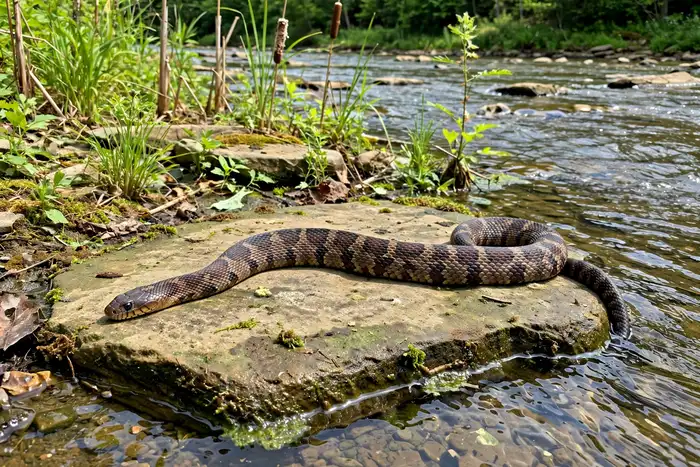
Stand on the bank at first light and the river announces its residents in order: heron in the shallows, kingfisher rattling downstream, and — warming on the first sunlit slab — a watersnake thick as a wrist, patterned in dark saddles, utterly uninterested in the path above. Willoughby lives alongside that snake community in a way suburbs built away from water never have to. Gardens run down to ravines, stone walls terrace the slopes, and cellar foundations were laid when a riverbank address was simply where town was.
Encounters therefore split into two families. Outdoors, the question is almost always reassurance: is the big river snake what I fear it is? (It is not — Ohio's river regular here is a nonvenomous fish specialist.) Indoors, the question is logistics: a rat snake has followed mice into a stone-walled cellar, and somebody qualified should carry it back out and point to the joint it used.
On the bank: the watersnake at home
Northern watersnakes own the Chagrin through town — basking on fallen trunks, hunting crayfish in riffles, swimming with head raised and body trailing low. Cornered on land they flatten the head, strike repeatedly and release a musky smell, a performance engineered to persuade you the animal is formidable. It has no venom apparatus at all. Anglers meet them most, because both parties want the same pools. Step back, let the snake choose water, and the incident resolves itself; problems start only when a dog pins one or a hand reaches to move it.
Garden walls, rockeries and the garter snakes that patrol them
Historic Willoughby gardens are terraced with stone — retaining walls, rockery slopes, edging piled a century ago — and every sun-warmed crevice in that stonework is garter snake real estate. These slim, yellow-striped hunters work the beds for slugs, worms and froglets, raising their heads periscope-fashion above low foliage when disturbed. A wall can host several through the summer, to the benefit of anyone tired of slug damage. Calls come when a wall fronts a play area or a stoop, and the usual resolution is confirming the species and adjusting one basking crevice rather than declaring war on the garden's best pest control.
Stone cellars and the rat snakes that audit them
Rubble and block foundations under older in-town homes breathe through a hundred small joints, and mice use them first. Rat snakes — powerful, patient climbers that can scale rough stone vertically — read a mouse-scented joint the way we read a doorway. Inside, they favour cellar ceiling joists, the tops of water heaters and quiet shelving. Discoveries are startling mainly for the size of an adult, which can exceed five feet. Removal is calm work with a bucket and hook, followed by the genuinely useful part: identifying the mouse activity and the specific joint that served as the door.
Babies in autumn basements and other seasonal puzzles
Late summer brings a different call: several palm-sized snakes found together near a bulkhead or cellar stair. Garter snakes give live birth in late summer, and a litter dispersing from a birth site beside a foundation can send youngsters exploring every ground-level crack for a few days. They are harmless, temporary and best swept gently — by a gloved professional — toward outdoor cover. The episode mainly signals a foundation crack worth sealing before the same route admits mice for the winter.
Telling the river regular from the snakes people imagine
Fear imports species that do not live here. The heavy river snake is routinely reported as something southern and venomous, yet its bands narrow toward the belly, its eyes sit high enough to see over the water surface, and its whole summer is spent visibly fishing in public view — behaviour no genuinely dangerous local species offers in this town, because Willoughby has no established venomous population to offer it. Photograph from the bank, zoom rather than approach, and let pattern plus place make the identification; both together are conclusive for the species found in town.
Stonework, woodpiles and a yard arranged for passing through
Snakes linger where cover touches food. Repointing the loosest joints in a garden wall, stacking firewood off the ground and away from the back door, and keeping a mowed margin between lawn and ravine brush all shorten visits without harming the river population that keeps rodents and slugs in check. Where a particular wall keeps producing indoor explorers, screening its base with fine mesh buried a few inches deep breaks the cellar route while leaving the garden's outdoor hunters unbothered.
Common snake questions in Willoughby
The big snake by the river path will not move and hisses at walkers — what is it?+
I keep finding small striped snakes in my downtown garden — should they go?+
A very long dark snake was on my cellar shelf — how do I stop the next one?+
Are there venomous snakes anywhere in Willoughby I should worry about?+
How much does snake removal cost in Willoughby?+
Other Willoughby problems that come with snakes
Our wildlife crew handles these closely related problems — the ones that most often turn up with a snake issue.
Got more than snakes in Willoughby?
Stone retaining walls and rubble foundations shelter snakes and mice in the same voids — repointing and screening those joints helps with both visitors. See everything we handle locally on the Willoughby wildlife removal hub, or jump to Ohio wildlife removal.
Serving all of Lake County
Willoughby is one part of Lake County. See wildlife removal in Lake County, OH for the county-wide picture — the animals we get called about most, and the other towns we cover.
One call to your Willoughby snake crew
The river will keep producing snakes every summer, because that is what a healthy river does. The achievable goal is a house and garden where they pass along the bank instead of pausing in the cellar or the stone wall. Call us and tell us about the job — we will confirm the local crew for your county before any work starts.
- Local to Lake County. ODNR-compliant handling — call to ask about licensing and insurance.
- Certain identification, gentle relocation on site. Confirming the species from pattern and setting, moving any indoor animal to nearby cover by bucket, and noting the stone joint or cellar gap it exploited.
- Done right. Removal, exclusion and cleanup.