Wildlife Removal in Fort Valley, GA
In Fort Valley the orchards never really leave the neighborhood. Fallen peaches, packing sheds and sandy yards sit right behind older houses and student rentals, so animals feeding out there at dusk often end the night in an attic, crawlspace or shed. Call us and we will talk through what you are hearing and seeing before anyone rolls out.
Why Fort Valley homes see the wildlife they do
Fort Valley runs on two rhythms that shape every wildlife call here. One is the orchard calendar, with rows of peach trees, mowed middles, irrigation lines and packing sheds that stay busy from bloom through harvest and then sit quiet with stored crates and equipment inside. The other is the in-town rhythm around Fort Valley State University, where older houses, divided rentals and other long-standing buildings have stood long enough for rooflines to open up and crawlspaces to settle. Wildlife follows both rhythms at once, feeding where fruit drops and field edges meet lawns, then bedding where a roof void or outbuilding offers dry cover close to that food.
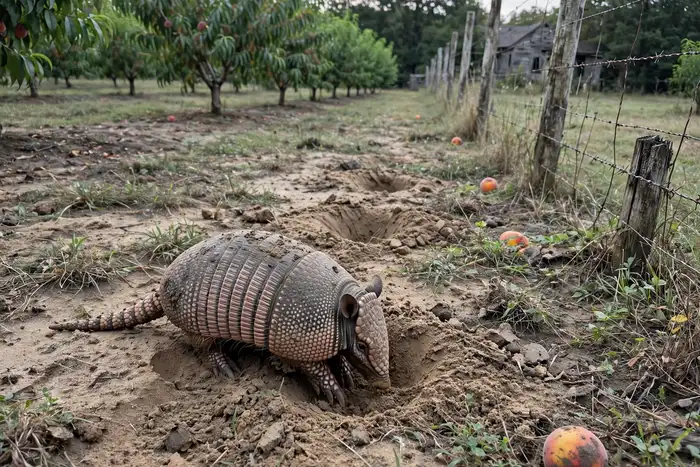
That overlap explains why a Fort Valley call rarely sounds like a single animal in a single spot. A homeowner near the orchards might watch armadillos rooting along a fence after rain while squirrels work the pecan limbs over the back bedroom. A landlord with a rental near campus might open a utility closet and find droppings, chewed stored produce in a carport bin and scratching overhead that turns out to be two species using two different gaps. Our crew starts by sorting that overlap out on the ground, walking the orchard edge, the shed line and the roofline together instead of treating the house as if it stood alone on a bare lot.
When you call us about a place in Peach County, we will confirm the local crew for your county before any work starts and we will explain what that first visit covers. Expect questions about fallen fruit in the yard, outbuildings that stay closed for weeks, rental turnover, attic access and whether the ground along the foundation digs soft after rain. Those details matter here because sandy loam, fruit ground and aging trim create entry and digging conditions you simply do not get in a newer subdivision on compacted clay, and the fix has to match the ground and the building, not a generic checklist.
How Orchard Rows and Packing Sheds Pull Animals Toward Fort Valley Houses
Peach ground feeds wildlife in waves. Windfall fruit softens on the orchard floor, field margins hold insects and rodents, and the shaded strips under trees give snakes and raccoons cover in daylight. At night that feeding ground connects directly to houses by fence lines, ditch banks and the backs of packing sheds and equipment barns. Raccoons learn the bins behind a shed, rodents work stored grain and produce residue, and squirrels commute from fruit and nut trees straight onto shingles. We map that route during the inspection, because sealing a gable while leaving a shed door gap and a fruit-heavy limb touching the roof only moves the problem a few yards sideways.
Outbuildings deserve the same attention as the house itself. A packing shed with a warped door, a pump house with a cracked slab edge or a detached garage with stored feed can shelter animals for months before anyone notices noise in the main dwelling. Our crew checks those structures, the conduit and pipe openings where lines enter them and the low corners where sandy soil has washed away from a footing. Many Fort Valley jobs are solved as much out in the yard buildings as up on the ladder.
Older In-Town Homes and Campus Rentals in Fort Valley Need a Different Roof Check
Inside town, the housing stock tells its own story. Older homes near the university often carry layered rooflines, boxed eaves, older vent screens and additions tied in at slightly different pitches. Each junction is a place where a squirrel can gnaw, a bat can slip into a void or a raccoon can test a loose panel. Rentals add another wrinkle, since a vacancy between tenants can let an attic colony or a crawlspace problem go unnoticed until the next occupant moves in and hears or smells it. We ask owners and managers about vacancy windows and recent roof or siding patching, then we inspect those junctions one by one instead of glancing at the main ridge and calling the roof tight.
Crawlspaces under these older houses run low and damp, with piers, older duct runs and plumbing penetrations that leave gaps big enough for rodents and snakes. Because the soil underneath is often soft and sandy, burrowing and washouts open fresh paths after heavy rain. A proper Fort Valley inspection therefore pairs the attic check with a ground-level pass, looking at vents, access doors and the shadowed sides of porches where animals cross from yard cover into the structure without ever crossing open lawn.
Sandy Loam Yards Around Fort Valley Change the Digging and Burrow Work
Peach County soil digs easy, and animals know it. Armadillos probe orchard-edge lawns for grubs and leave shallow conical holes overnight, raccoons tear at sod near fruit trees, and burrows appear along shed foundations, under steps and beside irrigation trenches where the ground stays loose. That same softness undermines quick fixes. A patch laid on loose sand without addressing the run underneath collapses, and a barrier set too shallow gets undercut in a single wet week. We talk through depth, backfill and compaction when we propose exclusion or burrow work, and we flag the low spots where water moves soil away from slabs and footings so you can correct drainage alongside the animal work.
Seasonal field work stirs this ground up further. Mowing, disking and harvest traffic push snakes, rodents and armadillos out of field edges and into the calmer strip of a yard or shed row. If your digging damage started right after nearby orchard work, tell us when you call. Timing like that helps our crew judge whether you are dealing with a resident animal denning by the house or displaced animals testing new cover, and that judgment changes where traps and sealing effort go first.
What Our Fort Valley Visit Covers, From Fruit Yard to Attic Hatch
A visit here follows the property, not a script. We start outside where fruit falls and field ground meets lawn, note which trees overhang the roof, check sheds, carports and stored-produce areas, then move to foundation vents and crawlspace access before going up to eaves and attic. Inside, we look for runways in insulation, droppings patterns that separate bats from rodents, gnaw marks on wires and stored items, and staining that shows a long-used entry. You get a plain account of which species is present, which openings it uses and which food or cover in the yard keeps drawing it back.
From there we lay out removal, exclusion and cleanup in order, with the limits that Georgia rules place on certain species explained before work begins. We will confirm the local crew for your county before any work starts, and we will leave you with specific yard steps that matter in orchard country, like picking up windfall fruit promptly, securing shed bins, trimming limbs off shingles and keeping stored produce and feed in sealed containers. Those habits do not replace sealing and removal, but around Fort Valley they decide whether a tight house stays quiet or gets tested again next harvest.
Wildlife we remove in Fort Valley
Seven call types cover nearly every Fort Valley job, and each one traces back to orchard food, outbuilding shelter, older rooflines or soft digging ground. Pick the animal you are dealing with for the detailed page.
🐿️ Squirrels
Gray squirrels shuttle between peach and pecan canopy and the roofs of older in-town houses, gnawing boxed eaves where limbs touch shingles. Attic noise in short morning bursts, especially over a back bedroom under a fruit tree, is the classic Fort Valley pattern.
🦝 Raccoons
Raccoons work the fallen-fruit ground first, then try shed doors, porch bins and loose attic panels nearby. As a rabies-vector species in Georgia they are removed, not relocated, under O.C.G.A. 27-2-10.
🦇 Bats
Big attic voids in older Fort Valley houses hold bat colonies that slip in at gable joints and louver vents. Exclusion timing matters because Georgia restricts bat exclusion from April 1 through July 31 during maternity season.
🐍 Snakes
Snakes follow rodents along orchard rows, irrigation lines and field edges, then cool off under sheds and porches. Georgia counts 47 native snake species with 7 venomous, and non-venomous snakes are protected, so identification comes before handling.
🐀 Rodents
Rats and mice build pressure inside packing sheds where grain and stored produce sit, then spill into nearby homes through utility gaps and crawlspace vents. Droppings in a shed feed corner usually mean the house run is already started.
🦔 Armadillos
Armadillos root orchard-edge lawns where sandy loam lets them dig shallow feeding holes fast after rain. Repeated damage along a fence or under a fruit tree points to a regular nightly route worth addressing directly.
⚠️ Dead Animals
Odor calls here often trace to an animal that died under a farm outbuilding or inside the crawlspace of an older home. Locating the carcass in tight, low ground and clearing contaminated material is the bulk of the work.
Animal-specific help in Fort Valley
Deep, local guides for the problems we get called about most — with our wildlife crew behind every one.
How to get help in Fort Valley
Tell us what you're hearing
Scratching in the attic, a snake by the porch, holes in the yard — call with your problem and your Fort Valley address.
We connect you locally
Call us and tell us about the job — we will confirm the local crew for your county before any work starts.
They solve it — for good
Inspection, humane removal, full exclusion and cleanup — handled by our wildlife crew, following Georgia rules.
Common wildlife removal questions in Fort Valley
Does fallen peach fruit really draw wildlife into Fort Valley yards?+
We found droppings in our packing shed but no noise in the house. Should we still call?+
Why does digging damage get worse in our Fort Valley yard after rain?+
Our rental near Fort Valley State University sat empty for a month and now smells. What could that be?+
Can you seal an older Fort Valley house without changing how it looks?+
How much does wildlife removal in Fort Valley cost?+
Serving all of Peach County
Fort Valley is one part of Peach County. See wildlife removal in Peach County, GA for the county-wide picture — the animals we get called about most, and the other towns we cover.
One call to your Fort Valley wildlife crew
Whether it's squirrels in an older in-town attic or a raccoon in a new subdivision crawlspace, the fastest fix is our wildlife crew, who knows Peach County wildlife. Call us and tell us about the job — we will confirm the local crew for your county before any work starts.
- Local to Peach County. Georgia DNR-compliant handling — call to ask about licensing and insurance.
- One company, one call. Call us and tell us about the job.
- Done right. Removal, exclusion and cleanup.