Bat Removal in Fort Valley, GA
The oldest houses in Fort Valley hold the roomiest attics in town, with tall voids, louvered gables and layered rooflines that bats find from the orchard treelines at dusk. One narrow gap at a gable joint can shelter a whole colony.
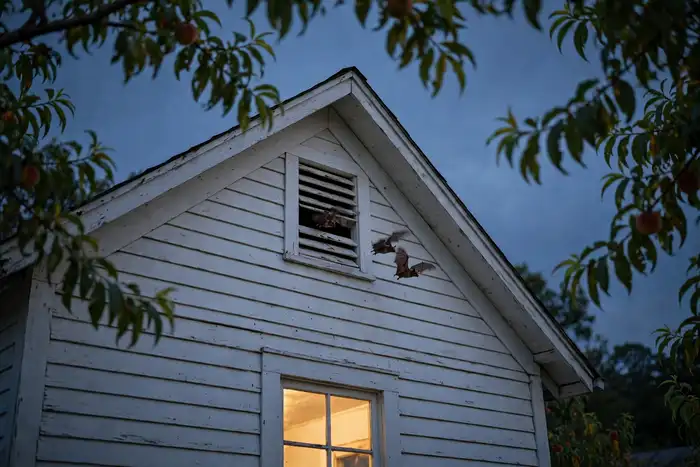
Tall Attic Voids in Older Fort Valley Houses Shelter Bat Colonies Unnoticed
Bats commute into Fort Valley over the orchards. Insects gather over peach rows, irrigation ponds and yard lights, and bats work that airspace from dusk, then fold back before dawn into the nearest tall, warm void. Older in-town houses provide exactly that, with steep roofs, uninsulated gable ends and attic spaces that stay quiet for years, especially in rentals or homes where nobody enters the attic between seasons. A colony can therefore build from a handful of animals at one louver to a established roost staining the siding below the vent before a homeowner connects the dusk activity to their own roof.
Guano is the evidence that settles it. Pellets that crumble to powder under a roost, dark staining at a gable joint, a musky odor in an upstairs closet on hot Peach County afternoons and soft chirping or scratching in a wall as bats shift at dusk all point to a roost rather than a passing animal. Do not sweep guano dry or climb in to investigate. Photograph staining from the ground, note which gable the bats exit at sunset and call us with that direction, because the exit joint determines where exclusion devices go and which other gaps must be sealed first.
Why Fort Valley State University Area Rentals Hide Bat Roosts Longer
Rental turnover hides bat problems better than almost any other housing pattern. Tenants rarely enter a low or tall attic, landlords may not inspect the void between occupancies and a colony odor gets blamed on a closed-up house. By the time a tenant reports bats in a bedroom or guano on a porch below a gable, the roost may have run several seasons and widened its staining and entry wear. We advise owners in Fort Valley to add a gable and attic hatch check to turnover work, looking for pellets on insulation just inside the hatch and staining at louver vents, and to call at the first sign rather than after a tenant encounter.
Finding Every Bat Gap Along a Fort Valley Roofline at Dusk
Bats need a gap barely wider than a thumb, so a daylight ladder check alone misses entries. We combine a daytime seal survey, covering ridge joints, fascia gaps, chimney shoulders, louver frames and addition seams, with a dusk watch when the property allows it, confirming which joints actually pour bats at sunset. Orchard-edge homes add one more source, since bats roosting in a barn or packing shed loft sometimes shift to the house void when the shed is cleaned or repaired. Tell us about recent outbuilding work when you call, as a displaced colony behaves differently from a long-established one.
Maternity Season Rules for Fort Valley Bat Exclusion, April Through July
Timing law shapes this job more than any other spoke. Georgia restricts bat exclusion from April 1 through July 31, the maternity season when females raise flightless pups in the roost. Excluding during that window would trap young inside to die in walls and attics. If you call during those months we will inspect, seal what can be sealed safely without trapping animals, protect living spaces if a bat has entered a room and schedule the full exclusion for when young are flying. That delay is not a sales tactic, it is the lawful and humane sequence, and we will put the planned dates in plain terms.
One-Way Exits and Full Sealing on Older Fort Valley Gables
Exclusion itself is unglamorous carpentry at height. Every secondary gap on the structure gets sealed with materials suited to the joint, while the confirmed active exits receive one-way devices that let bats leave at dusk to feed over the orchards and prevent re-entry on return. The devices stay in place through several nights of verified activity decline, then come down so the final gaps can be sealed. Houses with sheds or barns that also hold roosts need those structures assessed too, otherwise the colony relocates thirty yards and returns to the house the following season.
Guano Cleanup Under a Fort Valley Roost After Exclusion
Once the void is empty we turn to what accumulated under it. Guano depth under a long-used gable roost can be considerable, staining insulation and boarding and holding odor that drifts into upstairs rooms in summer heat. We remove concentrated deposits with protective equipment, treat the roost area and advise where insulation replacement is sensible. In outbuilding lofts we clear deposits away from stored equipment and produce areas. Disturbing dry guano without protection is the one step we ask homeowners and landlords never to attempt themselves.
A Bat Inside a Fort Valley Living Room or Bedroom Tonight
A single bat indoors is handled differently from a colony job. Close the room if you can, open an exterior window or door in that room, keep people and pets out and do not try to catch it with a towel. Note whether anyone slept in the room with the bat present and tell us when you call, since health guidance after a possible exposure matters more than the removal itself. Our crew will advise the next step for your situation and check for an attic roost above that room, because an indoor bat in an older Fort Valley home often signals a void colony overhead.
Common bat questions in Fort Valley
We see bats leaving our Fort Valley gable every evening. How many might be inside?+
Can bat exclusion in Fort Valley be done in June?+
Do bats also roost in our packing shed, not just the house?+
What does bat guano look like in a Fort Valley attic?+
Will bats leave our Fort Valley attic on their own in winter?+
Are bats protected in Georgia?+
Other Fort Valley problems that come with bats
Our wildlife crew handles these closely related problems — the ones that most often turn up with a bat issue.
Got more than bats in Fort Valley?
The same gable joints bats use are often gnawed wider by squirrels in winter. If your Fort Valley attic shows both guano and nut caches, review our squirrel page too, since sequencing squirrel sealing around a bat exclusion takes planning. See everything we handle locally on the Fort Valley wildlife removal hub, or jump to Georgia wildlife removal.
Want the background before you call? Read our statewide guide: Bats in your attic: Georgia law, maternity season and what exclusion costs.
Serving all of Peach County
Fort Valley is one part of Peach County. See wildlife removal in Peach County, GA for the county-wide picture — the animals we get called about most, and the other towns we cover.
One call to your Fort Valley bat crew
Bat work in Fort Valley is about timing and patience, letting the colony leave on its own wings through a controlled exit.
- Local to Peach County. Georgia DNR-compliant handling — call to ask about licensing and insurance.
- We seal the secondary gaps, fit one-way exits at the active joints and return to close those exits once the void is empty. Georgia restricts bat exclusion from April 1 through July 31 for maternity season, when flightless young are in the roost. We will confirm the local crew for your county before any work starts and schedule around that window honestly.
- Done right. Removal, exclusion and cleanup.