Armadillo Removal in Fort Valley, GA
An armadillo can prospect a Fort Valley lawn in a single night, because the sandy loam at the orchard edge offers almost no resistance to digging. The holes look minor at dawn and multiply fast if the animal settles into a burrow nearby.
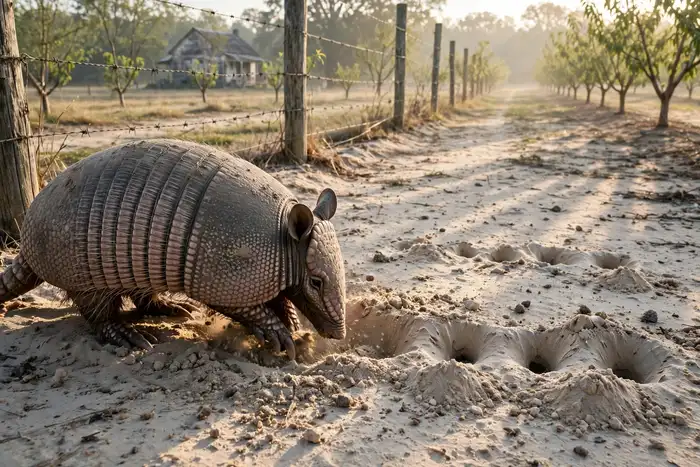
Orchard-Edge Lawns in Fort Valley Sandy Loam Get Probed Night After Night
Armadillos and Peach County soil are made for each other, unfortunately for lawns. The nine-banded armadillo digs by strength and smell, hunting grubs, earthworms and insects in the top few inches of ground, and sandy loam lets it open dozens of shallow probe holes across an orchard-edge yard in one feeding pass. Yards bordering peach ground get the heaviest pressure because the orchard floor itself is rich feeding habitat, and the irrigated lawn at its edge stays softer and more productive than dry field ground through summer. Homeowners wake to a lawn that looks tilled in patches, mulch scattered from beds under fruit trees and soil piled at a fresh burrow beneath a shed.
The burrow is the real problem behind the holes. By day an armadillo rests in a burrow dug under a shed, a porch, a woodpile or into a ditch bank, often with more than one entrance in soft ground. Removing lawn damage without finding that burrow leaves the resident in place to feed again the next night. When you call us about digging in Fort Valley, we will ask where holes concentrate, whether any hole has become a tunnel you could fit an arm into and whether the yard was recently watered or treated, since those details separate a passing feeder from a resident animal denning on the property.
Reading Armadillo Probe Holes Across a Fort Valley Lawn at Dawn
Armadillo feeding sign is distinctive once you have seen it fresh. Holes are small, conical and a few inches deep, scattered where the animal smelled grubs, with soil flicked to one side and occasional tracks or a tail drag in sandy patches. Damage concentrates along fence lines, under fruit trees where insects gather in fallen fruit, at the drip line of irrigated beds and in the soft strip where orchard ground meets mowed lawn. Skunks and raccoons also dig, but their sign is patchier sod tearing rather than this dense probing. A phone photo taken in morning light helps our crew confirm the species before a trap is ever set.
Burrows Under Fort Valley Sheds, Steps and Ditch Banks
Daytime shelter decides where trapping works. In Fort Valley we find armadillo burrows tucked under packing shed floors where sandy soil washes out, beneath front steps of older in-town homes, under low decks and into the banks of drainage ditches behind yards. A burrow entrance is wider than a feeding hole, often with a fan of excavated sand and a worn path from the yard. We check each outbuilding foundation and step base during the visit, because an animal denning under your own shed will ignore a trap set at the far fence while it feeds in a tight nightly loop around the house.
Trapping on Armadillo Travel Lines in Peach County Yards
Armadillos are not lured like raccoons, since they hunt live insects by smell and show little interest in bait. Successful trapping therefore depends on placement, setting traps on the worn paths between burrow and feeding ground and using guides or fencing wings to funnel a nearly blind animal into the set as it walks its route. Around orchard-edge homes those routes follow fence lines, shed walls and ditch edges, which makes placement precise once the burrow is known. We check sets frequently, adjust lines when feeding shifts after rain and remove the animal promptly once caught, explaining the route evidence as we go.
Why Watering and Rain Bring Armadillos Into Fort Valley Lawns
Moisture drives the calendar of damage. Irrigation and rain bring earthworms and grubs toward the surface and soften sandy soil further, so a Fort Valley lawn can be untouched for a dry week and heavily probed the night after a storm or a deep watering. Orchard irrigation schedules matter too, since a yard beside a watered block gets spillover moisture and insect activity. We do not ask you to stop watering a lawn in a Georgia summer, but timing, drainage fixes for persistently soggy corners and grub awareness all feature in the prevention talk after trapping, because the wettest corner of your yard will always be prospected first.
Filling Burrows and Protecting Foundations After an Armadillo Is Gone
An open burrow under a shed or slab is shelter advertising itself to the next animal, and in sandy ground it also channels water against footings. Once the resident is removed and we are satisfied no other animal is using the tunnel, burrows should be filled and packed, washouts at foundation edges corrected and any void under a slab assessed before it grows. Other wildlife, from rodents to snakes, readily inherits an abandoned armadillo burrow, so prompt closure is part of the removal job here rather than yard cosmetics left for later.
Young Armadillos Following Their Mother Across Fort Valley Yards in Summer
Summer calls often involve more than the single animal a homeowner spotted. A mother armadillo in Peach County commonly travels with identical young that fan out across an orchard-edge lawn to feed, so holes appear in several clusters at once and a trap that catches one juvenile does not end the damage. We ask whether sightings showed a single animal or a group, and we size sets and check frequency for a family when the sign supports it. Young animals also shelter in shallower burrows under steps and shed edges, so the burrow search widens in summer to cover the smaller entrances a homeowner might dismiss as rodent holes at first glance.
Common armadillo questions in Fort Valley
How can one armadillo dig up so much of our Fort Valley yard in a night?+
We filled the burrow under our shed and the digging came back. Why?+
Do armadillos carry disease we should worry about in Peach County?+
Will treating our Fort Valley lawn for grubs stop armadillo digging?+
An armadillo is out in our Fort Valley yard during the day. Is that normal?+
Can armadillos damage anything besides the lawn?+
Other Fort Valley problems that come with armadillos
Our wildlife crew handles these closely related problems — the ones that most often turn up with a armadillo issue.
Got more than armadillos in Fort Valley?
Armadillo burrows under Fort Valley outbuildings get reused by other animals once the armadillo moves on, and their digging often exposes the same foundation gaps rodents use. Our rodent page covers sealing those openings after burrow work is finished. See everything we handle locally on the Fort Valley wildlife removal hub, or jump to Georgia wildlife removal.
Want the background before you call? Read our statewide guide: Armadillos tearing up your Georgia lawn.
Serving all of Peach County
Fort Valley is one part of Peach County. See wildlife removal in Peach County, GA for the county-wide picture — the animals we get called about most, and the other towns we cover.
One call to your Fort Valley armadillo crew
Armadillo control here is route work, finding the burrow, setting on the travel line and closing the shelter the animal uses by day.
- Local to Peach County. Georgia DNR-compliant handling — call to ask about licensing and insurance.
- We locate the active burrow, trap on the paths the animal walks nightly and fill or block burrow shelter once it is clear. Because sandy ground reopens easily, we also advise on the lawn and drainage habits that make your yard less rewarding. We will confirm the local crew for your county before any work starts.
- Done right. Removal, exclusion and cleanup.