Squirrel Removal in Vero Beach, FL
Galloping overhead before breakfast, nuts rolling in the eaves, insulation turning up in the soffit vents. Vero Beach squirrels do not knock — tell us when the noise happens and we will match it to the animal.
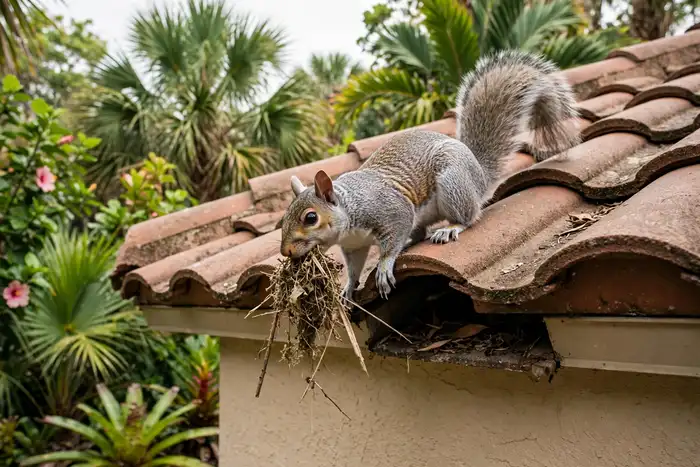
Squirrels in your Vero Beach home
The squirrel of Vero Beach is the eastern gray squirrel, and the city's live oaks are its infrastructure. In the older mainland streets and across the island, crowns planted generations ago now meet over the roads, so a squirrel can travel a whole block, choose among a dozen roofs, and drop onto yours from a limb you would swear was too far away. In the warm months it is raising young in a leaf nest. In the cooler months — and after every storm that strips the hammocks — a dry attic lined with insulation starts to look like the better nursery.
Two relatives deserve a sentence each and no more. The fox squirrel, a protected species of special concern in Florida, is not an animal we handle — if the large, slow squirrel on your fence is one, we will say so and leave it be. Flying squirrels appear here only as an occasional nocturnal attic note, and most after-dark scratching in Vero Beach turns out to be rats, which is one reason identification comes before exclusion on every call.
Daylight noise, and what the hour tells us
Gray squirrels keep commuter hours: out at first light, a noisy return toward dusk, and long midday rearrangements of nesting material that sound, through a ceiling, like a small renovation. Noise in short dawn bursts with gnawing at one eave corner is the classic Vero Beach pattern. Sustained activity in the middle of the night points elsewhere — most often to the roof rats this city has in abundance — and the distinction decides everything about traps, doors and sealing, so we ask about timing before we promise a method.
Wood soffits: the door Vero Beach built by accident
Newer construction wraps its eaves in vinyl or aluminium. Many of Vero Beach's older mainland homes, and not a few island cottages, still carry painted wood soffits — and wood in lagoon humidity softens, paint peels at the joints, and a squirrel's teeth finish the opening in an afternoon. Roof returns where a lower porch roof meets the wall are the second favourite. Our rebuild replaces the worked section, backs the venting with metal screening the next squirrel cannot chew, and then walks the whole eave line, because a squirrel excluded from one soft corner will test every other corner the same evening.
Storm season moves squirrels indoors
Leaf nests in oaks do not survive serious wind, and hurricane season regularly strips the canopy over whole Vero Beach streets at once. The weeks after a storm bring a wave of calls that is not coincidence: displaced squirrels, some with young, prospecting every roof on the street for a dry cavity. Pre-season soffit work in spring is the quiet answer to that wave. Post-storm, the answer is a careful check for young before any door is fitted, since a storm-displaced family is exactly the one most likely to have a nest already established inside.
What an attic litter does while you wait
A squirrel attic is not a static problem. Nesting material is dragged across insulation, compressing it; stored boxes are shredded for lining; and the gnawing that maintains a squirrel's teeth lands on whatever is nearest — trim, duct jacketing, and, the serious entry on the list, electrical cable. Breeding here runs in two broad waves, late winter and summer, so a 'noise we will deal with next season' decision usually spans at least one litter raised directly over the bedrooms.
Exclusion fitted to a climbing animal
The squirrel leaves under its own power through a one-way door mounted at the entry it actually uses — located by droppings, gnaw marks and the dusk watch, not by guesswork. Secondary gaps are sealed in the same visit in galvanised material. We return, confirm the attic is silent and the door untried from outside, then remove the device and close the final opening. Because a gray squirrel excluded from a sealed house simply rejoins the oak canopy, the method satisfies Florida's strict rules on releasing animals without a stressful capture in the process.
Common squirrel questions in Vero Beach
Why my roof, when the oaks are full of squirrels?+
Can I just patch the hole on a Saturday morning?+
Do squirrels here carry anything I should worry about?+
Will trimming the oak over the house end it?+
What does the inspection cost for a squirrel call?+
Other Vero Beach problems that come with squirrels
Our wildlife crew handles these closely related problems — the ones that most often turn up with a squirrel issue.
Got more than squirrels in Vero Beach?
Squirrels are rarely the only thing using an attic or yard in Vero Beach. See everything we handle locally on the Vero Beach wildlife removal hub, or jump to Florida wildlife removal.
Serving all of Indian River County
Vero Beach is one part of Indian River County. See wildlife removal in Indian River County, FL for the county-wide picture — the animals we get called about most, and the other towns we cover.
One call to your Vero Beach squirrel crew
The longer squirrels stay in the attic, the more they chew and the bigger the cleanup. Call us and tell us about the job — we will confirm the local crew for your county before any work starts.
- Local to Indian River County. FWC-compliant handling — call to ask about licensing and insurance.
- Humane exclusion. One-way doors and steel sealing, not poison.
- Done right. Removal, exclusion and cleanup.