Raccoon Removal in Vero Beach, FL
Heavy, deliberate movement overhead at night, a torn vent, a chattering you can hear through the ceiling. A raccoon has chosen your house as a den — call before a spring litter makes the job a family negotiation.
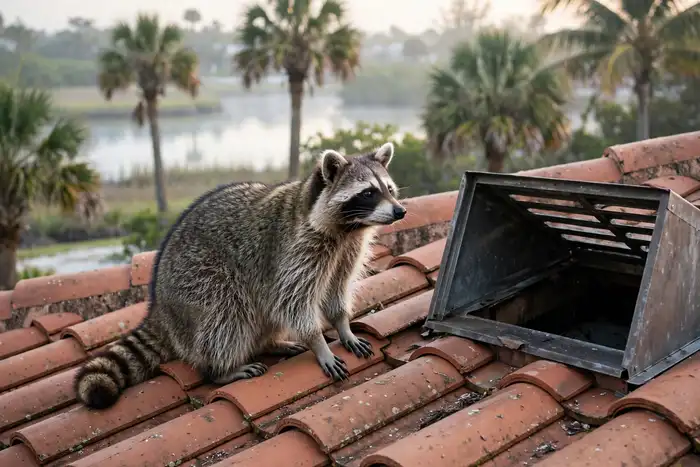
Raccoons in your Vero Beach home
Vero Beach raccoons live well. The lagoon gives them crabs, oysters and fish along the mangrove roots; the mainland gives them unsecured carts, fallen citrus and pet food on lanais; and the housing gives them what the shoreline cannot — a dry, elevated den. On the island that usually means an estate chimney or a tile-roof attic in Riomar and the older beachside streets. On the mainland it means the soffit corner of a ranch in Vero Beach South, opened patiently over several nights until it fits a very determined animal.
Strength is the fact every raccoon plan has to respect. A raccoon peels back thin aluminium, unscrews what fingers can grip, and remembers a successful entry for years. Removal that ends with the same materials it defeated is not removal. Our jobs here end with the family out, the latrine cleaned, and the opening rebuilt so the next raccoon that tests it — and one will — finds the negotiation over before it starts.
Reading raccoon sign around a lagoon house
The evidence is rarely subtle once you know it: five-toed, hand-like tracks in the damp sand beside a seawall path or in attic dust, a vent bent outward rather than in, shingles or tiles shifted at one roof edge, and droppings gathered in a single attic corner used as a latrine. Night noise is paced, not frantic — walking, pausing, the drag of something being rearranged. If the animal is commuting from the mangroves, expect mud on the entry and a route that starts at the water side of the lot.
Chimneys on the island, soffits on the mainland
Beachside chimneys serving fireplaces used a handful of nights a year are classic Vero Beach dens: rough interior walls a raccoon climbs like a hollow tree, a smoke shelf that makes a nursery platform, and no cap on top. Mainland calls run more to soffits and roof returns on one-storey homes, where a low eave overhangs landscaping the animal can climb. Each gets its own hardware — a properly fitted cap for a verified-empty flue, steel-backed rebuilding for a torn soffit — and neither is fitted until we know exactly who is inside.
Spring means kits, and kits set the sequence
From late winter into early summer, assume a denning female has young that cannot climb, walk out or regulate their own temperature. The sequence protects them and the house at once: find the litter, arrange the mother's exit so the family is reunited outside, and close the structure only when the den is confirmed empty. A mother separated from kits will attack a repair at its weakest seam to get back in, and she usually picks a worse place than the original entry. Working with her movements, not against them, is the faster job.
The latrine, the insulation and honest cleanup
A raccoon attic organises itself around one latrine corner, and that corner is a genuine cleanup: droppings can carry parasites whose eggs persist in material, so contaminated insulation comes out and the surface beneath is treated. We show you the extent before recommending scope — many Vero Beach dens lose a few batts around one corner, while a season-old den over a bedroom can need broader work. What we will not do is sell a whole-attic restoration for a two-week tenancy, or wave off a latrine that needs proper handling.
What Florida law allows us to do with the animal
Callers often ask us to take a raccoon to a preserve across the county line. Florida does not work that way: a native animal is released on site or, off site, only within the same county onto forty or more contiguous acres with the release landowner's written permission, with release or humane euthanasia inside twenty-four hours. Exclusion fits inside those rules comfortably — the raccoon leaves the building on its own feet, the entry is sealed, and a healthy animal resumes its lagoon route without a relocation that would likely fail it anyway.
Common raccoon questions in Vero Beach
A raccoon is on my Vero Beach roof every night. Is it living there?+
Why did it pick my chimney over the trees?+
Is it safe to be in the house while a raccoon is in the attic?+
How long does a raccoon job take?+
What stops the next raccoon after this one?+
Do you charge for looking at a raccoon problem?+
Other Vero Beach problems that come with raccoons
Our wildlife crew handles these closely related problems — the ones that most often turn up with a raccoon issue.
Got more than raccoons in Vero Beach?
Raccoons are rarely the only thing using an attic or yard in Vero Beach. See everything we handle locally on the Vero Beach wildlife removal hub, or jump to Florida wildlife removal.
Serving all of Indian River County
Vero Beach is one part of Indian River County. See wildlife removal in Indian River County, FL for the county-wide picture — the animals we get called about most, and the other towns we cover.
One call to your Vero Beach raccoon crew
The longer raccoons stay in the attic, the more they chew and the bigger the cleanup. Call us and tell us about the job — we will confirm the local crew for your county before any work starts.
- Local to Indian River County. FWC-compliant handling — call to ask about licensing and insurance.
- Humane exclusion. One-way doors and steel sealing, not poison.
- Done right. Removal, exclusion and cleanup.