Dead Animal Removal in Vero Beach, FL
You opened the front door after months away — or after one hot week at home — and the house told you something died inside it. In this climate the message only gets louder. Call and describe where the smell reads strongest.
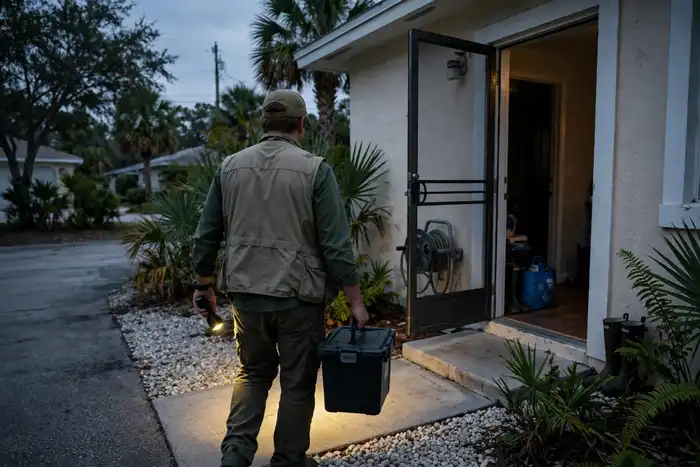
Dead Animals in your Vero Beach home
Vero Beach writes this call in two scripts. The first belongs to the seasonal home: a house closed in May, a raccoon or opossum or a family of rats dead somewhere in its voids by August, and owners who meet the whole story at once when they open the door in October. The second is the year-round version — an animal that fell into a wall from the attic, died in a crawlspace, or expired in a chimney of a house with people living in it, announced room by room as the heat works. Florida's heat and humidity compress the timeline for both: decomposition that takes weeks in a northern winter takes days here, and the odor follows the same schedule.
The skill in this service is location. Homeowners can smell that something died; finding a carcass inside a sealed wall, a tile-roof void or a crawlspace run — without opening the house at random — is an exercise in reading odor the way you would read a tide chart: where it concentrates, where the air moves it, which room reads strongest at which hour, and how the framing and ductwork connect them. We map first, open minimally, remove the source, sanitise what it touched, and close the entry that made the whole episode possible.
The returning-owner case, step by step
A seasonal house is searched differently from an occupied one, because the animal had months and the whole structure. Rats that entered through a dried drain trap or a soffit gap, a raccoon that denned and died, an opossum under the floor — any void is possible, and the summer's air-conditioning being off means odor has soaked rather than ventilated. We work the house room by room on arrival, grade the reading, and use the attic and crawlspace access before any wall is opened. Owners returning to this are often braced for a renovation; most cases resolve as a located removal, a sanitising, and a sealing list that also serves as the pre-departure checklist for next spring.
Wall falls and attic deaths in occupied homes
The classic occupied-home case is the fall: a squirrel or rat travelling a wall void slips, cannot climb the smooth interior, and dies at the base of a wall — often beside a warm pipe run that broadcasts the result through the house. Attic deaths read differently, strongest at the ceiling of one room and worse in the afternoon heat. Each pattern points at a different void and a different access: from the attic above, from a small, precisely placed opening at the mapped base of a wall, or through an existing cleanout. Minimal opening is a discipline, not a slogan — a cut made from evidence is inches wide, a cut made from guessing wanders.
Chimneys, pool cages and the unusual addresses
Island chimneys collect their own cases — a young raccoon or a bird that entered an uncapped flue and could not climb out, discovered whenever the fireplace is first considered in the cool months. Pool cages produce another: an animal dead in the cage's roof channel or in the soffit behind it, technically outside the house and functionally inside its air. Crawlspaces under older mainland homes hold the winter cases, opossums especially, unnoticed until warmth carries the news upward through the floor. The search method does not change with the address; only the access does.
Sanitising: what treated actually means
Removing the carcass removes the source, but fluids migrate into insulation, timber and the dust layer of a void, and untreated material keeps producing a fainter version of the same smell for weeks — the reason 'we got it out' sometimes fails to satisfy a household. We take out contaminated material that is reachable, treat the surfaces of the void with sanitising agents suited to it, and ventilate. Where insulation has absorbed contamination beyond a small area, we will tell you plainly how much should come out and why, and show you the photographs to go with the recommendation.
The entry is always the second half of the job
Every dead-animal call in this county began as a live-animal choice: this soffit, this vent, this flue was a door, and an animal used it for shelter and died behind it. Leaving that door as found schedules the sequel — the voids of a Vero Beach house are known to its wildlife, and a route that worked once is tried again by the next tenant. So the service closes with the entry found and sealed, and the rest of the roofline checked for the same weakness. Retrieval without sealing is half a service, priced as a whole one by too many operators; insist on both halves.
Common dead animal questions in Vero Beach
How long would the smell last if we simply waited it out?+
We just returned and the whole house smells. Where do you even start?+
Will you need to cut into a wall?+
Is there a health concern while the animal is in the wall?+
How do we stop this happening while the house is empty next summer?+
Other Vero Beach problems that come with dead animals
Our wildlife crew handles these closely related problems — the ones that most often turn up with a dead animal issue.
Got more than dead animals in Vero Beach?
Dead Animals are rarely the only thing using an attic or yard in Vero Beach. See everything we handle locally on the Vero Beach wildlife removal hub, or jump to Florida wildlife removal.
Serving all of Indian River County
Vero Beach is one part of Indian River County. See wildlife removal in Indian River County, FL for the county-wide picture — the animals we get called about most, and the other towns we cover.
One call to your Vero Beach dead animal crew
The longer dead animals stay in the attic, the more they chew and the bigger the cleanup. Call us and tell us about the job — we will confirm the local crew for your county before any work starts.
- Local to Indian River County. FWC-compliant handling — call to ask about licensing and insurance.
- Humane exclusion. One-way doors and steel sealing, not poison.
- Done right. Removal, exclusion and cleanup.