Bat Removal in Vero Beach, FL
Droppings beneath a ridge line, a faint musk at the gable, small shapes peeling off the roof at dusk toward the lagoon. If bats have taken the tiles, the calendar — not the ladder — decides the next step. Talk it through with us.
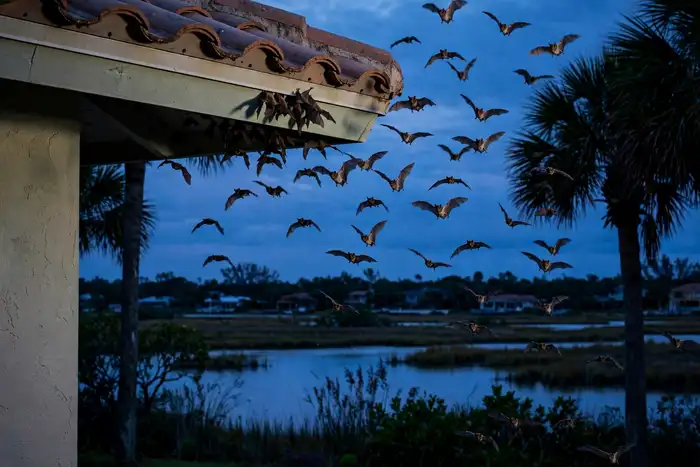
Bats in your Vero Beach home
The bats of Vero Beach are not cave bats and they are not the northern house bat many seasonal residents know. The two species under local roofs are the Brazilian free-tailed bat, a fast, high flyer that roosts in colonies, and the smaller evening bat, which works the lagoon edges at dusk. Both have adopted the island's barrel-tile roofs as a substitute cliff face: the curved tiles hold a cool, dark channel beneath them, safe from owls and weather, with the lagoon's insect life a short flight away.
Florida law shapes everything about this service. Bat exclusion is permitted only from August 15 to April 15. The closed months are maternity season, roughly mid-April to mid-August, when colonies raise young that cannot fly — and during those months, no exclusion device is fitted, whatever a caller offers to pay. Bats are never harmed or killed in our work. What a summer call gets instead is a proper inspection, a species and entry survey, and a booked date in the legal window, which in Vero Beach comes with a complication this page addresses directly.
The summer problem: maternity season meets hurricane season
The August 15 opening of the exclusion window lands in the middle of hurricane season, and a colony that spent the summer raising pups under island tiles may be sheltering behind storm-shaken rooflines by the time work can legally start. Our answer is sequencing. A call in June or July gets the dusk watch, the entry map and the sealing plan completed early, with any gap that can be closed without trapping bats closed then. The one-way devices go on at the first legal, workable stretch after August 15, and the colony leaves on its own wings before the worst of the storm months.
Under the tiles: where Vero Beach bats actually roost
On a tile roof the colony is rarely in the attic proper. Bats slip under a lifted ridge cap or a shifted tile at the eave and roost in the channels between tile and underlayment, which is why homeowners hear almost nothing and find the evidence outside — droppings streaked below one roof edge, staining at a single gable joint. Flat and shingle roofs on the mainland present the more familiar picture: a gap at the fascia, a louvre vent with a torn screen. Either way, a dusk watch settles which of a dozen candidate openings the colony actually uses, and guessing wrong wastes the whole window.
Exclusion is the whole method, explained plainly
A one-way device is a simple piece of engineering fitted over the active exit: bats push out through it at dusk to feed over the lagoon and cannot find their way back in at dawn. Over several nights the roost empties. Meanwhile every other gap on the structure — and on a tile roof there are many — is sealed, so the colony cannot simply move six feet along the ridge. Once exit counts confirm an empty roost, the device comes off and its opening is sealed to the same standard. The bats relocate to the bat houses, hollow trees and bridges of the lagoon shore, still eating insects by the thousand.
A single bat indoors is a different call
One bat circling a bedroom is usually a youngster or a storm-blown individual that entered through an open door or an unscreened vent, not evidence of a colony. Do not handle it and do not try to catch it in a towel. Confine it to one room with the door closed, keep people and pets out, and call us — and if anyone slept in that room or bare skin may have touched the animal, also speak to a doctor or the county health department about rabies exposure, because bat contact deserves that caution every time.
Guano under a long-used roost
Colonies that have used a roof void for years leave droppings that stain, smell in the heat, and should not be breathed as dry dust during cleanup. We remove accessible accumulation carefully, with protection, and treat the surfaces involved. Under-tile roosts are often kinder than attic colonies — most of the material falls outside the living envelope — but a mainland attic roost over a bedroom is cleaned as thoroughly as the structure allows, and we will show you photographs of what we found before recommending the scope.
Before the window: the March to May roofline check
The best bat work in Vero Beach starts before there are bats to move. A pre-season inspection in spring finds the lifted tiles, perished vent screens and open fascia joints while the roof can still be sealed ahead of maternity season — sealing an unoccupied roof in April is straightforward, while the same gaps in June become a waiting game. Island associations scheduling roof work in spring should treat the bat check as part of the same visit, not an afterthought discovered by the roofers.
Common bat questions in Vero Beach
It is July and bats are under my tiles. Why can nothing be done now?+
Are the bats under barrel tiles damaging the roof?+
How can you tell free-tailed bats from evening bats?+
Will the colony just move to my neighbour’s roof?+
What if a storm hits between inspection and exclusion?+
Other Vero Beach problems that come with bats
Our wildlife crew handles these closely related problems — the ones that most often turn up with a bat issue.
Got more than bats in Vero Beach?
Bats are rarely the only thing using an attic or yard in Vero Beach. See everything we handle locally on the Vero Beach wildlife removal hub, or jump to Florida wildlife removal.
Serving all of Indian River County
Vero Beach is one part of Indian River County. See wildlife removal in Indian River County, FL for the county-wide picture — the animals we get called about most, and the other towns we cover.
One call to your Vero Beach bat crew
The longer bats stay in the attic, the more they chew and the bigger the cleanup. Call us and tell us about the job — we will confirm the local crew for your county before any work starts.
- Local to Indian River County. FWC-compliant handling — call to ask about licensing and insurance.
- Humane exclusion. One-way doors and steel sealing, not poison.
- Done right. Removal, exclusion and cleanup.