Snake Removal in Vero Beach, FL
It is coiled by the canal bank, under the lanai chair, or stretched along the pool-cage door — and you do not know what it is. Do not get closer to find out. Describe it from where you stand, or send a photo taken from a safe distance.
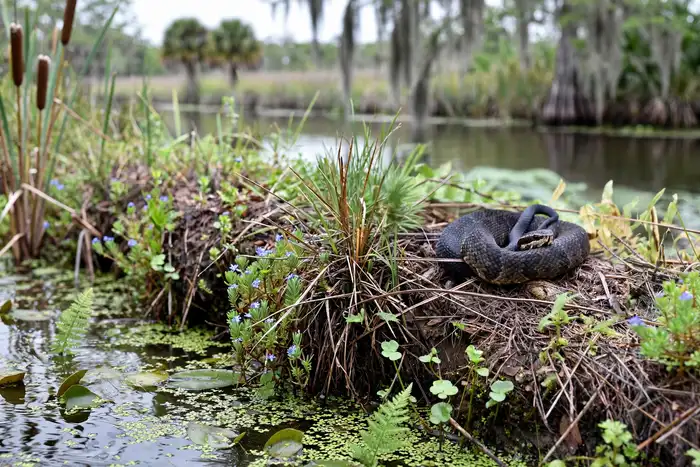
Snakes in your Vero Beach home
Every snake call in Vero Beach begins with the same step, and it is not a trap or a hook — it is a name. This county holds harmless snakes that eat the rats homeowners pay to remove, water snakes that are mistaken for a venomous species weekly, and a genuine venomous list that deserves respect: the cottonmouth, the eastern diamondback rattlesnake, the dusky pygmy rattlesnake and the eastern coral snake. Telling those two groups apart, from a description or a photograph, is most of what this service is, and callers are never charged in worry for a snake that turns out to be a harmless neighbour doing useful work.
The look-alike problem here has a star: the Florida banded water snake, a heavy-bodied, banded, entirely nonvenomous fish-eater of the canals and lagoon edges, is constantly reported as a cottonmouth — same habitat, similar build, an Oscar-worthy defensive display when cornered. The true cottonmouth is here too, in the same water. That overlap is exactly why 'it looked thick and angry' is not an identification, and why our first job on any water-side call is to settle the species before anyone discusses removal.
Cottonmouth or banded water snake: the Vero Beach question
Both snakes work the canal banks, retention ponds and mangrove edges of this city, and both flatten their heads when threatened, which ruins the popular triangle test. The reliable marks are finer: the cottonmouth carries a dark band through the eye, a visibly pitted face and a habit of holding its ground with its mouth open showing the pale interior that names it; the banded water snake has round pupils visible at a safe zoom, vertical bars on its lower jaw, and usually flees to the water given any chance. Photograph from distance, zoom rather than approach, and let the identification be made on evidence — guessing wrong in either direction helps nobody.
The dry-country snakes: diamondback and pygmy
Move away from the water — into the scrubby, sandy lots west of town, the grove windbreaks and the undeveloped parcels off the West Vero Corridor — and the rattlesnakes take over the file. The eastern diamondback is large, heavy and unmistakable once seen, a snake of dry ground that would rather be left alone and announces itself honestly when pressed. The dusky pygmy rattlesnake is its opposite in scale: barely a foot or two long, grey with dark blotches and a rusty stripe down the back, common in garden beds near water, and the venomous snake Vero Beach homeowners actually step near most often, precisely because it is small and still.
Coral snakes and the quiet leaf-litter call
The eastern coral snake is shy, fossorial and almost never seen in the open — it surfaces in mulch, leaf litter and garden beds, red bands touching yellow, venomous and retiring in equal measure. Most coral snake calls resolve as the harmless scarlet snake or a scarlet kingsnake, whose band order differs, which is another identification best made from a photograph rather than a rhyme recited under pressure. A genuine coral snake in a worked garden bed is removed carefully; one in wild ground at the lot's edge is usually best served by being left to its hidden life, with the household informed.
The harmless workforce: racers and rat snakes
The snake draped in your hibiscus at noon is probably a southern black racer — thin, fast, black, and hunting by sight in daylight. The snake in the pool cage or the garage rafters is likely a corn snake, the red rat snake, or its close relative the eastern rat snake, both climbing constrictors that specialise in the roof rats and birds around Vero Beach houses. Our counsel for these species is usually to keep them: a resident rat snake is rodent control that works every night and asks for nothing. When one has come indoors or taken up the pool cage, we remove it from the structure and address the entry and the prey that drew it.
The indigo exception, and what we will not touch
The eastern indigo snake — large, glossy blue-black, docile and fully protected — is not a removal job under any circumstances. If the big, calm black snake on your property is an indigo rather than a racer, we do not handle it; we will help you confirm the identification and point you to FWC, and the correct outcome is that the snake is left entirely alone. The same referral logic is the whole service for an alligator in a pond — that is an FWC matter through its nuisance alligator programme, never a service of ours and never a reason to approach the animal.
Making the yard less inviting, species by species
Snake prevention in Vero Beach is habitat editing. Rodent control removes the rat snakes' reason and the pygmies' prey base alike. Debris piles, stored lumber and dense groundcover against the house give coral snakes and pygmies their daytime cover, so moving harbourage away from doors and play areas changes the odds materially. Canal-bank properties cannot fence the water out of the wildlife's life, but keeping banks mowed, pool-cage doors screened at the base and woodpiles elevated removes the ambush cover that brings water snakes and cottonmouths close to the house.
Common snake questions in Vero Beach
The snake by my canal is thick and banded. Should I assume cottonmouth?+
A black snake is in my pool cage. What is it, most likely?+
Do you remove harmless snakes, or only venomous ones?+
My dog found a small grey snake in the garden bed. What now?+
Will sealing the house keep snakes out?+
Other Vero Beach problems that come with snakes
Our wildlife crew handles these closely related problems — the ones that most often turn up with a snake issue.
Got more than snakes in Vero Beach?
Snakes are rarely the only thing using an attic or yard in Vero Beach. See everything we handle locally on the Vero Beach wildlife removal hub, or jump to Florida wildlife removal.
Serving all of Indian River County
Vero Beach is one part of Indian River County. See wildlife removal in Indian River County, FL for the county-wide picture — the animals we get called about most, and the other towns we cover.
One call to your Vero Beach snake crew
The longer snakes stay in the attic, the more they chew and the bigger the cleanup. Call us and tell us about the job — we will confirm the local crew for your county before any work starts.
- Local to Indian River County. FWC-compliant handling — call to ask about licensing and insurance.
- Humane exclusion. One-way doors and steel sealing, not poison.
- Done right. Removal, exclusion and cleanup.