Armadillo Removal in Vero Beach, FL
The lawn was fine at dinner and looks ploughed by breakfast, with a burrow appearing beside the air-conditioning pad. That is an armadillo on night shift in sandy soil — tell us how much ground it is covering.
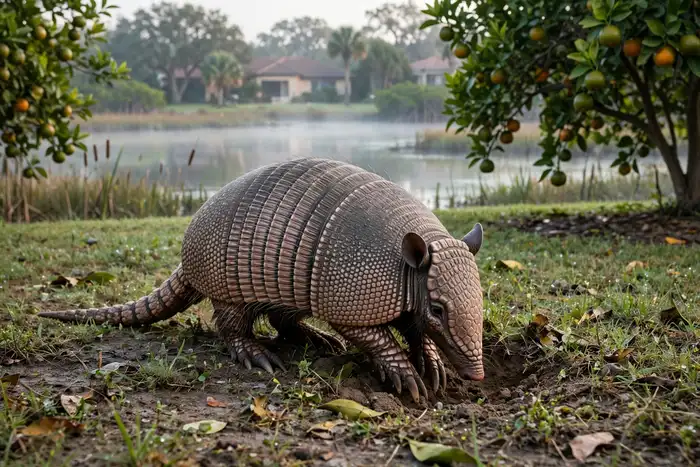
Armadillos in your Vero Beach home
Vero Beach soil — sand over shell, drained and easy digging — is armadillo country, and the nine-banded armadillo works it nightly from the grove-edge streets of the West Vero Corridor to the garden beds of the island. It is looking for grubs, worms and insects a few inches down, and it finds them with a sense of smell that makes eyesight almost irrelevant. The homeowner's evidence arrives at sunrise: turf rooted up in patches, mulch scattered from the beds, and, on the properties it has adopted, a burrow mouth under the edge of a slab, a deck or the pad beneath the outside unit.
One fact has to be stated plainly at the start, because callers ask for the opposite every week: the armadillo is a nonnative species in Florida, and it is never relocated or released. There is no humane drop-off at a preserve and no farm outside town waiting for it. Removal here means professional trapping under Florida's rules for nonnative wildlife, handled by a crew that will be honest about that rather than promise a relocation it cannot legally or truthfully deliver.
Reading a night’s work at sunrise
Armadillo digging has a signature: shallow, neat conical holes across the turf where individual grubs were excavated, broader rooted patches where the soil was rich, and pushed-up mulch along bed edges. It is tidier than hog damage and far more localised than drought or disease, the two explanations gardeners try first. Fresh work is damp and dark in the morning. A burrow, when one exists, is a round mouth roughly the width of a dinner plate at the base of a structure, with excavated sand fanned below it — and that mouth, not the lawn holes, is where trapping strategy begins.
Where Vero Beach armadillos burrow
The lawn feeding is a nuisance; the burrow is the liability. Armadillos here tuck burrows under concrete that shades and stabilises the sand — driveway edges, lanai slabs, the pads under pool equipment and air-conditioning units, and the low decks of island homes. A burrow under a slab edge removes the support the concrete was poured on, and sandy soil shows the settling sooner than clay would. Grove-edge properties add a second pattern: burrows in the windbreak lines and ditch banks, with the animal commuting in to feed on the lawn like a neighbour with a key.
Trapping an animal that navigates by smell
Armadillos are not baited the way raccoons are — a nearly blind, smell-led animal walking a habitual route is caught by placement and guidance, not menu. Traps are set on the runs between burrow and feeding ground, with low guide fencing that funnels a nose-down animal into the opening without it registering an obstacle. That is why the inspection walks the whole property first, mapping burrow, runs and fresh feeding sign: a trap placed where the homeowner wishes the armadillo walked catches nothing but weather.
After removal: the burrow and the next prospector
An emptied burrow under a Vero Beach slab does not stay a secret. Opossums inspect vacant burrows, and another armadillo working the street will find the ready-made den within weeks. Once the animal is confirmed out and removed, the burrow is collapsed and filled properly and vulnerable slab edges can be screened below grade. The lawn itself usually recovers from feeding damage in a growing season once the digging stops — rooted turf pressed back and watered settles surprisingly well in this soil, which is one reason we counsel repair before resodding.
Grubs, lawns and what does not work
The honest version: treating a lawn for grubs can reduce one food source, and on some properties it noticeably thins armadillo visits. It does not empty the burrow under the pad, it does nothing for the worms and insects that make up the rest of the diet, and it is not a removal method. Repellent granules and vibrating stakes have a similar record here — a smell-led animal with a den under your slab tolerates a great deal of discouragement. Trapping the resident, then closing the burrow, remains the sequence that ends the sunrise surprises.
Common armadillo questions in Vero Beach
Why can’t the armadillo be taken to the country and let go?+
How many armadillos are doing this to my yard?+
Is armadillo damage worse in some months?+
Should I fill the burrow under my slab myself?+
Do armadillos carry disease I should be concerned about?+
Other Vero Beach problems that come with armadillos
Our wildlife crew handles these closely related problems — the ones that most often turn up with a armadillo issue.
Got more than armadillos in Vero Beach?
Armadillos are rarely the only thing using an attic or yard in Vero Beach. See everything we handle locally on the Vero Beach wildlife removal hub, or jump to Florida wildlife removal.
Serving all of Indian River County
Vero Beach is one part of Indian River County. See wildlife removal in Indian River County, FL for the county-wide picture — the animals we get called about most, and the other towns we cover.
One call to your Vero Beach armadillo crew
The longer armadillos stay in the attic, the more they chew and the bigger the cleanup. Call us and tell us about the job — we will confirm the local crew for your county before any work starts.
- Local to Indian River County. FWC-compliant handling — call to ask about licensing and insurance.
- Humane exclusion. One-way doors and steel sealing, not poison.
- Done right. Removal, exclusion and cleanup.