Squirrel Removal in Fort Pierce, FL
Footsteps overhead before breakfast, a soffit corner going ragged, acorns rolling in the attic of a house that predates the interstate. The live oaks feed them and the old eaves admit them. Note when the noise runs — with squirrels, the schedule is the signature.
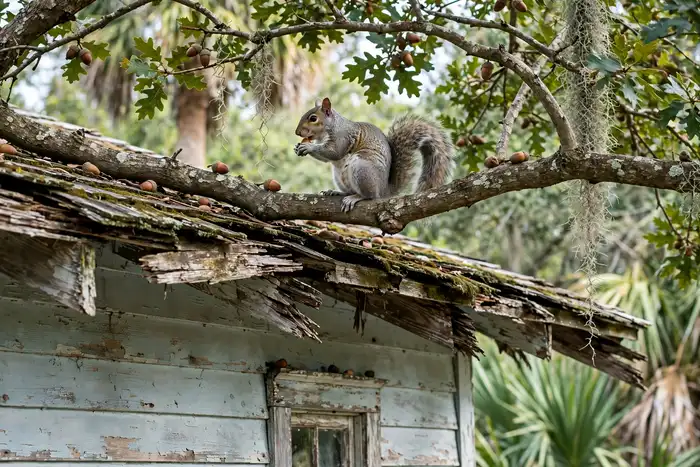
Squirrels in your Fort Pierce home
Downtown Fort Pierce and its older neighborhoods stand under a canopy of live oaks planted with the streets, and the gray squirrel population that canopy supports is dense, bold and thoroughly house-trained. A gray squirrel's day is a circuit — oak, fence, roof, oak — and any house on the circuit with a soft eave or an open gable becomes the circuit's warm, dry station. In the bungalow blocks, the same three or four entry details account for most attic nests, house after house.
Two relatives keep the identification honest. The fox squirrel of the pine flatwoods and grove edges is a protected species of special concern here; it stays outdoors, and it is not a removal animal under any circumstances. And some of the soft night scratching blamed on squirrels near wooded lots belongs to flying squirrels — nocturnal, communal and a different job entirely. Sorting out which tenant you actually have is the first ten minutes of a Fort Pierce squirrel call.
Daylight hours: reading the schedule
Grays are diurnal tenants with commuter discipline — a scramble out at first light, a return before dusk, and midday noise when the nest is being rearranged or the young are old enough to wrestle. Sound at 2 a.m. argues against grays: roof rats gnaw then, and flying squirrels glide and chatter then. Homeowners who can tell us 'it starts at 6:40 every morning' have done half the identification work before we park the truck.
Where old eaves let them in
Bungalow construction offers a menu: the open tail ends of rafters on exposed-eave houses, soffit corners gone soft behind full gutters, gable vents screened in mesh that rusted out years ago, and the junction where a later addition's roof dies into the original wall. Squirrels chew with intent — a gray can worry a thumbnail gap into an entrance in days — so the inspection distinguishes the active door from old damage, then checks the whole menu rather than the one item with droppings beneath it.
Two litters a year, timed to the oaks
Gray squirrels here raise a late-winter litter and a summer litter, roughly tracking acorn and food abundance, so an attic nest holds dependent young during a large share of the calendar. Evicting a mother from babies converts her into a demolition crew aimed at your new repair — she knows the nest's location to the inch. We locate nests before scheduling, and when young are present, the family departs together on a timeline the young can survive, with sealing immediately behind them.
Gnawing in a house full of old wiring
The standing worry with attic squirrels is electrical. Older Fort Pierce homes may carry wiring from several eras in one attic, and squirrel gnawing does not discriminate among them; bared conductors in dry, century-old framing are a fire risk that deserves plain language. Nests of oak leaves and insulation add fuel and block vents. This is the reason we rank a squirrel attic above a squirrel yard on the schedule, every time.
Exclusion that respects old carpentry
The tools are a one-way door at the live entry, then repairs that an old house actually needs: soft soffit sections cut out and replaced, vents re-screened in metal behind their period grilles, rafter-tail gaps closed in flashing formed to the profile. Where a door cannot be fitted, trapping under the Florida rules for native wildlife — release on the property or in-county under the acreage and written-permission conditions, within twenty-four hours — is the fallback. Either way, the job is only finished when the attic has been quiet and verified.
Limbs, feeders and the oak economy
An oak limb resting on the roof is a squirrel sidewalk with an awning. Trimming the roof-touching limbs back re-routes the circuit to the fence line, where it belongs, and moving bird feeders off the porch removes the subsidy that keeps the local population at carrying capacity your eaves cannot support. None of it replaces the seal — a determined gray climbs walls — but a house taken off the circuit gets tested far less often than one still feeding the traffic.
Common squirrel questions in Fort Pierce
How are attic squirrels removed from an older Fort Pierce home?+
The noises are at night. Still squirrels?+
A very large squirrel with a rusty-orange coat visits my grove-edge yard. Is that the attic animal?+
Why did they return after the soffit was patched last spring?+
What does squirrel removal cost in Fort Pierce?+
Other Fort Pierce problems that come with squirrels
Our wildlife crew handles these closely related problems — the ones that most often turn up with a squirrel issue.
Got more than squirrels in Fort Pierce?
Squirrels are rarely the only thing using an attic or yard in Fort Pierce. See everything we handle locally on the Fort Pierce wildlife removal hub, or jump to Florida wildlife removal.
Serving all of St. Lucie County
Fort Pierce is one part of St. Lucie County. See wildlife removal in St. Lucie County, FL for the county-wide picture — the animals we get called about most, and the other towns we cover.
One call to your Fort Pierce squirrel crew
The longer squirrels stay in the attic, the more they chew and the bigger the cleanup. Call us and tell us about the job — we will confirm the local crew for your county before any work starts.
- Local to St. Lucie County. FWC-compliant handling — call to ask about licensing and insurance.
- Humane exclusion. One-way doors and steel sealing, not poison.
- Done right. Removal, exclusion and cleanup.